The Pitt Fandom Phenomenon

The hit medical drama showcases three things you need to build a juggernaut fanfic community: popularity, modularity, and intimacy.

Share
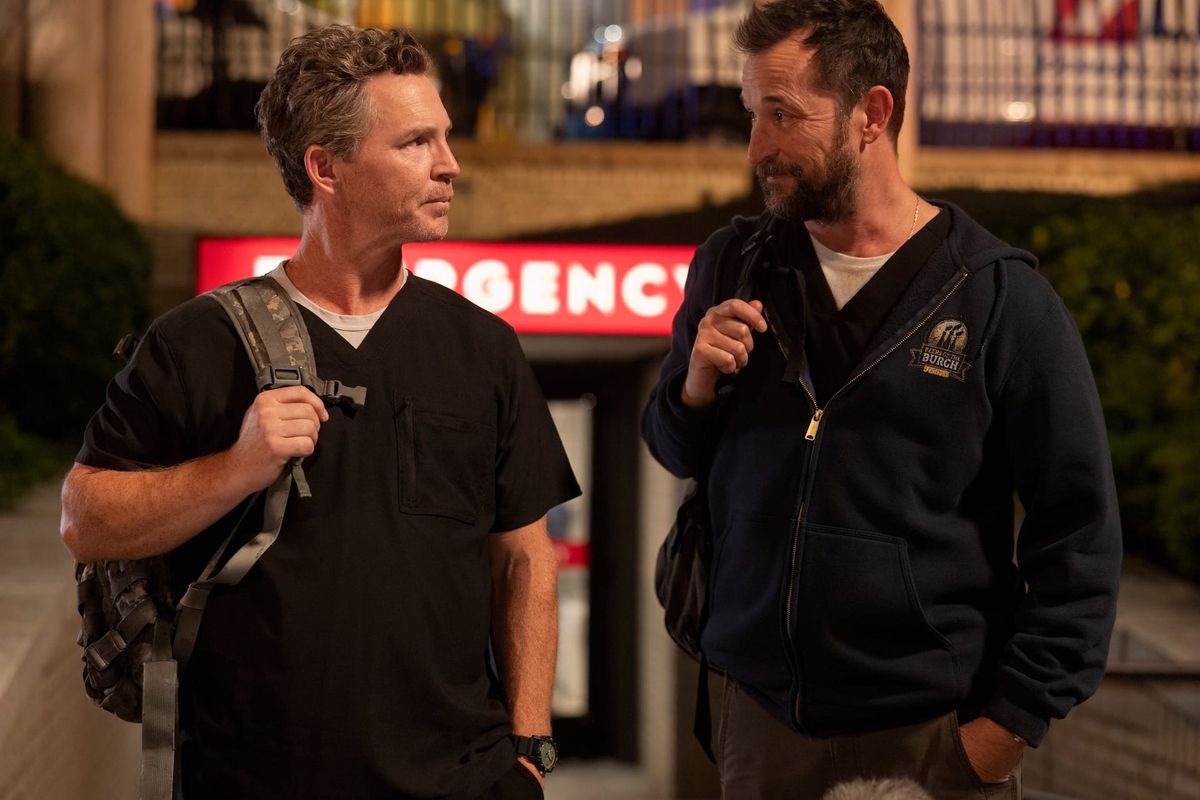
Production still from The Pitt featuring Drs Abbott and Robby standing in front of the red emergency entrance (in the evening), looking meaningfully at each other.
They share one brain cell. They’re one bad night away from exploring each other’s bodies. They’re divorced. They’re my fathers.
audio-thumbnail
The Pitt Fandom Phenomenon
0:00
/1837.54415

It’s hard to describe the combination of delight and utter mortification one feels when confronted with their own erotica while casually browsing Instagram. And yet, that’s exactly what happened to me earlier this spring. I had written a fic for The Pitt that had become inexplicably popular (said fic was largely an excuse to write erotica as a way to safely disassociate for thirty to forty-five minutes a day) and while scrolling social media, I saw my story served up to me by my very own algorithm: someone had included my work on a roundup of their favorite Pitt fanfics. How did we get here? How did I get here? And for the love of god, how many people were casually interacting with my PWP Pitt fanfiction on social media?
The Pitt hasn’t just become a critical darling over the past year and a half since its first season aired; it’s quickly become a breakout fandom phenomenon as well. From the HBO Max (Australia) TikTok account reposting Hucklerobby fan edits to the hundred of new fics showing up on AO3 every day, the fandom has become a cultural juggernaut, inspiring many, many pundits to raise their pen in defense of and in opposition to[1] the fandom.

At first blush, it doesn’t seem like The Pitt, a semi-procedural, single-set ensemble production with a middle-aged lead, packed full of medical jargon, realistic clinical gore, and without many obviously romantic storylines[2], would be a hotbed for fandom fixation. And yet, as of publication, The Pitt has nearly 21,000 fanfics and is one of the most popular new fandoms to emerge from the slate of television that premiered in 2025. If we compare this number to other highly-lauded prestige shows that aired alongside The Pitt last year—Severance (2,200 fics), Slow Horses (1,000 fics), White Lotus (800 fics), and Industry (100 fics)[3]—the magnitude of fandom’s fixation becomes stark.

Even the cast has become aware of the immense amount of fans and fanwork out there. Noah Wyle—who plays Dr. Michael “Robby” Robinavitch, the aforementioned middle-aged lead—has liked and commented on fanart posted to Instagram, happily stepping over some of the unspoken velvet ropes separating fandom from the original work and occasionally playing jump rope with them. (He has even stated he sends some of this fanwork to other cast members. He is a menace and must be stopped.) Isa Briones (Dr. Trinity Santos) has responded to fan theories on her Instagram. Patrick Ball (Dr. Frank Langdon) was asked on morning television to respond to any fans who might want to see his character get together with Taylor Deardon’s Dr, Mel King. For better or worse, fans and creators exist in the same spaces, and are actively interacting.

Gerran Howell, who plays Dr. Dennis Whitaker, was asked at the 2026 Actors Awards what he thinks of fanwork. He responded kindly, saying that it was all very lovely, and, “There are things that have been put in front of me…but, you know, I try to keep away from the stuff that is obviously for the fans to appreciate. I’m sure some of [the artists] would be mortified if they knew the actors were seeing it… so, it’s for them. I’ll leave it to them. But I love it, it’s very flattering—mostly.”

Creators being exposed to fandom isn’t new, but the current scale of public interaction is unprecedented, and seems to have sharply increased within the last decade or so. While the division between fans and creators—“the fourth wall”—used to be a core tenet of fandom, younger and newer fans don’t always hold the same values. Many are driven by a desire to be known as fans, or to be known as being “in fandom”—to have their fannish content spread across social media and microblogging sites. This creates an interesting paradox where fans want to be known as fans and culture-makers, but also want fandom to remain “for the fans” rather than become part of the larger cultural conversations spurred on by large fandom interaction.[4]

Even now, many fanartists, fic writers, and vid editors remain anonymous for a multitude of reasons, and a good portion of fandom still wants a division between fandom and the source material’s creators. We are nearly two decades into gotcha-style “journalism” where interviewers ask actors about fanart—particularly explicit fanart—and then shove it in their faces, with a kind of underlying implication that fanwork, and thus fandom, is the punchline underlying the conversation[5]; if anything, this trend has only become more common, and no more interesting or clever for its popularity.[6]

Regardless, there are many other shows that aired a season in 2025 that one might have guessed would enjoy a larger fanwork output, either because of a pre-established fandom, their genre, creative leads, or popularity. Taking a look through AO3, we can see much smaller fanfic output from the Game of Thrones spinoff A Knight of the Seven Kingdoms (<6000 fics), Fallout (<3,000 fics), and Peacemaker (<3,000 fics). Even popular shows in similar drama formats like The Bear (<3,000 fics), procedural structures like Will Trent [7](<100 fics), or even perennial fandom favorite, Interview with the Vampire (<13,000 fics[8]) aren’t enjoying the kind of massive fandom influx that The Pitt is currently reveling in after its Season Two finale.

(2025/26’s Heated Rivalry, an explicitly sexual, gay romance drama rooted in fannish tropes—and with a pre-established book fandom—is clocking major numbers at roughly 28,000 fics tagged in the TV fandom. An outlier, but one worth mentioning.)

Like a lot of other fandoms today, social media helped create The Pitt’s juggernaut. Fanworks stem from both the show itself and the cast and crew on the traditional media circuit—a near-constant influx of new interviews, red carpet appearances, and articles coming out that fans can latch onto and dissect.

Most of the recent coverage of fandom in general (and The Pitt fandom specifically) cite posts on X and Reddit, but fandom is so much deeper than these two platforms. While X and Reddit both have easily-accessible ways to find fans posting takes (you can browse hashtags or just go to r/thepitt), I doubt that it would be as easy for non-fandom fluent journalists to navigate the algorithmic hubs for fandom, like TikTok or Instagram, or the nonalgorithmic sites with higher barriers to understanding navigation, like Tumblr and AO3. (To say nothing of the completely closed fandom spaces: Discords, WhatsApp group chats, and other small, insular, private communities.) These are the sites where actual fandom creativity happens: gifsets, fanfic, fanart, skits, and meta. Fandom is, at its core, a collaborative act, and popularity helps foster community. Articles like this GQ piece by Tara Ariano deriding fans who post their opinions on social media are absurd precisely because fandom does not solely exist on microblogging sites where outrage is prioritized for engagement.[9]

Fanart gets posted and shared across social media. People recommend fics—in a handful of cases, my fic!—on platforms like TikTok and Instagram reels.[10] Fandom is a generative machine; all of this feeds into both fans’ desire for more Pitt fanworks and fans’ desire to create those fanworks. As the second season progressed over the past four months, there was a snowball effect as more people wrote for The Pitt, and more people read that fic. Fic readers genuinely love to read, so when a fandom takes off like this, writers and readers within that fandom increase exponentially.[11]

The fandom popularity around The Pitt didn’t coalesce immediately, however; when the first season ended in April of 2025, there were fewer than 250 fics on AO3. A few weeks later, longtime culture writer Emily Gould published a much-derided and deeply embarrassing article in The Cut that linked to just under a dozen Pitt fanfics, in case seven months was “still much too long for megafans to wait.” [12] The tone was very judgmental, and made many fans feel like they were the butt of the joke.[13] At this point, the show had fewer than 700 fics, so the exposure differential between fic writers and the wider cultural audience of The Cut was massive. There was widespread backlash from both fandom journalists and fanfic authors.

But between the two seasons, fandom exploded. When Season Two started airing in early January 2026, The Pitt had just over 10,000 fics; now, the AO3 tag has more than twice that number. Many fans joined after the first season aired, and were able to marathon the entire season; in that latent time, they sought out community, including fic fandom.

The single-shift structure of the show leant itself exceptionally well to developing a collective fan-established canon—commonly known as fanon—extrapolated from the small clues dropped during the season, as well as in cast and crew interviews. The fanon was built together: Abbot is a widower[14], Robby suffers PTSD from when he worked in the south during the Hurricane Katrina emergency, Whitaker’s family is deeply religious (and deeply homophobic), Santos grew up a too-white girl in the Phillipines, Mohan has a dating history that reads like a horror novel, Dana has a husband, two kids, and invites Robby to Thanksgiving every year. Fanon developed because of what the fic writers wanted to see from the characters after-hours—not because, as some pundits have opined, the fandom has “treated the show like a puzzle box,” tackling such mysteries as trying to figure out who the Pittfest shooter actually was, convinced he’s in the background somewhere. (He’s not, and there’s very little, if any, fanfic out there investigating the shooter’s identity.)

With such a massive fanon built between seasons, one might assume that the second season would clash with those expectations, but that fallout didn’t happen. Most of the fanon wasn’t ever contradicted by the canon, largely because the show’s creators and fans are focused on fundamentally different things: who a character is inside of the Pitt—that is, the hospital itself—and who a character is outside of it.


The Pitt’s incredible movement within the fandom space emerges from a kinetic mix of fantastic writing, stellar performances, and, most crucially, room for interpretation—we don’t get to see all the intimate details of the characters’ lives. Each season of The Pitt takes place in “real time” over the course of a fifteen-hour shift at the hospital, with every episode focusing on one hour of said shift. The drama of following a single working day is intense and unrelenting. The audience only sees these people on a handful of the worst days of their professional lives, and only in this single setting, doing their jobs.

For decades, fanfiction fandom has debated whether there’s an inverse relationship between the quality of a show and the amount of fic that it inspires—where fandom pursues fic as a way to “fix” bad canon. But well-made, smart television can also be deeply inspiring. The fact that all the characters have their own motivations, desires, tensions, and failures (and that the show doesn’t hide them or make them too esoteric to identify with or relate to) also contributes to fandom’s interest in picking up the doctors, nurses, and regular patients to play with.

The setting itself helps deliver these clear character portraits. There is an intimacy to an ER. It experiences extreme highs and lows, all driven by characters’ literal life-changing decisions and the feelings that they can inspire. This emotional range allows the large ensemble cast to shine, letting fic writers obsess over individuals as they change and grow, even in just the single day that we spend with them. The social commentary that The Pitt delivers (on AI, on bodily autonomy, on ICE) feels so in step with the real world that it creates an even more nuanced and relatable understanding of the characters.[15]

The ER as a setting shows characters at their worst (Langdon berating Santos; Javadi failing to quickly diagnose a patient because of a tech lag), at their best (Whitaker talking Robby through his panic attack; Joy recalling the entire board from memory), and at their most badass (Abbot donating blood while practicing medicine during an MCI; Al-Hashimi performing a novel surgical technique to insert an airtube). It also exposes us to characters at their most vulnerable: Dana talking a young woman through a rape kit examination, or Mel realizing that she has made her sister her whole life while Becca has been living her own. These moments come alongside the nurses gossiping, the security guards’ betting pool, and the occasional specialist swanning through the ER, creating a humanistic, rounded portrait of a highly pressurized workplace.

The structure of the show is similar to a traditional procedural, except instead of medical cases having to be solved by the end of the episode, a patient’s storyline could take anywhere from one to three to five episodes to finish.[16] Fanfic works along similar lines: drama walks in the door and has to be solved by the end of the fic, but the characters themselves are fully formed, extant entities that fanfic writers then put into specifically engineered situations. The procedural engine of fanfic is also built out along similar lines of The Pitt: extrapolations on tropes, oneshots, and fix-its—the story beats that we recognize and love. And with so much to build on—and build out—The Pitt has positioned all its characters perfectly for fic writers to iterate on in their own works.


Besides the specific parts of The Pitt that make it a rich text for fanfic writers, the show also does a lot of things that the source material for many huge fandoms does: it provides modularity. For the crossover fans, the revolving doors of The Pitt are easy to shove a character through. An ER in a large metropolitan city? Literally any character from any show, in any genre, could be waiting in chairs. More than that, you can set up an ER anywhere and the basic engine of the drama would still work. I’ve seen lots of popular crossovers in the halls of PTMC: Heated Rivalry athletes (real athletes, too), Anne Rice’s vampires, even the My Chemical Romance lineup. Compared to other mid-sized television fandoms (between 10-50K fics) we can see a lot of other workplace-focused shows doing this same kind of character importing, such as in the fandoms for Our Flag Means Death, Ted Lasso, and Star Trek: Enterprise.

And the characters? This is a teaching hospital, which means the student doctors and residents naturally move on. Physicians can narratively go anywhere and have purpose, which not only makes it easy to have them cross over, but also allows them to end up anywhere, just for fun. We can compare this to Supernatural or The X-Files, where the characters naturally travel across the breadth of the United States, and could arguably be anywhere, at any time.

The Pitt has a mix of familiar and unfamiliar faces, and leading men like Noah Wyle (Robby) and supporting actors like Shawn Hatosy (Abbot) have fans bringing ER and Animal Kingdom characters into the hospital, respectively. Hilariously, Gerran Howell (Whitaker) has inspired dozens of Young Dracula crossovers, and I’ve seen more Vampire Whitaker fics than I can count. Actor-driven crossovers are, to be clear, a time-honored fandom tradition, and the nature of The Pitt’s setting only encourages this sort of fun wink at the fandom audience.[17]

The adaptability and flexibility of the characters mean the building blocks of the show are not inherently tied to any other part: you could put Dana at the head of a NASA control and she’d be believable leading the Artemis 2 moon mission. The Pitt could be the lowest level of King’s Keep, each character a medic treating battle-weary knights suffering dragon burns. Who’s to say that ER’s Dr. John Carter and Dr. Robby aren’t cousins? Believability might not be paramount to all fanfic,[18] but modularity—the ease with which one can pull any part of the show out and find it fascinating in any context—helps a lot.


Even with The Pitt’s major characters, we only get hints of backstory: little lore drops, family histories teased out in between trachs and resetting bones, just enough to whet the appetite that keeps fandom coming back to fill in the blanks. This is, of course, what fandom has always done. But The Pitt, by nature of its format, is intentionally withholding, and that’s allowed fans to weave a fanon wholecloth.

What happens when Robby goes home at night? What does Abbot do when he’s not volunteering with the local SWAT team or doing naked yoga? Where will Mohan be next year—and is she really flirting with an attending? Does Javadi have meals with her parents? What kind of roommates are Santos and Whitaker? Will Dana ever know peace? The Pitt is not interested in answering these questions; it gives hints that shade a character’s motivation and personhood, but it leaves all of the actual hues on the palette—and fandom loves finding those moments and giving them color.

Fanfic especially thrives in these spaces that canon doesn’t fill in. Beyond The Pitt giving us these brief outlines of characters, it delivers fanfic writers a “fruitful void” to play in. (This is a term coined by Ron Edwards, an influential tabletop roleplaying game designer.) To bastardize tabletop design theory, The Pitt poses unfulfilled questions, tensions, and character interactions, and fanfiction responds. The biggest question the fandom seeks to answer is unreservedly: “Who are these people outside of their work?” There’s no canon answer—thus, a void. A lot of it. Especially when writers don’t necessarily have to worry about being contradicted by canon, because the canon is aggressively contracted, focused on fifteen hours in a single day’s work.

Getting every hour of a person’s day can feel more intimate than a show that attempts to follow every interesting second of a character’s life over a week or six months. Each character reveal is precious: it’s hard to overstate the number of farm boy fanfics Whitaker’s single line about being from Broken Bow, Nebraska has inspired. Then there were all the other details we got about him: “he guessed” his parents were proud of him being a doctor, he was sleeping rough on the eighth floor of the hospital, he assumed “Krav Maga” was one of Santos’ friends. Writers collected these details and rearranged them into a hundred different patterns across thousands of fics. Fandom gets to explore who these characters are as friends, as practitioners, and, most importantly to fic writers, as multi-faceted characters that get to live a whole life outside of the Pitt.

The structure of the show encourages close reading, which then fuels fandom communities. Fans fully dissected the dramatic irony of the exchange in 209 when Robby tells Whitaker “he needs to set better boundaries” and then immediately asks him to house sit. Fans clocked Frank Langdon’s look of pain in 211, recalling the back injury that spiralled into opiate addiction.[19] Much was made of Baran Al-Hashimi’s reveal in 207 that she had been at the maternity hospital in Dasht-e-Barchi in 2020, with fans suspecting that her moments of disassociation in the earlier episodes while working with the abandoned baby were actually PTSD and not, as revealed in 214, that she was instead suffering a neurological issue that stemmed from a childhood viral meningitis infection.

Fanon is when someone asked, “What moral injury is Abbot trying to heal?”[20]—and I haven’t been able to get that thought out of my head. What makes him volunteer as a SWAT medic on his days off, what does he talk about in therapy, what hurts him so deeply that he sleeps with a police scanner and has top-of-the-line emergency medical supplies in his go-bags at home? This is the intimacy that connects fans: pouring over these insights and wondering what makes this man click, and all of us coming away with a deeper understanding of the text, even if we do not all come to the same conclusion.

It might seem a little counterfactual at first, but fandom is, at its core, a proof-based system. Fanon, headcanons, inserts: all of it is based on something. Whether or not fans agree doesn’t matter, and, frankly, whether or not it is objectively true doesn’t matter.[21] Someone saw something and it inspired them. Extrapolations of media critique can be one person looking at Dr. Robby and saying, “That’s a trans man,” or it can be a whole group of people watching Dr. Abbot and Dr. Mohan interact for less than five minutes and saying to themselves, “They’re yearners, your honor.”

This is at the heart of transformative fandom, and is a huge part of what makes The Pitt so good at rewarding fans who care enough to create the fandom. It gives opportunities for people to imagine a text greater than 15 episodes a year. It’s a heady mix that has pushed fandom to clock into their own fanfic shift after every episode and get to work. A thousand fics a week don’t write themselves.


Post-Season Two, The Pitt fandom is actively watching the boundaries between themselves and creators crumble, primarily because fandom at large has become accessible. Fic isn’t relegated to hidden corners of the internet; it’s become cool to TikTok about your fic, to write rec lists on Instagram, to post your art on X and Bluesky and wherever else someone might see it. But that exposure is a double-edged sword: you get the attention of other fans, yes, but you also get the attention of journalists, actors, and crew members.

The Pitt’s popularity isn’t to blame for this fandom containment breach. Fandom has always been culture, but now that fans are performing culture in public, at scale, journalists are attempting to take it seriously. This is partially because it’s uncommon to have such a highly regarded, critically acclaimed show with this kind of fan engagement. But look at the furor kicked up about Heated Rivalry and the endless “why slash” articles; many people writing about fandom right now might not have the lingo, the history, or know which fork to start with, but that’s on them. Journalists covering fans will either be from fandom or they will learn in public. With fans eager to find community, these occasional interlopers will peek their head in and assume that hand in hand with accessibility is consent.

Contemporary, social media-based fandom—the same fandom that decided my erotica was good enough to be included on a fic roundup on Instagram of all places—isn’t going away. And it shouldn’t. If fans are going to leverage the algorithms for content, clout, or just to share their favorites with others, they need to get comfortable with some uninvited guests seeing the fics, art, and edits that they want to celebrate. At the end of the day, fandom is a gift culture, and sometimes those gifts land on unexpected doorsteps. But you don’t build the kind of fandom The Pitt has now without yelling, loudly, about the things you love. That’s the best part of fandom.


  1. Frankly, I find this take by Chris Evangelista to be completely absent of any cogent understanding of contemporary fandom—imagining individual users on Twitter posting takes as an indictment of a larger fandom movement only proves that Mr. Evangelista has never spent time in the trenches. He might be a good reviewer, but this article is removed from almost all fandom contexts. ↩︎

  2. To be clear: a lot of fandoms don’t care over-much about the canon romantic storylines. But in The Pitt, romantic storylines are notable more for the near-complete absence. ↩︎

  3. Worth mentioning is that the main character of Industry is a Black woman, and fandom is notorious for its disinterest and sometimes overt rejection of characters of color and especially women of color. This number might be less of an indictment of the popularity of the show and more a recognition of the racism that traditionally goes hand in hand with fandom. ↩︎

  4. You only have to look on social media to see this desire expressed over and over, typically in the aftermath of a particularly terrible incident of the fourth wall breaking. I specifically recall a TikTok which called fandom “a closed practice.” While it speaks to the desire for some fans to be “counter-cultural” in a sense, there have rarely been words uttered in so much error. ↩︎

  5. I also think this is compounded because both The Pitt and Heated Rivalry are having this happen during roughly the same timeframe, but while the cast and crew of HR appear to expect it, and thus there seem to be fewer instances of it happening. I can’t help but sense an underlying cruelty when journalists show off erotica and explicit fanart of “prestige” television as compared to much more canonically explicit soap opera-style romance of HR, as if the actors on The Pitt should be above seeing themselves rendered sexily by fans who are enjoying the show, or as if there is something naughty about seeing The Pitt fanart versus softcore porn of the softcore porn show. ↩︎

  6. Anne Rice, the author of The Vampire Chronicles, is infamous for sending cease-and-desist letters to fans who produced fanwork, and is often cited as one of the factors that drove fandom culture “underground” in the early aughts. With her death five years ago, I fear we lost an apex predator in the space. Maybe we needed a shark in the water to prevent journalists from getting over-excited to share erotica with actors who certainly already know it’s out there. ↩︎

  7. After looking this show up at the recommendation of an editor, I found out that the third season of Will Trent, which airs on ABC, aka terrestrial TV, in addition to streaming on Hulu, enjoyed an average audience of 10 million viewers per episode. This is double the live audience that Nielsen said tuned into The Pitt’s Season 2 premiere. And yet it has 93 fics on AO3. When it comes to fandom, audience is not king. ↩︎

  8. The Vampire Chronicles as a whole have more work, this is strictly fics with the TV tag. ↩︎

  9. Once again, as I said with regards to Mr. Evangelista’s work, I will not take your fandom reporting seriously if your only proof of fandom is linking to tweets on Elon Musk’s fascism app. You simply cannot open X.com and imagine that you now have an accurate, or even interesting, snapshot of any fandom. Once again, get in the fucking trenches. ↩︎

  10. Instagram and TikTok are particularly baffling places to recommend fic, considering you can’t actually link out to those fics! Why are fans doing this! Get back to Tumblr where hyperlinks and HTML work. ↩︎

  11. One only has to look at the many, many devastated reactions online when AO3 experienced multiple outages in early March 2026 to see just how passionate readers are about fanfic. ↩︎

  12. For Ms. Gould, to be clear: she should be deeply, profoundly embarrassed by this. Her editor should be embarrassed by this. It shows a staggering lack of understanding about fandom, shipping, and fanfiction. To describe this article as cruel, mean, and contemptuous would be far kinder than it deserves. ↩︎

  13. Ms. Gould is engaging in long and storied journalistic tradition with regards to fandom: pearl clutching over erotic fanfic. ↩︎

  14. This piece of fanon was canonized in Episode 215! Fans were delighted to see that they were able to pick up on the hints that the show was dropping—and while I wouldn’t call “Abbot is a widower” a theory, I am always immensely satisfied to see fans accurately clock a character based on thirty minutes of screentime. ↩︎

  15. In my opinion, the occasional medical lecture around abortion, gender care discrepancy, or even the cost of a hospital visit are the only weak parts of The Pitt. It sometimes feels like they are looking straight to the camera and saying, “Did you know healthcare is fucked up?” Still, the rest of the show is so good and makes so few mistakes, I can forgive a bit of narrative soapboxery, especially, as Santos says in Season Two, since the CDC is “now a medical toxic waste site.” ↩︎

  16. While a lot of fans were positing theories online as the show aired (a time-honored and near-universal fan experience), fanfic writers didn’t seem nearly as interested in “solving” the problems presented in the show. ↩︎

  17. As I once stated on Bluesky, I know that I am the beloved of a higher power because every day there is at least one more Pope Cody/Dennis Whitaker fic posted. May everyone be so blessed with their own ridiculous crossover ships. ↩︎

  18. While many fic writers are deeply concerned with whether their renditions of characters are “in character” or not, there are plenty of writers who aren’t—they just want to play in the sandbox. ↩︎

  19. I was one of those fans who then postulated that because of this reveal and the fact that Langdon was excited and perky (especially with the re-enactors) that he had relapsed! This didn’t pan out, but it was fun to talk about in Discord with my friends. Which is a totally normal thing normal fans do all the time. ↩︎

  20. I’m so sorry; I don’t recall who said this, but it’s lived rent free in my head all season. ↩︎

  21. Some fans, for example, don’t believe that Frank Langdon is “really” an addict. ↩︎