Three Bags Full’s Faithful Flock

How a German novel about Irish sheep (detectives) inspired a legion of devotees around the world.

Share
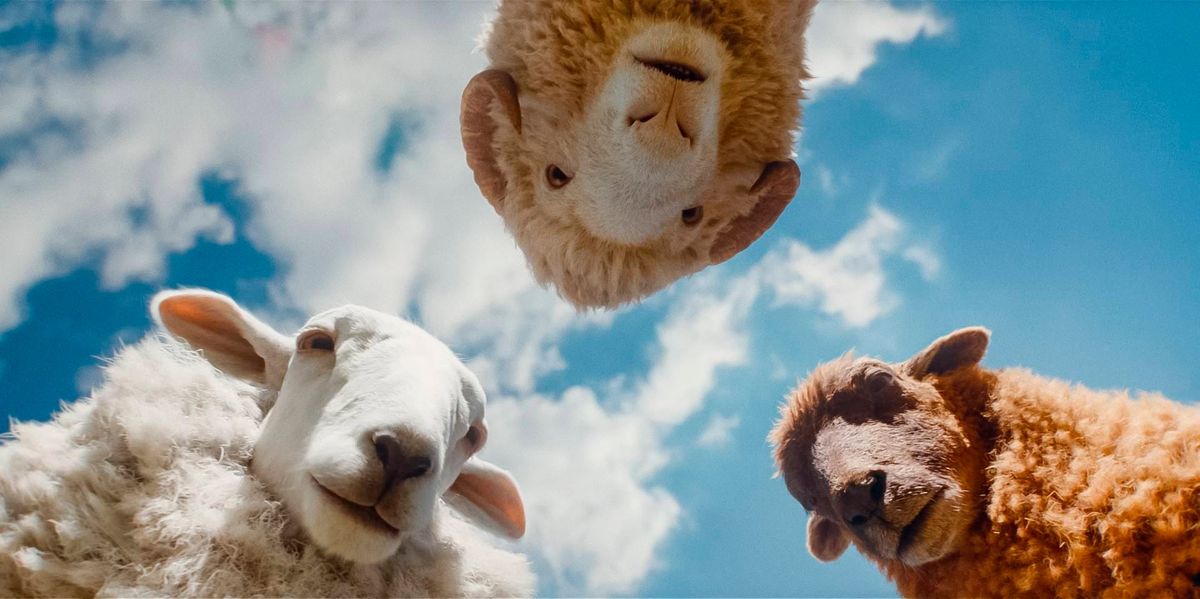
Image of three sheep, depicted as if you are lying on the ground and they are peering down at you, backdropped by a blue sky and clouds.
The Sheep Detectives will introduce many cinema-goers to the Glenkill flock this weekend, but the novel on which it’s based, Three Bags Full, has inspired cult-like admiration for decades. Image courtesy Sony Pictures UK.
audio-thumbnail
Three Bags Full’s Faithful Flock
0:00
/1563.166848

The new movie The Sheep Detectives—a movie about sheep, who are detectives—has elicited the bewildered responses you’d expect to a premise that seems, well, fake. “i’m choosing to believe this is a 30 rock bit,” reporter Marisa Kabas posted on Bluesky. Other users expressed dubious enthusiasm or straight-up incredulity: “The Sheep Detectives looks dumb and I really want to watch it.” “It’s just unhinged enough that it’ll probably be iconic.” “When I saw the commercial for The Sheep Detectives last night I wasn't sure it was real or if I was drunk, but it seems like it’s real?

Reading these posts, I shook my head knowingly: I, too, had once been a member of the uninitiated. I first encountered Three Bags Full[1], the book upon which The Sheep Detectives is based, on Bluesky in 2023, when I saw New York Times columnist and academic Tressie McMillan Cottam post gushingly about it. I deeply respect Cottam’s opinion, but I couldn’t wrap my mind around the idea of a mystery novel narrated by sheep.


  1. Fansplaining is part of the Bookshop.org affiliate program and receives a portion of the sale if you buy through this link. ↩︎

Soon, though, Cottam was only one of many Bluesky posters reading and discussing the book as part of an informal Bluesky book club. This phenomenon began thanks to a suggestion made by Cait, a public defender and mystery aficionado, who suggested the book to Cottam and poet and cultural critic Saeed Jones. “There is a strange, lovely little book called Three Bags Full about a flock of sheep who try to solve their shepherd’s murder,” she wrote. “The way I just sat up!!!” Jones replied.

I didn’t join in on the fun, but for the next couple years, I felt like I encountered Three Bags Full everywhere. I saw references to it on Bluesky, where it kept being mentioned even after the book club was over. Announcements about the movie adaptation were in the news, too. The book even infiltrated my podcast feed: Christopher Hermelin, host of the podcast So Many Damn Books, gushed about it repeatedly and ultimately interviewed author Leonie Swann when the English translation of the sequel, Big Bad Wool, was released last year. (While Swann lives in England, she writes in her native German.)

Okay, fine, I thought. I had heard glowing reports about the book from enough people with great taste that I decided I had to give it a chance. But I’ll admit that I remained skeptical. I am an avid reader of mystery novels, but I am also a snob, and the idea of a sheep-driven mystery novel remained bizarre to me. Wasn’t there a series of mysteries narrated by a cat? I had vague memories of encountering these books with my grandmother at a church rummage sale and dismissing them around age 13. But I decided to expand my horizons and read the sheep book.

Naturally, like seemingly everyone else who read it, I became obsessed with Three Bags Full. Swann’s novel, I discovered, was not only a seriously clever exercise in mystery tropes and storytelling, but also a surprisingly thoughtful representation of how animals think. Most impressively, Swann uses the circumstance of sheep being confronted with untimely death to explore deep existential ideas. Having to contemplate the death of their beloved shepherd, George, forces the sheep to bend and expand their minds, which is a difficult and complicated task. Their confusion about death and violence, in turn, forces the human reader to think about these things with fresh eyes. And even though Swann takes her premise and the trauma of a violent death seriously, the book is very funny. The sheep are utterly terrified, for example, by the prospect of a wolf in sheep’s clothing, “the most frightening story they had ever heard George tell.”

In short, I was hooked. I texted everyone I knew about Three Bags Full as I read. “Btw,” I told one friend, trying to sound casual, “this sheep mystery is incredible.” “You have got to read this,” I texted another, hoping I didn’t sound increasingly desperate. Another patient friend told me that while she hadn’t read it, her German husband had read it as a teenager when it had originally been published in Germany in 2005.

With the release of The Sheep Detectives—which stars a host of well-known actors including Hugh Jackman as shepherd George, with the likes of Julia Louis-Dreyfus and Sir Patrick Stewart providing voices for the sheep characters—Three Bags Full is receiving renewed attention, though much of that attention has come in the form of bewilderment. I can understand these responses: it just doesn’t seem like a story that should work. I haven’t seen the film myself, so I don’t know how well it translates to the screen, though reviews have generally been positive. But I can attest that the book feels like a bit of magic captured in a bottle.

Reading Three Bags Full had fully persuaded me of its genius, but its popularity remained a mystery. How had a decades-old book about sheep solving a murder become such a phenomenon? To solve this mystery, I set out to do some detective work of my own. I retraced my steps, picking up the trail of Three Bags Full devotees first back to the Bluesky book club, where I got insights from Cait and “the Mayor of Bluesky,” Joshua J. Friedman. Then I sought out historical context and expertise from crime fiction aficionado Sarah Weinman and books podcaster Christopher Hermelin. I swung by my friend’s German husband, Simon, to get a sense of what reading the book had been like when it was first published all those years ago. And finally, I got to the heart of the matter: I spoke to Leonie Swann herself. 


Cait first came across Three Bags Full in 2008, two years after it came out in the United States, in a Barnes and Noble in Albuquerque. She and her husband were looking for audiobooks to listen to on a cross-country trip to New York, but, as she tells me, “I saw the book on a display table and picked it up because I was intrigued by the subtitle: ‘A Sheep Detective Story.’ I read it out loud to my then-boyfriend (now husband) on the drive. We loved it; we kept laughing at the sheep. So that was my introduction to Three Bags Full, on a long drive on I-40.” 

Over the next decade and a half, Cait recommended the book to many people—including to Tressie McMillan Cottam on Bluesky in October 2023. Though loath to suggest books to strangers, she decided to do so in this instance, she explained, because Cottam and Jones were already talking about sheep. It was kismet.

Immediately after making this suggestion, Cait came down with COVID, and was isolating from her family. With little else to do, “I kept checking Bluesky and watching the book club develop. My husband was leaving tea outside my door and texting me, like, ‘Hey, you really started a thing.’” She listened to the audiobook in bed and “was posting photos of the different sheep breeds in the book” for everyone else’s enjoyment. And so a mini-phenomenon was born.

Bluesky was in its infancy at the time, having launched earlier in 2023. But being a small site also drove community engagement: as Joshua J. Friedman put it, “When [Bluesky] was still small, everyone felt like they were creating this new, better place together.” (Friedman is now a Head of Media and Government Partnerships at Bluesky.) Friedman made a custom feed for book club engagement, and Cottam posted discussion questions, though the account she used at that time has since been deleted. Cait describes it as a “magical experience.” “People wanted to come together and read this silly, moving little book about sheep and talk about it,” she says now, reminiscing. “There was a sense of community about it—a little fad that swept through a corner of Bluesky, the way it would through a small town.”

Engagement with the book club was significant enough that “people had trouble finding [the book],” Friedman remembers. “There were all these threads about people trying to get a copy from their library, finding all the random websites they could possibly order it from so they could participate in the book club.”

Thread featuring a series of posts on Bluesky. Click through to the thread itself (linked in the caption) to get full text.
A thread of eager sheep detective lovers on Bluesky.

Some time after this, mystery expert and true crime writer Sarah Weinman ran into the book’s author, Leonie Swann, at a book festival in Toronto. “I went up to her and introduced myself and said, ‘I don’t know if you know, but there’s this social network called Bluesky and everyone’s talking about Three Bags Full.’ She was pretty nonplussed, but appreciative.” 

Weinman’s own history with the book goes back much further: to 2006, when it was first published in the U.S. Though the book wasn’t widely popular at the time, Weinman read and loved it right away: “Leonie’s writing is charming and effervescent and sparkles, but there’s a real weight of emotion to it,” she reflects. She wrote about it on her blog at the time; more recently, in her role as the New York Times’ mystery columnist, she’s reviewed other books by Swann, including Big Bad Wool and The Sunset Years of Agnes Sharp.

I was curious if Weinman, given her expertise, could shed light on how Three Bags Full fit into the wider landscape of crime fiction, especially novels narrated by animals. What about those cat books I remembered? 

She had, in fact, written a whole piece about the history of cat mysteries; specifically, the series that kicked off the genre: “The Cat Who…” books, by Lilian Jackson Braun, consists of nearly three dozen installments. “The Cat Who…” books, Weinman explained, didn’t only give birth to the animal mystery novel, but “the contemporary cozy mystery would not exist if not for Lilian Jackson Braun.” 

Originally a journalist working for the Detroit Free Press, Braun wrote the first three installments of her series in the 1960s, but they flopped. It wasn’t until the 1980s, when she submitted a fourth volume to editor Natalee Rosenstein at the imprint Berkley, that her fortunes changed: Rosenstein picked the series up and they became a phenomenon. Braun had included some dark elements in her first “The Cat Who…” novels, but as the series gained steam she shifted to writing much cozier books, effectively inventing the genre as we know it.

By the time Three Bags Full was published in the mid-2000s, Weinman explains, cozy mysteries were an established genre with familiar conventions that readers had come to expect. Swann’s novel embraces some of those elements—it’s funny, it’s not graphically violent, and it takes place in a beautiful seaside town in the west of Ireland—but it subverts others. The darkness that makes the book stand out was probably not welcome to many readers at the time. 

Podcaster Christopher Hermelin, a devotee of the novel and an aficionado of novels narrated by animals, agrees. Though Three Bags Full has obviously grown significantly in popularity since then, thanks to the Bluesky phenomenon and word of mouth generally, Hermelin still considers it a cult book: “It is still an ‘if you know you know’ title—mystery writers miss it because it's not a standard mystery, lit folks miss it because it gets shelved in mystery, and even animal narrator fans miss it, because it isn't always on those lists either.” For Weinman, “It was either ahead of its time or just out of its time, because Swann clearly had bigger thematic fish to fry. It wasn’t just, Oh, these cute little sheep are solving a mystery.” 


The sheep in Three Bags Full know something is wrong about their shepherd George’s death when they find him lying dead on the ground, impaled by a spade. In the novel’s opening lines, the flock’s oldest ram, Sir Ritchfield, announces, “He didn’t die of an illness. Spades are not an illness.” The sheep panic: a wolf, a wolf! It is then up to Miss Maple, “the cleverest sheep in all Glennkill, quite possibly the cleverest sheep in the whole world,” to explain that wolves do not wield spades, and then up to her to persuade her fellow sheep that they ought to find out who killed George. “[H]e was our shepherd. No one had a right to stick a spade in him. That’s wolfish behavior. That’s murder.”

Miss Maple (an obvious play on Agatha Christie’s Miss Marple), whom we may think of as the flock’s lead detective, sums up both the flock’s and the book’s ethos in this short speech. The sheep were loyal to George, and want to do right by him. George, we later discover, was remarkably loyal to his sheep, too, preferring them to human company. He read to them every night: a mystery novel (which provides a helpful guide for their investigation), romance novels about women named Pamela, and, horrifyingly, a book about “the diseases of sheep.” 

George regarded them both as a flock and as individuals: in one flashback scene, he sees that a sheep has decided to run away, and he respects the sheep’s decision, endowing him with autonomy as an individual, not just as a member of a collective flock. In the past, he welcomed Mopple the Whale, so named for his girth, who is from a meat breed and therefore not as productively woolly as his flock-mates. (More on meat breeds below.) Most astonishingly, when George’s will is finally revealed, the townspeople are agog to learn that he has left the bulk of his estate to…his sheep.

But Miss Maple and the other sheep also have an innate sense of what is right—one that does not exactly map onto human morals. (Wolves come up a lot in the sheep mind as imagined by Swann.) Her straightforward way of stating that nobody has a right to kill anyone else is bracing. At multiple points in the novel, including after this speech, the sheep all bray, “Justice!” It’s hard not to feel roused on their behalf. But, of course, the sheep do not actually understand human society, and this makes solving George’s murder an especially tall order.

Image of two sheep peering through the window.
Swann clearly had bigger thematic fish to fry,” says Sarah Weinman. It wasn’t just, Oh, these cute little sheep are solving a mystery.” Image courtesy Sony Pictures UK.

Three Bags Full’s biggest strength is how seriously Swann takes the fact that she’s writing from the perspective of animals. It’s hard to over-emphasize how successfully she achieves this, and how unusual that achievement feels. Though we mostly associate animal narrators with children’s books, there are plenty of adult novels narrated by animals, too—but in my experience, most of them simply substitute animals for humans. 

To Hermelin, a true aficionado of this genre, this approach has gotten stale. “I am less interested, these days, in trying to graft on Oh, they're using porcupines to be accountants, these rats are racing, aha, a ‘rat race,’ as I read,” he tells me. “Basically, just using animals to parallel humans. I’m more interested in a writer trying to grapple with animal consciousness. And at that, Three Bags Full is uniquely perfect. These aren’t just basically humans, these are sheep, with sheep concerns and a sheep’s ordering of the world. She uses every part of being a sheep to put them in believable hijinks.”

There are many moments, like the sheep not understanding how religion works (they think the local priest is named “God”) or what marijuana (“grass”) is, that make for silly jokes for the reader. But Swann also thinks more deeply about what sheep do and don’t understand, and how that knowledge might affect them. One of the most chilling sequences in the book comes when the sheep encounter a new flock, owned by their temporary guardian in the wake of George’s death. This new flock has been brought to their meadow, but when our protagonists approach to say hello and find out what’s going on, the new sheep… don’t talk. This is profoundly disturbing to George’s sheep, and chilling to the reader, too. What would it mean to encounter a version of yourself that was stripped of your humanity—or rather, sheepiness? The presence of sheep who not only do not think, but seem incapable of doing so, is therefore seriously alarming.

One ram from the new flock does manage to tell Zora, the most existentially inclined sheep in the novel, that they are being bred to be eaten: they are a meat breed, “fodder.” Zora tries not to believe him, but like a child learning about death for the first time, she can’t help but recognize this horrific truth. The rest of the flock insists that the ram is “crazy,” based on their experience with George, who would never even consider such a thing. 

Finally Mopple, who is a member of a meat breed himself, freaks out. Meat breeds can’t be for eating because he’s still alive and kicking, he insists. But although Mopple is renowned for his memory among the flock, he can’t remember anything about his earlier life: “‘Being a meat breed means something quite different,’ he bleated. ‘Being a meat breed means…’ Head on one side, Mopple sifted through his memories. But nothing came to him. ‘Something quite different,’ he obstinately repeated.” Mopple’s failure of memory is a signal to the rest of the flock that Zora is right: they recognize that he has blocked out a horrible trauma. Then, they panic.

Here, Swann melds human and animal sensibilities. Real sheep do not identify trauma in their flock-mates: while scientists have been impressed by the intelligence and memory of sheep (in one study, sheep were found to identify familiar human faces), awareness of trauma is a distinctly human phenomenon. Their inability to understand that they could be treated as “fodder” is both animal and human—what creature could possibly accept this?—but their naivety about the world, their circumstance as potential meat animals, and the flock-wide panic that ensues are all specific to their position as sheep. Swann lets us in on the terror that powerless, domesticated animals must feel in many circumstances, but she gives her sheep the agency to do something about it by setting them on the path to solve a crime, and get justice for George and themselves.


I spoke to Leonie Swann over Zoom, which felt like a culmination of this absurd detective work that I’d created for myself. She looked effortlessly chic: one dark gray curl falling over her forehead, her glasses tinted. Her affect was decidedly more down to earth. Even twenty years later, she seemed both delighted and bewildered by the extraordinary success her book had found in Germany. 

Because if Three Bags Full remains a cult favorite in the U.S., it was a decidedly mainstream hit in Swann’s native country. When it was released there in 2005, it shot up the bestseller lists, and remained there for years. It sold approximately 300,000 copies in its initial hardcover release, and has sold 1.32 million copies in the years since in paperback. (For context, a book needs to sell roughly 5,000-10,000 copies in a week to land on the New York Times bestseller list.) These figures launched the book internationally: in addition to the United States, it’s been published in 24 countries across the globe, from Russia to Brazil to Estonia.

“It really took off within a month or two,” Swann remembered of Three Bags Full’s release in Germany. “It was absolutely mind-blowing. I can tell you what is really thrilling: seeing people in a tube or bus reading your book.” She was less delighted when I told her that my friend’s German husband had read the book as a teenager. “That’s always very depressing, when everyone’s like, Oh, yes, that’s my childhood!” she said, groaning. “I’m so old.”

Sarah Weinman had speculated that part of Three Bags Full’s difficulty when it made it to the States was Swann’s sensibility as a German writer. But Simon, the aforementioned German husband, remembered being curious about Glennkill, as it was titled in German—named after the novel’s fictional Irish village—as an extension of other cozy mysteries he’d read that his mom had around the house. He mentioned yet another cozy series featuring a cat investigator, causing me to practically jump out of my seat: animal narrators were everywhere! Rita Mae Browne’s “Miss Murphy” series was published in English beginning in 1990, and in German in 1996. 

Swann says she wasn’t that influenced by other mystery writers, anyway, though she probably picked up some of these ideas via osmosis: Three Bags Full does play with mystery tropes even if it also has fun undermining some of them. Like practically everyone I spoke to for this piece, Swann described reading and loving Agatha Christie books as a young person, but she also said that she’s “not a dedicated fan of crime fiction … It’s rarely the genre that attracts me.” 

Simon also pointed out that where most mystery novels featuring animal narrators feature the animals and humans working in close concert, in Three Bags Full, “The investigation of the animals is more separated from the humans, in that they do their thing and the humans do their own thing.” The book is about their experiences rather than a cutesy collaboration they embark on with their human counterparts. This lines up with how Swann describes Three Bags Full. She wrote the book as a mystery, she explains, because it made writing from the point of view of sheep more approachable: “Having a mystery to solve is satisfying and speaks to almost everyone. Murder is approachable to sheep as well. Most books are written on subjects that would be a non-issue to sheep. You know: Tax fraud, so what? Let’s keep grazing.”

The core of her project was, therefore, the sheep rather than the murder, though the book couldn’t exist without both. “Taking them seriously as sheep was really important,” she told me, as was not imposing human morals onto their perspective. “It was quite important to me that they don't have [our] moral background to work with. They have values, but they're not moral values; they're more like practical values. I find that refreshing, because it takes away a lot of things we take for granted, and it helps me to look at things the way they are or the way they would appear to somebody who doesn't come with all that moral baggage.” Though, of course, she does recognize that a truly realistic novel about the consciousnesses of sheep would be “grass and nothing else.” Fiction writers are allowed some creative embellishment.

Ultimately, the difference in moral valence also means the sheep can’t understand the depths of human darkness and despair that Swann describes in the book, though of course they have fears of their own that Swann describes very powerfully. In the end, there’s also a limit to what the sheep can grasp of the mystery itself, because it revolves around human emotions that are too dark and upsetting for sheep to understand. When the human and sheep plots finally fully do collide, the sheep realize that some aspects of humanity will always escape them. 

“In a way,” Swann says rather poignantly, “it’s kind of endearing. A part of me wishes that I couldn’t understand, either. There’s an innocence in that positive attitude toward life.” Escaping into the animal world—for the space of a book, anyway—can give us a glimpse of that feeling, before the human world comes rushing back in.