Good Omens’ Final Love Letter to Fanfiction
The author is dead. Long live the authors.

I’ve been teaching Good Omens for years now: the 1990 fantasy novel co-written by the late Terry Pratchett and another writer, the 2019 series adaptation, the vast collection of sources both gleefully draw upon, and the fanfiction for it all. I wasn’t going to teach it again this time around—I like to change things up—but when the final season’s release coincided with my summer class in Fanfiction and Adaptation at the University of Utah, it seemed like a good plan.[1]
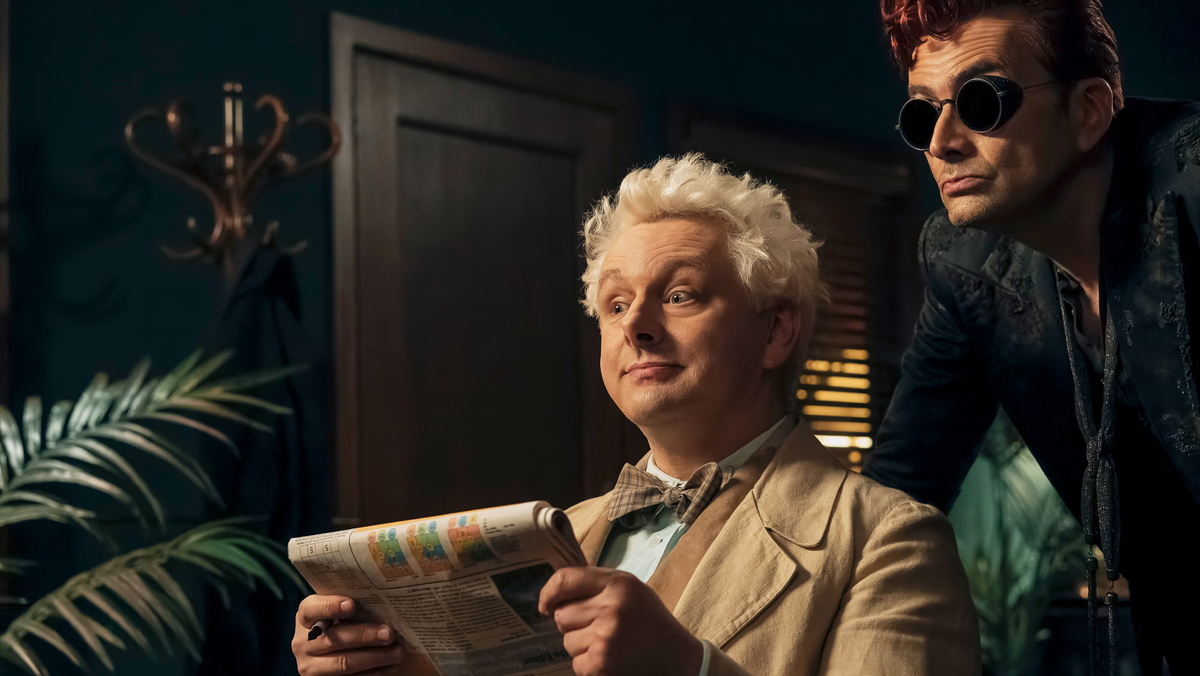
And so, May 13th found me awake at 1 A.M., watching the series finale through bleary and teary eyes. Despite widespread sorrow at the glittering yet gutting conclusion for our heroes, 6,000+–year-old angel and demon Aziraphale and Crowley, I thought it was the most heartfelt and validating love letter to fanfiction I’ve seen come out of a commercial enterprise. Unfortunately, this message got tangled up with the show’s other unique ambitions: to save itself from its author—not Pratchett, the other one—and restore the Good Omens legacy to its fans.
(Note: There will be spoilers for the finale throughout this piece.)
Former beloved icon and current pariah Neil Gaiman, of course, is the co-author in question. He was also the Good Omens series head writer, showrunner, and a huge part of its brand until serious allegations of sexual misconduct against him derailed his career and the adaptations of his work then in progress. Good Omens’ finale is at such pains to erase his involvement that it feels insensitive to even mention him in its vicinity. Gaiman denies anything nonconsensual, but the allegations and the pattern of behavior they reveal—even allowing for the most generous interpretation possible—have irrevocably damaged his creative legacy, including Good Omens. With production on indefinite pause, the characters and their fans were left on a cliffhanger with little hope of resolution. Only when Gaiman exited the series and the six episodes he’d written were overhauled and condensed by other writers could the show be resurrected at all.
Like its adorable and quietly tragic Jesus, when Good Omens finally did return, the finale made a point of openly bearing and baring its scars. Like Aziraphale, it was trying to do the right thing in a flawed system. And like Crowley, it had reason to fear this might not go well for all concerned.
It may be structurally impossible for an official source text—a canon—to succeed in what Good Omens’ third season set out to do: turning itself over to fans through an act of self-annihilation that doubles as an expression of love. There’s canonical support for that gesture in Good Omens’ oldest source text—the original Canon, no less—but what works in the Bible may not work for a television show based on a comic novel.
First, there’s the problem of genre expectations. Both its director and writer could not have been clearer that Good Omens’ first season was structured around the beats of a love story between Aziraphale and Crowley–complete with “a breakup halfway through.”[2] In contemporary popular culture, the final beat of a love story is a happy ending, which the first series provides. The second season did follow up, lampooning romance conventions to drive home the point that they’re lousy relationship blueprints, even when passed down from Jane Austen. The characters’ attempts to follow them ended in an unhappy cliffhanger, but the emphasis on the romance genre only intensified the expectation of a happy ending. Note: if the ending of your love story resembles Hamlet more than Pride and Prejudice, it may not register as “happy” in romance terms.[3]
Of course, Good Omens has always been a hot mess of a genre mashup—why shouldn’t it try to have things both ways? The novel has roots in horror as well as humor and the Bible.[4] Given that legacy, the ending of the series was incredibly on-brand. If the series—as distinct from the book—was a romance, even that was two genres for the price of one, a romance in the sense of a sprawling saga of wandering Quixotic heroes as well as a love story with pre-ordained beats. But not every mashup can have the outcome of the old school Reeses’ commercial. (Hey, you got romance in my…romance!) Flaming out in a blaze of glory or whirl of pixels is a fine end for one, but anathema—not the witch kind—to the other.[5]
Equally messy (and likely equally flaming): the double-edged sword of impossible fan expectations. Series fans of all kinds want an ending on their terms; many have already written it themselves. Fanon—what fans hold or wish to be true—competes with canon. Yet fans' widespread desire to see fanon realized onscreen, all shiny with celebrities and special effects, reinforces a sense of fanon’s subordinate status. This dynamic means that any canonical nod to fic can feel condescending.
The inherent tension between canon and fanfiction does not turn on equality. Fanfiction writers and fan artists labor largely in anonymity and obscurity. Many of them come to terms with aspects of themselves through this labor of love or find support and validation they haven’t found elsewhere. On the other side of the equation, there are professionals, some of them wealthy and famous, who are getting a paycheck. They are the ones whose version of the story the wider world—even many fanfiction writers—will come to see as valid and true.
That’s all baked in, and even the most heartfelt expressions of respect and gratitude for fan creativity on the part of the pros cannot budge that underlying reality. Rightsholders who celebrate the prerogative of fans to believe and create what they want while asserting not only ownership but their special relationship to canonicity inevitably come off as flexing. But in my view, the Good Omens finale lands differently.
Good Omens’ final scenes are not subtle about their allegory of fanfic empowerment. The finale sacrifices its canon world for a world without Godlike authority—but it’s so much more about writing than its John Lennon-like pop existentialism would suggest.[6] First off, it casts a book (the Book of Life) in the dual role of MacGuffin and doomsday device.[7] When Aziraphale and Crowley take refuge from the heavenly MacGuffin’s ravages in Aziraphale’s bookshop, they find the books all blank, the authors and their words erased—sad, but it leaves plenty of room to write in. The world’s abusive narrator-author-God agrees to bow out to usher in a new universe free from her authority—already in question, given that we’ve just seen her written into the scene by her characters.
Still, contract negotiations are difficult. This new universe comes at a great cost, but in choosing to pay it, the angel and the demon secure humanity’s freedom from the corrupt authorities they cannot help but represent: “A story doesn’t have to go beyond the last page of its book, Crowley, and that story is over,” says the author-God. “I do not accept that,” says Crowley, anticipating a legion of fans who will shortly be writing fix-it fics. “Why should you be the one to make all the decisions?” Why indeed? It’s not subtle, but then, subtlety really would be off-brand.
It’s also not subtle as an allegory of the finale’s own path to existence. Following the allegations against him, the show’s problematic author-God did bow out, making way for others—including a female director—to take the reins. Contract negotiations were no doubt difficult, because the new finale came at great cost. Its length was cut from six episodes to one, its scale and budget dramatically reduced. The production’s world was small, and its shooting locations beyond the studio few and far between. Even after it managed to be filmed, some involved doubted the episode would ever see the light of day.
Fortunately for the fate of its adaptation, Good Omens the novel had more than one author. Terry Pratchett haunted the series longer and more jovially than Neil Gaiman’s bad behavior—in the shape of his hat, always hanging in Aziraphale’s bookshop and visible in the background until the end. He comes through via Gaiman’s memories of Pratchett’s intentions, or in the form of his estate representatives, who are cautious with his image and legacy. With Gaiman gone and God the character likewise stepping back, it’s Pratchett’s authorial presence that looms largest, most visibly in an enormous portrait that hangs on a pub wall in the penultimate scene. From there, literally and figuratively dead but neither forgotten nor erased, Pratchett can preside over the afterlives of his characters in benign quiet, the very model of proper authorial behavior.
And yet it was Pratchett—via his estate—who spoke the loudest on the subject of authorship. The estate removed Gaiman from all association with a planned graphic novel adaptation. It’s less clear how, together with the BBC, the estate negotiated Gaiman’s exit from the Amazon series and salvaged the final episode, but that’s at least one version of the story. Whatever the details of its path to production, in ending Gaiman’s series world, effectively erasing him from its own Book of Life, the finale made room in canon for a multiverse of stories. The cost of this canonicity is not one all fan writers would have agreed to pay, but no amount of homage could place them in the actual writers’ room to protest.

Professionals who respect and understand fanfic are aware they are walking a knife’s edge in creating for these beloved worlds. That’s been especially apparent in interviews with series leads David Tennant and Michael Sheen over the years, and it’s highlighted in the bonus feature released with the finale. They know they entered into a venerable fandom with a long history of thoughtful creativity, which they speak about in terms of “delight” and “joy.” They’re honored, but they’re also worried about their potential outsized effect, and their words and actions have borne this out over the years. You never see either lead calling middle-aged fans “florals” or mocking the tastes and hopes of the fan writers whose ranks they have expanded with their performances. Such respect is also evident—to me—in comments by season three director Rachel Talaylay as well as in her directing.
But just as every new installment of a fanfic source provides new pathways for storytelling, it also forecloses other possibilities, dashing the dreams of some of its most fervent fans. In one poignant example, the book version of Good Omens fandom often imagined Aziraphale and Crowley as characters of color before the casting of Sheen and Tennant effectively overpowered that narrative. Every new canonical certainty represents a loss of potential, and more than any other installment, series finales are destined to disappoint and even crush many of those who most eagerly await them. Series endings can poison whole years-long stories retroactively even faster than the bad behavior of an author.
If series endings are not universally loathed, they are divisive. Fans want what they want, but they certainly don’t want the same things. In the case of Good Omens, the longed-for passionate kiss or other sexual expression would sacrifice the rare positive representation many asexual fans found in Aziraphale and Crowley.[8] Their human avatars’ happy ending as apparently cisgendered gay men didn’t preclude ace interpretations, but it did disappoint fans of canonical gender fluidity and the show’s nonbinary characters. To others, their gentle handholding seems to participate in a longstanding tradition of neutering queer romance.[9] Yet despite all such perils, fans’ worst fear is that they will be left hanging, deprived of an ending that many of them will surely vow to pretend never happened as soon as it arrives.
In the face of all this, Good Omens has made for a weird teach. It started so joyously, too. The moment I finished watching the series in 2019, I began building it into a syllabus for my Fanfiction and Adaptation course for one main reason: it took the most profoundly fanficcish approach to adaptation I’d ever seen. It would help me trouble the boundary between adaptation and fanfiction that my course title names. Then, too, the novel’s co-authors were very open, even prideful, about their reliance on their sources, so I could teach those as well—including Milton! And the Bible!
This was all an unexpected turn of events. I had read the book years previously and thought it was fine, but too close to Douglas Adams for anyone but Douglas Adams to be.[10] I only watched the adaptation because one of my graduate students wanted to work on it. How was I to know it was going to blow up my course (twice) and send me back to writing fic after a decade’s hiatus?
What truly cemented my love for Good Omens was the fanfiction it generated—its creativity and skill, its erudition and humor, its frequent footnotes. Good Omens fanfic was clearly like catnip for ficcish academics and other literature, history, and theology nerds, queers of a certain age, and young people seeking history and representation or ways to cope with religious trauma—among them many of my students.
So by night, I wrote self-indulgent fanfic bristling with literary references; by day, I wrote joyous lectures. I looked at the adaptation’s ficcish qualities—the cast and production teams’ obvious affection for the novel; Gaiman’s nods to his late friend and co-author; the jubilantly gender- and racially diverse casting. Drawing on the huge publicity juggernaut that led up to the premiere, I featured conversations with the director talking about David Bowie as an explanation for his approach (famously, not “Life on Mars” but “Aladdin Sane”); Michael Sheen celebrating the fanfic the novel had inspired, embracing it as a source for his character; and David Tennant talking about how inspiring and fun it was to act with Michael Sheen. Above alI, I wrote about how the adaptation took the novel and amplified affect and romance through fill-in-the-blank backstories and post-canon scenes. How its overwhelming logic, for good and ill, was that of fanfiction: “more is better.”
The result of all this ficcishness was a 6,000-year love story with a literal heaven-sent obstacle, theologically inspired gender and sexual ambiguity, and the potential for every queer subgroup to see themselves in love, history, and religion. I cannot possibly overemphasize how valuable such a thing is in places like Utah, where over the years, I’ve had many students tell me that my classes were the first place they’d ever seen any positive representation of queer people. Salt Lake’s sole queer bookstore didn’t exist when my students first encountered fanfic Aziraphale’s bookish haven for young queers, and they yearned for such a thing, so that’s progress, even while the state is rapidly banning queer books in schools and threatening to prosecute non-compliant teachers. I know from experience: these kids turn to fanfic. I love anyone and anything who validates it for them.
Naturally, Good Omens also offended other students, and some of the fanfic of course even more so—depictions of angels fornicating, or middle-aged bodies, for that matter, don’t land well with everyone. Most students, I found, embraced much if not all the material.
But in the fall 2024 iteration of the course, with the stories about Gaiman having broken just a few weeks before the start of the semester, I was scrambling. It was too late to restructure, and the story kept coming. A course focus became the risk entailed in locating one’s joy and even identity in a world originally created by someone else. Seemingly working to represent and empower marginalized people while victimizing others, today’s loud authors and their bad behavior can taint the worlds where fans may have found themselves and one another.
Culture comes from some ugly places, and I believe literary studies should reflect and acknowledge that truth, not whitewash it. But it does feel different with the living. Ezra Pound was an avowed fascist, but he can’t use any profit from his books to actively attack the rights of his readers. The Marquis de Sade can’t today fight an employee he abused in court.[11] Good Omens’ third season had good reason to try to rescue itself and its fans from its living author. It's all a bit on the nose, but the finale knows it. It owns it, what with Michael Sheen swanning around Hell in murder clown makeup and Laurence Olivier’s absurd prosthetic nose that he bought at auction.
Admittedly, my recent pedagogical experiences with living authors had me primed for an allegory of fanfictional empowerment—if not for a murder clown—but also, I often prefer fanfic. But since the finale was good enough to drop its canonically AU characters like anvils into a couple of popular fanfic tropes, I didn’t have to choose. (“Hey, you got fanfic in my canon!” “You got canon in my fanfic!”)
I love a good “mundane AU,” as Fandom Olds used to term it when superpowered beings wound up in fic as human baristas or shopkeepers.[12] The finale’s mundane version of fanfic Aziraphale’s queer haven bookshop comes complete with a pink sticker in the background proclaiming “Gay’s The Word.”[13] In addition to clarifying issues of language and sexual orientation, that’s the name of the oldest queer bookstore in the UK, which probably has a more rational shelving system. Astrophysics beside gardening. In what universe of bookstore organization? Apparently, in one where the bookseller awaits his star-loving, plant-tending soulmate while “Derek” (Jacoby, erstwhile Metatron) doles out dating advice from behind the counter.
One of the pleasures of such stories is seeing how all the supernatural entities and other canon elements will translate. In a subsequent scene in a very normal pub, we get a glimpse of former angels, demons, and the odd antichrist or messiah serving or drinking pints, all with Pratchett’s portrait presiding. Via a glint not in his eye but in his wineglass, Pratchett ushers our mundane heroes from a cozy pub to a much-anticipated cottage garden in the South Downs.
The adaptation of Good Omens spoils its ending within its first five minutes, when its narrator-God proclaims, “It starts, as it will end, in a garden.” But the cottage part had been spoiled years before that: the South Downs entered fandom lore 15 years after the novel’s publication, first in a 2005 blog post explaining that the authors had decided over dinner that Aziraphale and Crowley were there. It entered fanfic via Q&A exchanges between Pratchett, Gaiman, and the fic writer irisbleufic, who set out to two author events to clarify the authors’ South Downs intention and was eventually told that Aziraphale and Crowley were “sharing a cottage.”
What the Good Omens authors did not explain is that as lifelong Holmesians, Pratchett and Gaiman had borrowed the South Downs cottage from the great detective, who retires to one to raise bees. Irisbleufic went home and wrote a story that would launch not only what became a fan favorite saga written over 15 years and 75 chapters, but also a trope that now boasts over 4,500 stories on Archive of Our Own. Good Omens fic was not the South Downs’ first fannish outing, however. To my knowledge, it first appeared in fanfic—called pastiche in the Holmes fandom—in 1955, when one Good Omens author was a young child and the other hadn’t been born. I really can think of no more ficcish place to end the most ficcish adaptation the world has ever known.
This turn delighted me and many others, though it did not delight everyone. There were those who felt the way the beloved trope was handled was akin to cheating. There were those who found it as boring and schlumpy as its aged-up characters. This divergence in response puts me in mind of another common feature of Good Omens fanfic: the fandom, at least my corner of it, loves its middle-aged person romance, and its canon protagonists, at well over 6,000, have long qualified as a good bit older than that. It may be that fans who are themselves of middle age and beyond are less likely to view their agemates finding love over books and unfashionable hairstyles as a sad compromise. Many in the financial precariate might happily take secure retirement in a cozy cottage over eternity with their spouses, a prospect that even those with great marriages might find daunting.
Older fans are also more likely to have lost partners they hoped to grow even older with, who will now never have the chance to favor things like handholding and cocoa over sex. What counts as fantasy or fairytale wish fulfillment depends on where you sit in reality. It hurts my heart that fans mourning the fate of fictional characters growing old in a garden hounded the director of this scene off of X while she was grieving the recent death of her real husband. But living canonical authors have no monopoly on awfulness.
As for me, I’m here for the fanfic, which in my book can take over any world it wants. I’m dusting off my old unfinished fics, because the finale did make me want to resurrect a fussy angel and a prickly demon, specifically. If there’s one thing I don’t need fic for, it’s professors; I turn to fanfic for stories about characters not like me. As a fic writer, I tend to hew close to canon—confusingly, retired professor/bookseller AU is now canon—but I’d still rather write about a bookselling angel running into Karl Marx in Soho.
With canon now a sprawling fanfic multiverse, there’s plenty to choose from. I hope that fandom, asking with Aziraphale, “Why give us Crowley only to take him away?” will make use of the many pens and blank books the series holds out and keep writing. Maybe the dropped threads of Good Omens’ hastily downsized third season will serve their fanfic purpose and inspire some new stories—in whatever universe the authors most like.
A good plan, but hopefully not a Great Plan in the apocalyptical Good Omens way. ↩︎
The context was an interview at the Good Omens fan gathering Ineffable Con 2. Gaiman: “There are definitely people out there who seem to think that I accidentally wrote a love story, with all of the beats of a love story, including a break-up halfway through, without somehow noticing that I’d written a love story.” McKinnon: “I’ve been directing for quite a while, and I tend to notice if characters are falling in love. I tend to notice a love story happening in front of me.” ↩︎
Canonically, Aziraphale was a Hamlet fan, while Crowley preferred the funny ones, thus establishing himself early in the romance fandom. ↩︎
Also children’s literature, but that dropped out of the adaptation with the young Antichrist after season one. He was meant to have a plotline in the third season, but with all the cutting, he’s there for about two seconds. ↩︎
Disambiguation: Anathema Device is a witch and a character in Good Omens, whereas anathema is a common noun meaning something intensely loathed. Anathema is anathema to no one except possibly witchfinders, but only before they get to know her. ↩︎
Imagine there’s no Heaven, and no Neil Gaiman, too... ↩︎
The Book of Life has a rich history in Good Omens’ source material. In the ur-Canon, not the Johnny-Come-Lately Testament but the Old one, the Book of Exodus teases the concept when Moses offers to have his name erased from God’s book if doing so will save the Israelites. This marks the earliest instance of the Book playing this role in contract negotiations with the Canonical author-God and thus also the earliest spoiler for Good Omens’ finale in this essay. The trope comes into its own with the Book of Revelation, from which Good Omens the novel derives many of its characters and much of its plot. The Book of Life also enjoys a lively existence in the early apocrypha and serves as a multifandom tag on Archive of Our Own. A MacGuffin is a popular term for an object that serves as plot device, such as the Maltese Falcon in the film of that name. It often doubles as a doomsday device in action movies to increase the stakes for finding it. ↩︎
In arguing with fans on Twitter in 2019, Gaiman specified that he “wouldn’t exclude the ideas that [Aziraphale and Crowley] are ace, aromantic, or trans” and “they are canonically not gay, because they are not male.” ↩︎
Fans also brought this up with Gaiman, like one who displayed a complicated perspective on the potential for canonical handholding. The fan noted in Gaiman’s Twitter replies that the series’ heterosexual couples enjoy plenty of “explicit physical and emotional intimacy” but “the queer angels can’t even HOLD HANDS.” ↩︎
Neil Gaiman’s first book was in fact a guide to Hitchhiker’s Guide to the Galaxy, which the present author read when it came out. She made the connection only 30 years later when she was prepping for class. ↩︎
The author known as the Divine Marquis—no connection to Heaven—was tried in court for abuse of a maid. His mother paid her off to drop the charges, but they were so scandalous the trial went forward and Sade was imprisoned and subsequently banished. Sade in fact spent much of his life incarcerated and institutionalized, and the first version of his pornographic Samuel Richardson fanfic Justine was written in the Bastille but believed lost and only published as profic in 1930. Sade notably put the S in BDSM and is thus one of the most popular if unacknowledged sources on Archive of Our Own as well as notable fic-to-pro bestsellers. In reality, responsible practitioners recognize that without explicit and informed consent, BDSM constitutes abuse, especially when undertaken with a partner in a position of financial or institutional dependence. ↩︎
Finale director Talaylay quaintly refers to this as “the real world,” but Good Omens’ God character does use the word “mundane” to describe it. In the same interview, Talaylay describes this distinct ficcish pleasure as “going through the bar and seeing every character in there human. That was an incredibly fun challenge, both for costumes, for all the actors: Who is your human form and what are you dressed in?” ↩︎
Gaiman on Twitter: “I’m not going to describe them as gay men, because whatever they are, they aren’t that.” ↩︎