The Elation and Anxiety of Reading Fic in Your Native Tongue
For fans in Kenya, Nigeria, and Burundi, “uncringing” non-English fanfiction is an endeavor in decolonialism.

This article is free to read in honor of the new and expanded Fansplaining’s six-month anniversary! Help us publish more great fandom writing and take advantage of our big sale, which runs through October: 50% off subscriptions for the first six months.
There are currently only three fanfics on the Archive of Our Own written in Swahili. They are all in the Supernatural fandom and written by one author. As a 30-year-old Kenyan fangirl who’s been devouring fanfiction for more than half my life, it had never even occurred to me that there was anyone writing fanfiction in my native language.
Even though I’m not in the Supernatural fandom, I clicked on the most recent one. It’s a 142-word Castiel x Dean one-shot published in 2017. Its title, “Kama Ni Mapenzi,” means “If It’s Love.” I read it, but felt uncomfortable attempting to imagine the scene. And it wasn’t just me. Most of the comments express shock at finding a Swahili fanfic. One even says, “I’m the first person in my bloodline to see a Swahili fanfic and ofc it’s Supernatural M/M” with another user replying, “imagine if it got to dirty talking XDDD.”
This phenomenon—a latent discomfort with reading fanfic in a non-English language—spiked my curiosity. It’s a sentiment that’s been echoed across the internet for ages from people across the world that speak all kinds of different languages. In my view, this discomfort with reading non-English fic (or even writing fic in a language like Swahili) is an issue of language-informed colonization, more specifically internalized racism that is created and unfolds in very specific ways that start from childhood.
My introduction to this internalized racism began with the ways in which I consumed media, and literature specifically, as a child. I grew up in the early 2000s devouring Nancy Drew, The Babysitters Club, The Hardy Boys, Secret Seven, Famous Five, and Goosebumps. I and my fellow bookworms in class bought and traded these books amongst ourselves. When I was growing up there were distinctly fewer options of Swahili books to read in the genres I preferred, such as fantasy and sci-fi.
Reading these stories with mostly white characters living in the Western world encouraged this dual identity where, despite living in Kenya, one feels like the mental image of ourselves in fiction is more closely aligned to the Western World. Because I already exclusively spoke English at home (my mum is Nigerian and cannot speak Swahili) I became disconnected from my environment and the authenticity of my own Kenyan experiences, which then became shameful. People like me are known as ‘barbies’—Kenyan girls who are Americanized. This was, of course, further reinforced by the extreme lack of diversity in Western entertainment media at the time. For example, the main character in Mean Girls moves back to the United States after a stay in Africa, probably Kenya or Tanzania because she spoke Swahili in one brief scene in the film, but the entire thing was portrayed with the usual poverty narrative attached to the continent.
In addition to the Western books we read for fun, the Kenyan and African literature in the Kenyan school curriculum is largely centered around serious themes and topics like colonialism, gender inequality, corruption in governance, and family and tradition. These books are so entrenched in Kenyan culture that they form a huge part of the everyday citizen’s Kenyan literary knowledge.
Though these high school texts (commonly referred to as setbooks) are studied in both Swahili and English, because these novels were the only time I consumed Swahili literature, my child brain learned to associate these serious topics with the language. This division established a subconscious “code”: English is for fun fictional worlds, while Swahili is for real life, serious subjects.
My experience ties into the larger colonial legacy of the English language in Kenya in the 19th to 20th centuries, when the British embarked on a concentrated effort to marginalize indigenous languages, the ramifications of which are still felt to this day. This period warped the Kenyan psyche to believe in the superiority of the English language. This inferiority complex seeped into the Kenyan education system, even after we gained independence in 1963, and remains a thorn in the side of post-colonial Kenya. The language of instruction in schools is still English, and Swahili is only taught and spoken during Swahili lessons.
It follows then that in the early years of the curriculum I studied (called the 8-4-4 system), the literature had way more foreign pickings for English, from Shakespeare’s Merchant of Venice and Romeo and Juliet to Orwell’s Animal Farm and Gogol’s The Government Inspector. This is not to say there were no African authors being read. Literary greats such as Nigerian writers Chinua Achebe (Things Fall Apart) and Wole Soyinka (The Interpreters, The Lion and the Jewel), and Ngũgĩ wa Thiong'o (Weep Not, Child, The River Between) from Kenya were in the curricular from the early 8-4-4 years. However, from the mid-2000s to date, more foreign books began being dropped in favor of more African writers being added to the curriculum, such as H.R. Ole Kulet (Blossoms of the Savannah), Paul Vitta (Fathers of the Nations), John Lara (The Samaritan) and Francis Imbuga (Betrayal in the City).
However, these African authors were given credence by having studied in Western countries and writing in English. Those who reneged from these colonial structures (Thiong’o, for example, began writing his novels in his indigenous language, Kikuyu, then translating the books into English) were seen as anti-establishment, at least by the budding publishing industries on the continent. This led to an infamous ‘rivalry’ between Achebe and Thiong’o on their ideas of decolonization of African literature. Like most authors who wanted to publish with a U.S./UK publishing house, Achebe defended the universality of the English language while Thiong’o championed the study of literature in African languages.
In the past decade, African readers have been decrying the lack of “fun” and “joyful” Kenyan and African novels, especially romance. Iconic African literature with name recognition by the average person tends to be painful accounts, fictional or non-fictional, about the pains of poverty, misogyny, war and various traumas. An example of such a book is The Joys of Motherhood[1] (1979) by Buchi Emecheta, an ironically-titled novel about a woman who struggles with familial expectations, eventually dying a lonely death in the end. Many of these iconic pieces of African literature have similarly sad endings.
Fansplaining is part of the Bookshop.org affiliate program and receives a portion of the sale if you buy via the links throughout this piece. ↩︎
Unless one is embedded in the literary scene on the continent, one might not know the African authors writing romance, such as Bolu Babalola (Love in Colour, Honey & Spice), Adesuwa O'man Nwokedi (Adanna, Ginika's Bridesmaids Series) and Mona Ombogo (The Visa Series). Similarly, there are also several African fantasy, science fiction, and horror authors who have been grinding for years in the short story market and are now getting their due through publishing deals for full length novels. These include authors such as Wole Talabi (Shigidi and the Brass Head of Obalofun), Nuzo Onoh (Where Dead Brides Gather) and Suyi Davies Okungbowa (Son of the Storm). And even then, most of the authors having these breakthroughs have emigrated to the Western World, and are not currently African residents. Nnedi Okorafor (Akata Witch, Binti) is a giant in the speculative fiction space and has had mega-hit novels but is a Nigerian based in America, or a Naijamerican as she calls herself. Even Prof. Ainehi Edoro, who created the iconic (and now most influential) African literary blog Brittle Paper, is not based on the continent.
Additionally, a slew of iconic Black American authors have paved the way for Black characters in fantasy, such as Octavia E. Butler (Parable of the Sower, Kindred), N.K. Jemisin (The Broken Earth, Inheritance Trilogies) and Tananarive Due (The Reformatory, African Immortals Trilogy). A recent study showed that the U.S. is the largest market for African storytelling, with “Black American women consuming Black-led content at roughly six times the rate of the U.S. general population.” Though the influence of these authors is undeniable on the African literary landscape globally, the effects of their popularity are not always obvious on the continent. Most of the literature from the continent that gets picked up by local publishers and the few that go global have the ‘serious’ themes I learned as a child to associate with African stories. Books such as Chimamanda Ngozi Adichie’s Purple Hibiscus and Half of a Yellow Sun have to do with potent cultural criticisms about war, religion, colonialism, and violence within family systems.
All these years after independence, most African publishing industries are still gaining their footing and therefore prefer these tried and true themes. The tide is slowly turning, with more and more fantasy, romance, crime, and other genre fiction being published by African companies, but most Africans are still unable to access books written in their own countries because of the high cost of books, which are sometimes taxed in countries like Kenya. It’s easiest for a casual consumer to come across media published in the U.S. and UK because they have better marketing and quality. One has to be deeper in the reading world to discover the many African authors and publishers breaking that mold.
The deep psychological imprints of this language disparity remain. And therefore, when I encountered fanfiction, it didn’t even occur to me that there were fanfics written in any language but English, let alone Swahili or any of the 42 indigenous languages in Kenya.
Most of the world is hooked on American and British media franchises, such as Star Wars, and the Marvel and DC Universes. Due to the global history of colonialism, and the fact that it was mostly anglophones and anglophone audiences that originally built a lot of contemporary fandom infrastructure, the English language proliferates across the globe in these franchise vehicles. As a result, much of the fanfiction we write and read feels more easily expressed in English.
However, there are exceptions to this. For languages that receive publishing priority after English, such as German, French, Portuguese and Spanish, there are established fanfiction networks that exist in these mostly Western European languages, though they come nowhere close to the number of English fics on sites like AO3.
Asian-language media, like Japanese and various Chinese dialects, are the exception to the dominance of English-language media in fanfiction. Asian-language media has continually appeared to take up more and more space on the global stage. Chinese dramas (Pursuit of Jade and The Untamed), anime (One Piece, Frieren, Jujutsu Kaisen), K-Pop (BTS, Black Pink, and KPop Demon Hunters), and a plethora of Korean and Chinese fiction have all made a huge mark on global media consumption.
French sociolinguist and philosopher Pierre Bourdieu first proposed the idea of linguistic capital in 2003, where he posits that language operates as a form of capital, its value determined by social hierarchies and power relations. Fanfiction writers are not immune to these linguistic power structures.
This bleeds into media taste and reception, where a person’s first language could make you more or less willing to consume media in that language versus consuming foreign media in one’s non-native languages. For example, interest in learning Korean has exploded recently due to the increased cultural capital South Korea has gained through the popularity of their K-Pop and K-Drama industries. There are Kenyan K-Pop groups, cosplay events, and dancing competitions that have cropped up to feed the fans, some of whom are now learning Korean.
A canonical example of fans’ desire to write in English despite it not being their mother tongue is the ubiquitous message found all over AO3 authors’ notes: “Sorry for my English, it's not my native language.” This disclaimer sometimes precedes a fic written in extremely competent, even excellent English. The need to appear exceptionally proficient in the English language is deeply ingrained in fandom communities.
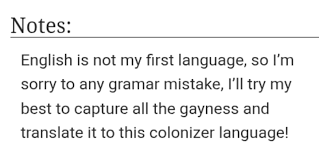
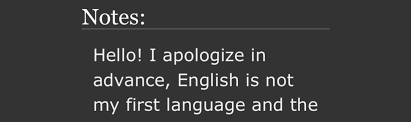
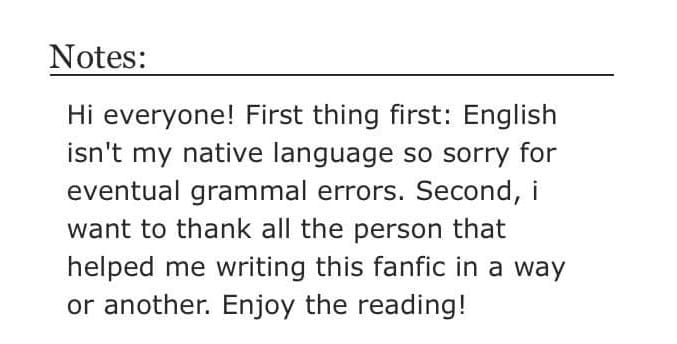
A sampling of English-language AO3 author's notes from non-native speakers
Africans, whose languages are lower on the global language hierarchy, often prefer foreign-language media and fanfiction. This systemic emphasis of linguistic capital reinforces the non-native language internal world of escapism for us, in which fanfiction feels natural to read and write.
Additionally, our own languages are often portrayed as primitive, gibberish or even alien. A famous example occurs in Star Wars’ Return of the Jedi (1983) where a Kenyan actor played an alien character that spoke Kalenjin and Kikuyu, both Kenyan indigenous languages. Such portrayals invoke equal parts shame and pride, depending on the execution. Luckily, in this case, it was done well; however, there is a far larger chance for it to come off as condescending and mocking, further pushing down the value of indigenous languages on the global stage.
A correction of this slight against African languages was attempted with Marvel’s Black Panther, which was an absolute visual masterpiece but fell short in the language when the actors playing Wakandan characters failed to replicate a singular authentic African accent when speaking English. Of course, there’s no single African accent, but the producers could have picked one. T’challa’s father, T’chaka, was played by legendary South African actor John Kani. Wakanda’s language is actually Xhosa, a South African language, and the films borrow heavily from South African cultures, so the actors could have been coached to replicate one of the many South African accents that exist.
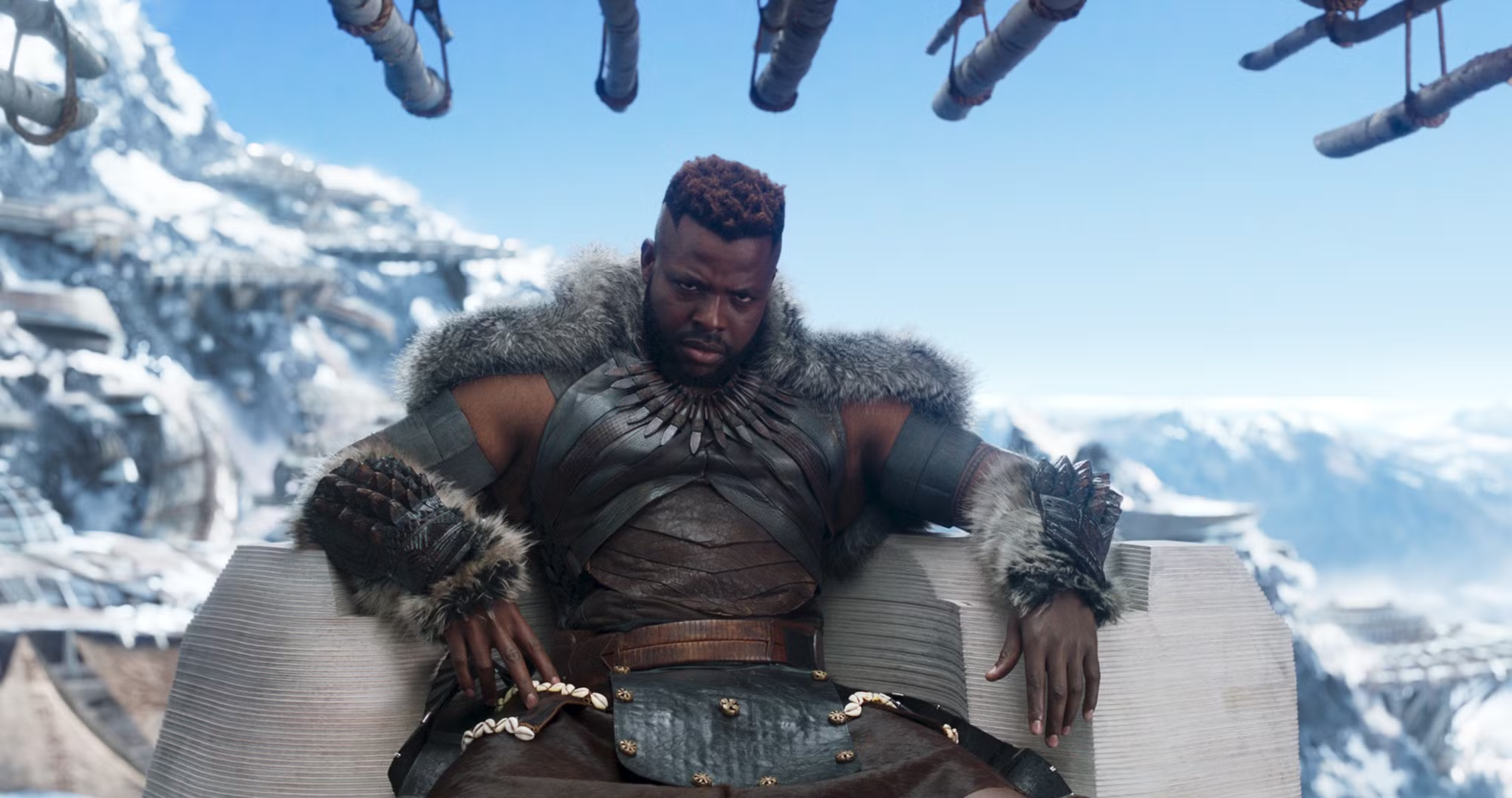
The exception to this scattershot approach to accent was M’Baku (Winston Duke) and his Jabari tribe, who were clearly going for a generalized Nigerian accent. Ironically, it was the white actor, Andy Serkis, who was able to successfully imitate a fantastic South African (Afrikaans) accent when portraying the villain Ulysses Klaue. It’s a film that falls into the African accent trope, where non-African filmmakers portray a caricature of an African accent, which has been a long-discussed Hollywood problem.
When I first discovered the wonderful world of fanfiction as a Kenyan teenager, I dove in head first. I hopped from Ichigo x Orihime fanfiction on FF.net to Bella x Edward fanfiction on AO3, not to mention the (in?)famous Wattpad. Speaking of Wattpad, its global expansion in the early 2010s wasn’t just a matter of platform growth, but of reader-led translation ecosystems: stories and interfaces were translated by users into their own languages, allowing new audiences to discover and circulate them locally, often through peer networks and teen communities. As these translated stories gained traction, they didn’t just attract readers: they seeded entirely new, language-specific writing cultures, which Wattpad then formalized through localisation and regional investment. This helps explain why a majority of its readership quickly came from outside North America, with vibrant national communities emerging in places like the Philippines, where the platform became a dominant youth entertainment space.
For a good number of years, I hadn’t even realized that I had never encountered any fanfiction in my country’s lingua franca, Swahili. And I personally knew Kenyan fanfiction consumers and writers, so I knew a lack of other fanfiction lovers wasn’t the issue. On my quest to understand more about this trend between fanfiction and native languages for other African readers and writers, I spoke to a few other fanfiction enthusiasts.
To begin with, it was harder to find fanfiction writers than it was to find readers. As a member of several pop culture communities in Kenya, I asked around on different groups and found a few people willing to talk, but had to cast my net wider to other African fanfiction writers.
Joy Njuguna is a 36-year old Kenyan social media manager whose first reaction was to laugh at the notion of reading omegaverse fanfiction in her native tongue of Kikuyu. “What would be the words for ‘slick’, ‘pheromones’, ‘rut’ or ‘heat’?” she asks while giggling. She’s never even thought of the idea of reading fanfiction in any language other than English.
Though she’s never come across fanfiction in any of her local languages and she only writes fanfiction in English, the idea of erotica in Swahili is especially egregious to her. “Can you imagine reading smut in Swahili? Something like ‘fuck me harder’? That would be so weird and cringe. But if it’s just a [Gen] fanfic it would probably work,” she said.
Though she admits that English sometimes falls short in some areas. “When you’re trying to write about being obsessed with a person, Swahili and Kikuyu have more analogies and descriptions than English does.”
Ann Nyaruai, another Kenyan book lover, has an experience similar to mine. “I read fanfiction of all the media I grew up with. Both TV shows and books. It's never occurred to me that they're entirely in English until now. I also had a hard time with Swahili [literature] books in high school,” she said.
Her experience ties in with a larger phenomenon in Kenya that she also brings up. “Every fandom space I've been a part of defaults automatically to English. At the opening ceremony of the 2025 Macondo Literary Festival [in Nairobi], one of the Kenyan speakers made a point of opening with Swahili. She explained to the foreigners what she meant[,] then invited everyone to echo her greeting. But immediately [the language] switched to English,” she said. Even Kenyan literature struggles to establish itself in Swahili.
Sally Garama grew up in Kenya but studied the British curriculum (IGCSE), which means she did not go through any formal institutionalized classes to learn Swahili. She, like most Kenyan youth, cannot speak or read fluently in her indigenous language. English is therefore her native language. “If I were to try writing fanfiction in Swahili or Jibana it would be quite awkward and clunky. I can’t even imagine my characters speaking these languages,” she said. “What I try to do instead is emulate as much Kenyan suburban culture that I grew up with in my fanfiction.”
When the Jujutsu Kaisen movie came out in 2022, Kenyan fans were overjoyed to see the capital city Nairobi featured alongside Kenyan cuisine and various other Kenyan cultural markers. This prompted a Kenyan anime WhatsApp group, of which Garama is a part, to imagine scenarios of Jujutsu Kaisen characters traipsing around different locations in Kenya. “It was fun to see the interplay between the Japanese characters and the culture in Kenya. So, yeah, the idea of fanfiction in my local context exists, but it's just, like, a form of roleplaying games,” she said.

In Burundi, where the official languages are Kirundi, French, and English, Vera Kabushemeye faces the same cognitive dissonance. “I do find French fics to be a bit awkward at times. In some fandoms like Hannibal, French can feel very natural. However, for fandoms like Teen Wolf it feels particularly tortured. What leads to awkwardness and/or cringe for me is whether the language is written with correct grammar and in a natural way for the genre and setting,” she said.
Kabushemeye can’t speak or write well in Kirundi, but there’s an added layer of complexity that reinforces the language barrier. “Even if I could speak Kirundi, there is a major issue with this language in the written form. Most people write in Kirundi without accents—” for example bica means “to pass through” but bīca means “to kill”— “[so] you cannot accurately read it without [accent marks] (especially literature since choice of word may not always be obvious given context).” Despite this, Kabushemeye, who as a writer has explored the issue of non-English language fanfiction before, did make an attempt at finding Kirundi fanfiction but couldn’t find even a single Kirundi-language fic.
In her view, the issue is much less about the dominance of English and French in Burundi, and more about the local languages being difficult for most people to read and write. “Do fans know their local language well enough to read literature in it? And if they do, are they used to it or even to writing in that language? In Burundi, I can confidently say that most people do not know how to write or read Kirundi properly (i.e. with accents),” she said. “Therefore, I find it hard to believe they could participate in reading/writing fanfics in Kirundi. That said, I definitely think there is the space and capability to partake in Kirundi Podfics.”
This leads to my next mode of inquiry: Do fans know their local languages well enough to write literature in it? Reading aside, the issue of fluency in local languages has been a point of concern in the past decade as older generations realize the failure of younger generations to pick up their native tongues, as mentioned earlier. In fact, UNESCO estimates that up to 10% of African indigenous languages will have vanished by the turn of the century. It would seem absurd for most other non-native English speakers from other continents to even think that writing in their native language is an impossibility.
Similarly to most of my interviewees, I too would be unable to write fiction in Swahili. This points at a phenomenon where code-switching among urban youth who grew up reading in English has led to a loss of linguistic proficiency in their local languages. This seems to only affect a certain subset of suburban urban youth, however. Studies show that some Kenyan youth are still tapped into their native languages, meaning that the people with the ability to write in local languages are either not interested in or not exposed to fanfiction—perhaps due to how white and white-centered fandom tends to be.
Over in Nigeria, which has the largest media cultural capital in Africa, I spoke to a fanfiction writer who goes by si11yw0rm on AO3 and Tumblr. They are also unable to speak more than a few phrases in their mother tongue, Isoko. When they've come across fanfiction written in Isoko, the weirdness factor still pops up as a barrier because their brain has been trained to expect English in fiction spaces, due to growing up being exposed to mostly English literature in the Nigerian school system.
This case of Nigeria is even more unique in that their movie industry, Nollywood, is in fact larger than Hollywood. This means that Nigerian youth have been exposed to more home-grown fiction from young ages and have more intuitive connection with their local contexts and languages in their entertainment media. This hints at a larger issue when it comes to the ‘cringe’ factor, something beyond familiarity, exposure or proficiency: an internalized racism that expresses as an ingrown rejection of one’s own cultural identity through language.
For si11yw0rm, seeing their mother tongue in fanfiction pulls them out of the story because it changes the vibe completely. “But after the initial reaction, sometimes it’s fun and refreshing, especially when it captures humor or cultural slang better than English could,” they said. “In small doses, it really enriches the text and removes the distance that English gives and makes it personal.”
I felt the same when, on my hunt for Swahili fanfiction, I found a White Collar fanfic called “Dreaming in Kiswahili” in which one of the characters has dreams about the first time he fell sick with malaria while living in Tanzania and speaks Swahili in those dream sequences with the locals. On reading the notes section more, it wasn’t surprising to find that the author was an ex-pat who lived in Tanzania for a few years and included in her notes the real-life impact of malaria. Despite this being true, and probably coming from a good place, it speaks directly to this native language perception problem in fiction. It's hard to enjoy media when your local experiences are almost always associated with suffering. When I click on a fanfic, I do not want to be reminded about the cruel world around me, but instead escape into a fantasy. In my experience, my native languages have been tied so much to these suffering narratives that I’ve been Pavlov’d into cringing back from them when I seek entertainment. I require the emotional distance that English provides in order to immerse myself in the story.
Si11yw0rm also brings up the issue of discoverability. “If I post a fic in Isoko, how many people can actually read it? English makes fanfic feel universal, while local languages can make it feel limited. But I do think younger generations might experiment more and start mixing languages. Our local languages carry emotions and textures that readers crave—whether they admit it or not,” they said. They themselves have sprinkled in a few Isoko and Nigerian Pidgin phrases in some of their fanfics and have received very positive feedback from Nigerian readers who understood the language and contexts.
As previously mentioned, a new crop of small African publishers has arisen in the past few years that is changing the narrative on what makes up “African literature.” For example, Masobe Books, a Nigerian publisher, has begun acquiring publishing rights for the West African market, which means books will become more affordable. They have also launched an app where readers can read e-books of their favorite titles for a monthly subscription fee. These burgeoning publishers have the potential to re-invent what it means to associate our individual home countries and cultures with the topics we love fanfiction for; science fiction, fantasy, and bold reimagings of the acceptable canon that combine genres and worlds that hardly ever appeal to mainstream African publishing.
One widely-read African-inspired novel, Children of Blood and Bone, the first book in a Yoruba fantasy trilogy by Nigerian-American author Tomi Adeyemi, is getting a Hollywood movie adaptation. This is usually an indicator of its popularity and success. However, the books, the first of which came out almost a decade ago in 2018, only have 30 fanfic on AO3. So even with our stories being distilled into widely loved formats (in this case a Young Adult fantasy), there still seems to be a missing link.
In 2014, the author Kiru Taye wrote a Things Fall Apart fanfic called Thighs Fall Apart. And just with that title, I’m sure you can guess it is an erotic reimagining of the fade-to-black scenes Chinua Achebe left to his readers’ imaginations. In his analysis of the piece, academic James Yékú notes that fanfiction isn’t just about stories—it’s about finding people who see those stories the way you do. Because Things Fall Apart is such an iconic tale, in its importance and themes, it seems almost sacrilegious to imagine how virile Okonkwo is (embodied by one commenter who said “OMG!!! Can u really do this?”), but it’s not a stretch of the imagination as he was described just so in the original text.
Part of why reading fanfiction in our own languages can feel so “cringe” has less to do with the language itself and more to do with who we think owns certain storytelling spaces. Fanfiction, by design, is playful and deeply participatory; it thrives in environments where readers feel free to take apart and rebuild stories. Right now, those environments are overwhelmingly English. Most global fandom platforms operate in English, and that’s where this culture of rewriting, joking, experimenting, and pushing boundaries has already taken root. So English becomes the default language of escapism; it’s where fiction feels fluid and open to play. By contrast, our local languages haven’t been as visible in these fan-driven, low-stakes creative spaces. We’re used to encountering them in more formal, “serious,” or real-life contexts. When they suddenly appear in something as unserious, imaginative, and indulgent as fanfiction, it can feel jarring—not because they don’t belong there, but because we haven’t been taught to see them as languages of play.
Nyaruai, one of the Kenya fanfiction readers I spoke to, recounted an experience where she stumbled across a fic on AO3 where the non-Kenyan author wrongly used some words from Kenyan slang (known as sheng) in their fic while simultaneously complaining about being stuck in Kenya. In the author notes section, they referenced often having no electricity, no running water, and no internet, and ended with how they’re glad to be back home and can now continue posting. These racist undertones that exist within some fan spaces on the internet subconsciously contribute to our low perceptions of our own cultures, and subsequently, languages.
This harkens back to the long fight against racism in fanfiction spaces. Platforms like AO3 were built on a philosophy of “maximum inclusiveness,” meaning that as long as content is legal, it is generally allowed to remain; critics argue this has enabled racist tropes and harassment to persist with limited moderation intervention. For example, in the Black Panther fandom, non-black fanwriters were depicting Wakandans as savages and romantically pairing them with white characters. Scholars have also traced how fandom spaces, including AO3, inherit a longer history of “white feminist” defaults that marginalize fans of color and normalize exclusionary customs. In response, sustained grassroots campaigns such as #EndOTWRacism have pushed the platform to adopt stronger anti-racism policies, highlighting both the prevalence of racist content and the resistance such efforts often face within fandom communities. Taken together, this suggests that racism in fan spaces is not incidental but embedded in platform governance, community norms, and the ongoing struggle over what “inclusivity” actually means in practice.
There is a popular TikTok creator known as @thisismikeo who places characters from DC and anime into Nigerian contexts using local accents, settings, and humor. Garama pointed out during our interview that such creative freedom is just the beginning. “[This type of] reimagining and recreation is definitely on the rise, and I love the way fan culture is growing and how it's become more inclusive and [it's] not just one-off people like [it was] in the early to mid-2000s,” she said.
Ultimately, “uncringing” non-English fanfiction is an endeavor in decolonialism. In his seminal work, Decolonizing the Mind: The Politics of Language in African Literature, Ngũgĩ wa Thiong'o says, “Language carries culture, and culture carries the entire body of values by which we come to perceive ourselves and our place in the world.” Just weeks before his death in May 2025, he published his last book, a collection of essays titled Decolonizing Language and Other Revolutionary Ideas. Literally to his dying breath he championed African-language literature. Readers and writers of non-native English speaking nations will have to become just as dedicated to this cause.
As we decolonize our languages, we will be able to read—and write—Merlin x Arthur or Zutara fanfiction in our native non-English languages without a second thought. How we perceive ourselves is filtered through, among other things, the value we put on the importance of our native cultures and languages. Though Africa's linguistic capital is rising through music, we can't keep waiting for the world to catch up. The act of decolonizing our minds as Africans will be the biggest contribution to bridging that mental gap that makes writing fanfiction in non-English native languages so cringe. If fanfiction is about play, remixing, and community, then the discomfort we feel reading it in our own languages might say less about the language itself and more about what we’ve been taught those languages are for. As more and more “fun” African books gain popularity, the collective African literary imagination will continue to push those boundaries. And so will fanfic. Even Destiel fanfic.