Too Big To Fail (On Television)

TV was perfect for tech’s failure narratives—but as Silicon Valley embraces a post-failure mindset, will audiences still want to tune in?

Share
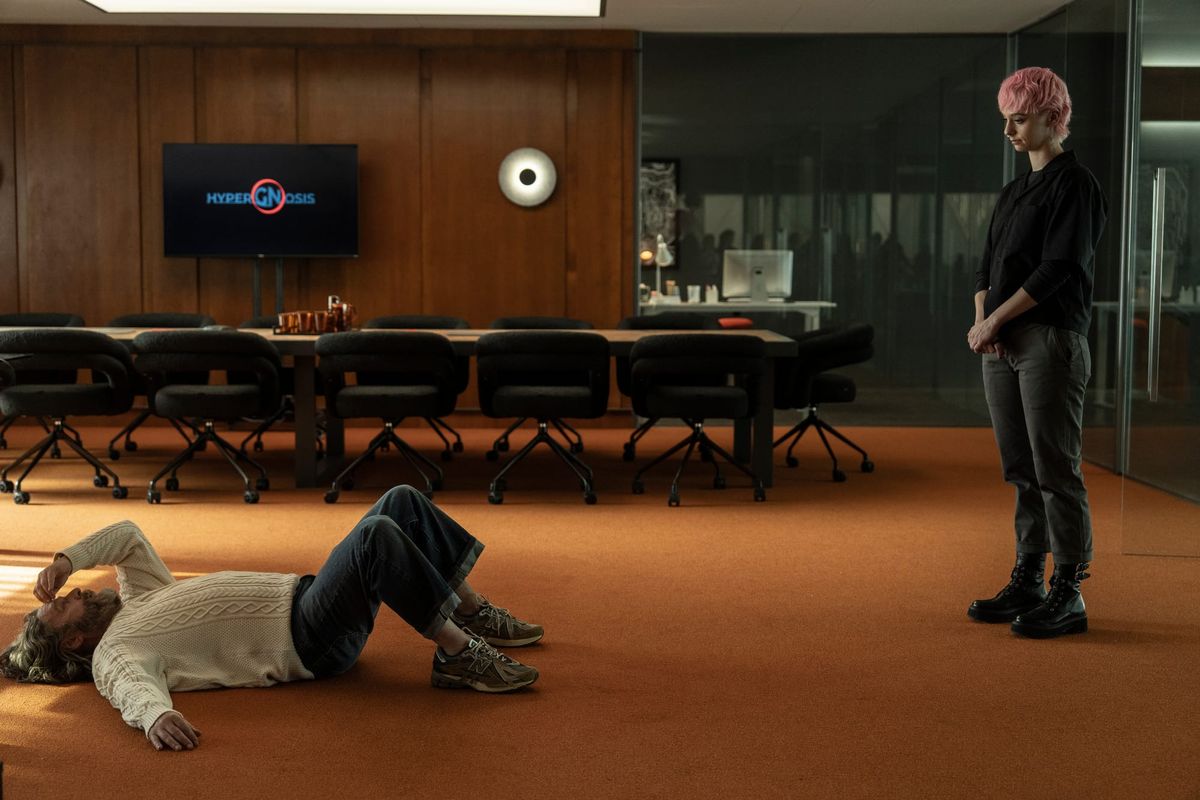
Image of Carl lying on the floor and Harper standing looking down at him. Orange carpet and conference table behind them. TV screen on the wood-paneled wall reads "Hypergnosis".
Zach Galifianakis and Jess McLeod in AMC’s new Silicon Valley-based drama The Audacity, where characters spend a lot of time lying on the floor. Image courtesy AMC.
audio-thumbnail
Too Big To Fail (On Television)
0:00
/1368.340317

Towards the end of the second season of HBO’s Silicon Valley, Gavin Belson, the CEO of fictional tech giant Hooli, addresses his company’s board while standing beside a screen that offers a single-word question: “FAILURE?” 

“What is failure?” Belson asks the board (“gentlemen…and lady”). He’s screwed up a major initiative in his quest to defeat the show’s protagonists and their startup, Pied Piper; attempting to spin a narrative in his favor, he delivers a pitch-perfect rendition of the classic tech titan’s paean to failure. “The point being,” he concludes, “what those in dying business sectors call failure, we in tech know to be pre-greatness.”

When Silicon Valley premiered in 2014, people in tech—especially those in the literal Silicon Valley—often remarked on how uncomfortably sharp the show’s parodies were. This was the era of Big Tech’s great ascendance, emerging triumphant from the post-Dot Com crash wilderness of the 2000s in the ultimate failure-resurrection arc. Giants like Google, Apple, and Amazon were getting infinitely giant-er. Uber and Netflix were disrupting the hell out of their respective industries. Facebook, as they so often liked to remind us in that period, was changing the world.

2014 also saw the premiere of another significant show about tech: Halt and Catch Fire. Where Silicon Valley was sometimes painfully of-the-moment, the AMC drama looked at the industry with several decades of perspective—its first season was set in Dallas in 1984, and its fourth season concluded in the mid-’90s Bay Area. As a period piece, it didn’t directly comment on the contemporary tech world, but it certainly showed many of the foundations upon which it was built. 

Both Silicon Valley and Halt and Catch Fire were critical darlings in the mid-2010s, but tonally, these two tech shows were vastly different. The former was a sharply funny Mike Judge comedy; the latter was a character-driven drama that overlapped on AMC with the final season of Mad Men (it was even initially positioned as a sort of Mad Men for the computer age). On the surface, their similarities stem from the subject matter: characters building software and hardware, some of whom clearly understand machines better than people, and plots driven by alliances and betrayals at the rapid pace of tech, entangled in the messiness of working with your close friends and romantic partners.

What these shows share at their heart, however, is a fixation on failure—not Gavin Belson’s lip-servicey “pre-greatness,” but genuine, often monumental setbacks that strike the protagonists down when they’re on the cusp of success. These failures spring from the characters’ own hubris, or double-crossing due to the aforementioned messily going into business with the people you love, or just plain bad luck. In tech, timing is everything; in tech on TV, the writers can make sure the timing never quite works out.

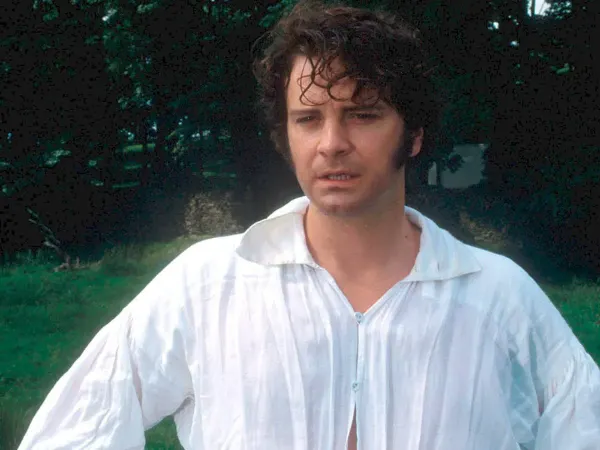
Image of Lee Pace as Joe sitting at a desk resting his hand on his chin.
Lee Pace as the always-reinventing Joe in the third season of Halt and Catch Fire. Image courtesy AMC.

Television as a whole is full of failure: adversity that provides the friction to move plots forward across multi-episode and seasonal arcs. Perhaps shows about other industries don’t depict people losing their jobs quite so often as ones set in tech, but good television offers plenty of professional setbacks alongside personal ones. A two-hour movie culminating in some kind of success is satisfying, and often expected; TV characters racking up endless wins from week to week would make for a very boring watch. 

But with these tech shows, structural failures within the narrative serve to bolster the theme of failure, which has historically held a prized place in the real-life tech world. The college dropout toiling away in the garage, the “fail better” concept; for decades, tech celebrated failure to the point of fetishization. Maybe your startup flopped, or you were ousted from your own company—you found true success in rising from the ashes, perpetually pivoting and made stronger from the experience. As with reality, tech failure narratives on television humble characters, most of whom have far more money and power than the viewers will ever know. Pulling them downwards humanizes and helps us connect to them—and continues to move the plot along in an episodic fashion.  

In 2026, the real-life Silicon Valley failure narrative is essentially dead. Tech titans are done with humble, even faux-humble; they live in a state of “post-greatness,” if you will. If it felt like they’d won back in 2014, in 2026, it feels like more of a trouncing, and yet somehow, they’re mad about it: the industry’s enormous, world-controlling success has calcified into something bitter and reactionary. The insularity of Silicon Valley’s elite has revealed that a remarkably thin-skinned group of people control a good portion of our lives. Tech titans used to proudly tout their ability to get back up after being thoroughly knocked down; now, the slightest hint of critique prompts a full-blown billionaire tantrum. 

It’s into this landscape that AMC has dropped its latest drama about tech, The Audacity, which premiered, fittingly, at this year’s South by Southwest, and wraps up its first season this weekend. (It has already been renewed for a second season.) Created by Succession and Better Call Saul writer/producer Jonathan Glatzer, The Audacity has the unenviable task of making viewers in 2026 get invested in the lives of tech titans—while feeling things other than a desire to see them jailed or even guillotined. 

Viewers don’t necessarily need to like or approve of characters to keep tuning in: the prestige TV era was dominated by anti-hero types, our screens filled with not-so-great men doing not-so-great things, season after season. We’re even willing to see those not-so-great men profit wildly from their actions—Glatzer himself worked on Succession, which had millions earnestly rooting and feeling sympathy for a collection of amoral, out-of-touch members of the .01%. 

But somehow, tech feels different. Perhaps it’s our ambivalent relationships with the devices in our pockets, or the LLMs that feel like they’re being thrust into every corner of our lives from on high. Or perhaps it’s the fact that we’ve suffered through watching these tech titans publicly crash out over the past few years—while they continue to toss around words like “trillionaire.” How do we take pleasure in individual setbacks when the whole system feels rotten to the core? Can a show about tech actually succeed in Silicon Valley’s post-failure age?


Tech has always been heavily invested in its own myth-making. The classic failure narrative aligned with the industry’s chip-on-the-shoulder nerddom, helping reassure tech leaders that no matter how much money they made, they remained the outsider and the underdog, still poised to disrupt. It also aligned with the way software itself is created: iteratively, learning from past flaws and pushing towards newer, improved versions. It’s a metaphor that works beautifully for fictional character development, too. 

In the final quarter of the 20th century, tech onscreen clearly reflected our anxieties about the looming digital age: sci-fi and speculative thrillers about cyberpunk hackers, surveillance states, and computer systems gone awry. In the 21st century, TV joined in on the fun: Mr. Robot, Devs, even Severance, to some degree. The most famous tech-related show of the past two decades has arguably been Black Mirror, which has tended to hug so closely to the speculative edge that “like real-life Black Mirror” has become a common way to describe many of the tech industry’s recent “innovations.” 

More ordinary depictions of people making software and hardware—what might be termed tech realism—took longer to emerge as a subject of TV and film. There’s a reason 1999’s Pirates of Silicon Valley retains an outsized role in the cultural memory given that it initially aired on TNT (and it’s not just because it stars Noah Wyle). Centering on the early careers of Bill Gates and Steve Jobs, it was a precursor for much of tech realism to come: namely, biopics upon biopics, Hollywood’s responses to the narratives Silicon Valley’s stars spun about themselves.

The early 2010s saw a slew of tech-oriented entries into the Great Man subgenre of film, most notable among them David Fincher’s The Social Network and Danny Boyle’s Steve Jobs, both of which had screenplays by Aaron Sorkin. Audiences went into these films fully aware of the astronomical business successes of their subjects, so the narrative tension had to be drawn from these men’s disastrous personal lives.

By the end of the decade, though, Hollywood could clearly see the public souring on tech and its luminaries. Depicting them as selfish friends or bad dads wasn’t enough: the meteoric rises needed to be followed by equally meteoric falls. WeWork founder Adam Neumann in Apple TV’s WeCrashed, for example, or Theranos founder Elizabeth Holmes in Hulu’s The Dropout. Audiences approached these series knowing their endgames: real-life headlines gave it away. Though it was lumped in with other “brand movies” (Air, Barbie, Flamin’ Hot) a few years back, BlackBerry is a prime example of this formula, and a truly great film to boot. Unlike the rest of this cohort, where the narratives (about shoes, dolls, and Cheetos, respectively) were penned to bolster present-day brands, we’re fully aware that no one has a BlackBerry in their pockets these days. The characters will fail—and we want to see how it all went down.  

Purely fictional tech realism has a lot more freedom with character arcs than biopics. Part of what makes Silicon Valley, Halt and Catch Fire, and now The Audacity work is that the characters are built as original figures operating within a milieu we recognize, rather than trying to call up specific real-life analogues. While the thinly veiled biopic can sometimes yield better art than a straightforward one (see, for example, not-David Bowie in Velvet Goldmine versus just about every sanctioned musician biopic in recent years), when we can clearly spot the specific beloathed tech titan behind a character, it can make the “fiction” harder to swallow.   

This was the approach Succession creator and showrunner Jesse Armstrong took with Mountainhead, an HBO film released last year. Armstrong is no stranger to the thinly veiled—Logan Roy and his children are clearly modeled on the Murdoch family—and in his first project after Succession, he turned his attention from media billionaires to tech ones. It’s easy to decode the sources for the characters who convene at “Mountainhead,” the Utah compound where the film’s action takes place (the name is, of course, a play on Ayn Rand’s The Fountainhead). Cory Michael Smith’s erratic Ven is a clear Elon Musk; Steve Carrell’s elder statesman Randall hews most closely to Peter Thiel. Ramy Youssef is…Sam Altman with a conscience? No, he’s not Dario Amodei, either.

Image of the four tech titans in the movie all dressed in matching orange snowsuits, sunglasses, and a variety of goofy hats, taken like a selfie.
Cory Michael Smith, Steve Carrell, Ramy Youssef, and Jason Schwartzman as the quartet of tech titans in Mountainhead, depicted shortly after writing their net worths on their chests in lipstick. Image courtesy HBO.

Mountainhead received positive, if somewhat lukewarm, reviews from critics. Obvious real-life analogues or not, the characters themselves are well drawn: following on from Succession, Armstrong continued his remarkable ability to nail the language of our modern elites, pivoting seamlessly from Kendall Roy’s buzzword-filled abstractions to the pseudo-philosophical proclamations of the Valley venture capitalist in the mid-2020s.

But many of the negative critical reviews—along with Mountainhead’s 27% audience score on the Rotten Tomatoes’ “Popcornmeter”—echo a similar sentiment: I hate these people in real life, and I hated them here, too. “For all the bright writing and smart performances, who wants to spend this much time with such a repellent collection of characters?” wrote the Wall Street Journal’s John Anderson. “It’s a lot of work for a Saturday night. The schadenfreude dividends aren’t high enough.” “This was difficult to finish,” an RT user named CB wrote. “All I could think was ‘I hope they don’t really talk like this or we are all doomed.’”


In Halt and Catch Fire’s first season, the characters attempt to reverse-engineer an IBM computer—fitting, showrunners Christopher Cantwell and Christopher Rogers later admitted, because they were trying to reverse-engineer Mad Men, with stilted initial results. Halt and Catch Fire’s early episodes chafe with derivativeness, but before long, the show finds its own footing, blossoming into an extraordinary piece of television that was beloved by critics, even if it remained something of a cult favorite among audiences. Its driving theme of failure was often noted by those admiring critics; in a beautiful reflection on the show’s conclusion, the New York Times’s James Poniewozik wrote that failure was “part of what made the show a triumph.”

Halt and Catch Fire spans more than a decade of tech history, first in Dallas’s “Silicon Prairie,” then in Silicon Valley itself. The show centers around two romantic partnerships (Joe and Cameron, Gordon and Donna) and two professional partnerships (Joe and Gordon, Cameron and Donna), though one could easily argue that the professional pairings are just as romantic as the traditional ones: the show is uniquely skilled at depicting the complicated mix of emotions that animate creative partnerships, and makes a strong argument for the idea that your true soulmate is the person that you most love making stuff with. 

Production still of Cameron and Donna sitting in a booth at a diner.
Mackenzie Davis and Kerry Bishé as Cameron and Donna: co-founders (soulmates) whose partnership lies at the heart of Halt and Catch Fire. Image courtesy AMC.

Deeply researched with rich historical details, it’s easy to imagine Joe, Cameron, Donna, and Gordon actually existed in our reality, because—and this isn’t spoiling too much if you have yet to watch it—they never really make it big. Their arcs are full of near-misses and gutting twists, those messy personal entanglements leading them to regularly sabotage each other—or themselves. Lee Pace’s Joe in particular engages in a constant cycle of failure and reinvention, fully transforming himself each season, which prompts the other characters to treat him with a mix of bemusement and distrust. Throughout it all, they largely retain a sense of tech optimism: they want to make money, to be sure, but they’re fundamentally driven by less prosaic goals, like writing beautiful code, or helping connect people across the burgeoning internet.  

The uniqueness of the initial setting—the 1980s Dallas tech scene—yields some wonderful specificity, but by the time the characters move out to California, the writers are truly able to dig into the capital-T Tech Industry, which, in the 1980s, was busy building up the foundations of its modern narratives. The Season 3 opener is titled “The Valley of the Heart’s Delight,” a nickname for the Santa Clara Valley that preceded the VCs setting up shop (the same title is used for an episode of The Audacity—almost irresistible, given the subject matter). In one mid-season scene, Joe and his new protege, Ryan, look out over San Francisco. “Nothing lasts in this place,” Joe says. “The whole city burned down seven times in the first couple years of its existence.” “Look, that’s what makes this city so great,” Ryan replies. “You can screw up, you can fail, and so what? You get another chance.”

In the Silicon Valley of the 1980s, a somewhat romanticized idea of reinvention feels genuine; when the characters of Silicon Valley are touting it 25 years later, it’s hard to see it as anything more than cliché. The writers of Silicon Valley were incredibly adept at capturing the disingenuousness of the industry’s narratives—take, for example, an incredible montage set at TechCrunch Disrupt, where presenting teams describe their startups’ extremely technical work, and then cheerfully tack on that it’s “making the world a better place”:

Silicon Valley’s protagonist, Richard, is one of those classic engineers who’s primarily interested in performing technologically remarkable feats—oh, and also making the world a better place, obviously. He and his fellow engineers at Pied Piper are locked in a sort of Tom and Jerry back-and-forth with Gavin Belson and the Google-esque (Yahoo-esque?) Hooli, where several of the characters initially work before defecting. Pied Piper’s groundbreaking data-compression algorithm promises to revolutionize the entire industry, and over the course of the first few seasons, the Hooli versus Pied Piper rivalry is ripped from Big Tech’s real-life playbook: Belson employs acquisition offers, bullying lawsuits, corporate espionage, and, because it’s a comedy, generally wacky schemes in his quest for dominance over Richard and the team. 

The failures in Silicon Valley hit differently than the ones throughout Halt and Catch Fire: they’re mostly played for laughs, even if many of them are of the “oh no” variety. Spoilers ahead, but in one incredible scene, a goofy billionaire character accidentally places a bottle of his vanity-label tequila (“Tres Commas,” because he likes to say he’s in the “Three Commas Club”) on the delete key of a laptop—and erases a third of a database. These pratfallish setbacks are so numerous that the show’s finale winds up being a meta-commentary on the pattern, when the network Pied Piper has built becomes so powerful that it’s going to destroy the world, and they’re left with no choice but to sabotage it themselves. “Your entire life has prepared you to publicly fail,” Guilfoyle tells Dinesh as the team debates what to do. “You’re just failing to see that right now.” “Don’t insult me,” Dinesh shoots back. “I can fail circles around you losers.”  

The cynicism of the world-improving narrative is interesting to reflect on a decade later, when no one in tech seems to care enough to even pretend anymore. Silicon Valley could see how shallow the veneer was even then, and it dug into the cracks that were already showing. When Gavin Belson sits down opposite the real tech journalists Kara Swisher and Walt Mossberg in Recode’s famed red chairs, he declares, “Billionaires are people, too,” before continuing, “Look at history: Do you know who else vilified a tiny minority of financiers and progressive thinkers called the Jews?” The moment is played for sheer absurdity, but many viewers probably didn’t realize that the rant was taken almost verbatim from a 2014 op-ed by Tom Perkins, one of Silicon Valley’s most famous venture capitalists, in which he compared attitudes towards billionaires to the Holocaust.  


“People act like we took something—as if we didn't build everything they touch, Carl Bardolph announces early in the first episode of The Audacity. “And we didn’t build it to be worshipped, we built it to work, and it does work—but where’s our parade? All I see are pitchforks and ingratitude, and I gotta be honest with you: it’s starting to make me maybe a little mental.” Across from him, Dr. JoAnne Felder says in an ever-patient therapist voice, “Would you like to starfish, Carl?” “No,” Carl tells her immediately, and then, a beat later, “OK, yeah. Thank you.” He gets onto the floor and lays on his back, limbs spread wide. 

In The Audacity, characters spend a lot of time lying on the floor. Prickly billionaire VC Carl Bardolph, always a hair’s breadth away from losing it, is played with hilarious precision by Zach Galifianakis. (In another therapy scene, he gets out his rage by rapidly pulling tissues from a box and chucking them ineffectively into the air.) Therapist JoAnne—who we soon learn is an ethically compromised one—is played by Sarah Goldberg, the criminally underrated female lead of Barry. But the show’s core protagonist is Billy Magnussen’s Duncan Park, the gleefully amoral head of Hypergnosis (Tagline: “Where ‘gno’ means ‘yes’—the G is silent.”), a data-mining company that he’s looking to push even further beyond the industry’s ostensible bounds of privacy. Everyone in Silicon Valley is already harvesting everything, Duncan argues. Why not be honest about it?

Unlike Halt and Catch Fire and Silicon Valley, a good portion of The Audacity’s sprawling cast of characters don’t actually work in tech: they are the spouses, the children, the principal at the fancy school. JoAnne and fellow therapist-husband Gary see many of the other characters as patients; tech-company gossip spreads at school functions and backyard parties. Creator Jonathan Glatzer said he wanted to evoke “a bubble, which is really what Silicon Valley is.” The gossip is an interesting analog mirror of digital data collection, with the show’s complicated, webbing plots resting on secrets being traded via both networks. 

It’s a razor-sharp portrait of today’s tech industry and the insular world its leaders have created, but The Audacity is also a great television show, full stop. It’s darkly funny, and at times, just plain dark; in one episode, nearby wildfires leave the Palo Alto sky a sickly golden-grey, an accurate depiction of increasingly frequent weather conditions in the region, but also an on-the-nose visual representation of the end-of-days atmosphere that permeates the show. The cast of characters is large but rewardingly complex, most of them falling on a spectrum from “telling a lot of white lies” to “engaging in widescale blackmail and fraud.” Glatzer and his writers manage to thread a tricky needle: humanizing these deeply flawed people without excusing them or their actions. 

Production still featuring Duncan holding up a laptop to JoAnne and placing a finger on her mouth to silence her.
Sally Goldberg and Billy Magnussen in one of The Audacity’s many scenes that depict JoAnne and Duncan’s…interesting therapist-patient relationship. Image courtesy AMC.

The Audacity certainly captures Silicon Valley’s post-failure state: it’s easy to imagine that what was forming in Halt and Catch Fire and peaking in Silicon Valley has sort of lumbered into this, a world where everyone has too much money and nobody is happy. When JoAnne complains to Gary about having to listen to whining rich people all day, Gary chidingly reminds her that everybody deserves therapy—and the audience can clearly see just how much these characters need therapy. The “always moving forward” philosophy of the Valley means that genuine unresolved traumas have been hastily papered over; combined with the petty whims and short tempers of the ultra-rich, the result is a fairly unstable group of individuals that you could easily imagine on the other side of the crash-outs we all have to witness on X dot com. 

But when it comes to Duncan in particular, Silicon Valley’s post-failure state might be more accurately described as its “post-giving-a-fuck state.” Duncan is often childish, impetuous, and irrational—the show’s title is surely meant to capture the entire world, but “audacious” is the perfect descriptor for him specifically. He says the things we’re certain the rest of his peers are thinking, seemingly without shame. When his teenage daughter tells him they don’t need to fake any diseases or disabilities to get her extra time on her standardized tests, she explains she doesn’t need to cheat—she’s sure she can get into Stanford for real. “Sweetie, cheating is doing it for real,” Duncan tells her. “The only real cheating is when you cheat yourself. Cheaters never lose. And losers? They never cheat.”

“Watching this man eat shit may be the only justice the world has to offer,” Carl Bardolph says in a mid-season scene when, through a series of Carl’s own machinations as an investor in Hypergnosis, Duncan is at his lowest. You don’t necessarily want Duncan to win—but then, do you want any of the other characters to win, either? One of the season’s core plots involves officials from the Department of Veterans Affairs, people with deeply unsexy technical problems that no one in the Valley is deigning to solve. Other characters make noises about how important the work is, but in the end, they’re no better than Duncan, who dismisses the project outright. The public is tired of the tech elite pretending they actually care about the rest of us: Duncan Park is the perfect mask-off character for this moment, the embodiment of the meme, “Are you tired of being nice? Don't you just want to go ape shitt.” 

The most famous Silicon Valley failure text might be Steve Jobs’s Stanford commencement address in 2005. Outlining a trio of professional and personal setbacks—dropping out of college, getting fired from Apple, being diagnosed with cancer—he advised graduates to embrace their own failures with the famous concluding directive, “stay hungry, stay foolish.” A cynical read can easily place the speech within Jobs’s own elaborate project of personal myth-making (a decade and a half after his death, the myth about this particular address only grows stronger), but taken in good faith, the speech boils down the best parts of tech’s failure narrative. You can’t control the world—but you can control how you respond to life’s disappointments. 

It’s notable that, two decades later, tech elites have spent the past month taking commencement stages and smugly telling graduates that they live in Big Tech’s AI-fueled world now—and they should be grateful for it. (Is it worse when they’re surprised by the booing, or when they seem to welcome it?) The art about tech that seems most likely to resonate with today’s audiences probably won’t be one of individual setbacks—and certainly won’t be one of tech figures rising from the ashes. We want to burn the whole system down, for good. Which fictional character will be the one to light the match?