Lanterns: The Murder of Hal Jordan
In episode 6, John and Kerry investigate Hal’s death in 2026, revealing how much Rushville has suffered over the prior decade.

Returning to the present day of 2026, it's time to explore the circumstances of Hal’s apparent murder. In the decade since he rejected the Green Lantern ring, John has launched an architecture firm with his older brother Marcus, a detail introduced during a pitch meeting with a group of politicians in Midway City, where John wants to build a series of bunkers to shield the population from intergalactic threats. It’s exactly the kind of practical thought experiment that writers like to consider when crafting “realistic” takes on the superhero genre, playing into Lanterns’ identity as a show that isn’t really interested in being about Green Lantern.
As we work through the latter half of the season, the story threatens to veer into Surf Dracula territory. In addition to my ongoing complaints about the show’s main plot (i.e., that it isn’t a compelling crime drama), Lanterns also doesn’t offer a convincing reason to find the eponymous Green Lanterns entertaining in their own right, which strikes me as a bit of an oversight. This creative team is so bogged down in delivering a grounded American drama that they’ve forgotten to show off all the cool stuff you can do with the ring, or to explain to new audiences what Green Lanterns are actually meant to do—or, for that matter, stand for.
“Firepower does not save lives,” John tells the panel at this 2026 pitch meeting, illustrating just how far he has come since his time in the military. In a great little moment from Aaron Pierre, John adopts a charismatic salesman persona for a speech that smoothly ties his traumatic experiences in Rushville to his current desire to shield civilians from harm—as long as he can land $30 billion in federal funding to do so. He presents a convincing case, but once the speech is over, his eyes flicker nervously across the panel, aware that the power to complete his mission still lies in other people’s hands. Even after the panel signs off on his designs, they inform him that he’ll still have to persuade a higher authority to sign the check: a tough Army colonel who will meet with him later in the week.
After the meeting, John receives a call from his mother, Bernadette, telling him that Hal has changed, and he wants to apologize. This is surprising news on several counts, because a) John and Hal haven’t spoken in ten years, b) John had no idea that Bernadette was even in contact with Hal, and c) Hal isn’t known for his heartfelt apologies.
John’s current relationship with his mother seems distinctly frosty, and he learns here that she and Hal became friends while Hal was in prison, paying for his role in Rushville’s destruction. Now Hal has served his time, he’s made the unexpected choice to move to Rushville, and Bernadette says he wants to speak with John. Naturally, John can’t resist the temptation of a long-awaited apology from Hal. So he drives across country on a dark winter night to meet Hal in Rushville’s diner, where Hal promptly reveals that he has no intention of apologizing at all. Bernadette fabricated this meeting because she wants the two men to get along.
After ten years in prison, Hal feels guilty for his actions in Rushville, but on an interpersonal level, he’s still an asshole, mockingly scolding John for “breaking his mother’s heart” by choosing to reject the ring. Hal refuses to apologize because he believes he “took the fall” for what went down in 2016, to which John replies: “You didn’t take the fall. You fell.”
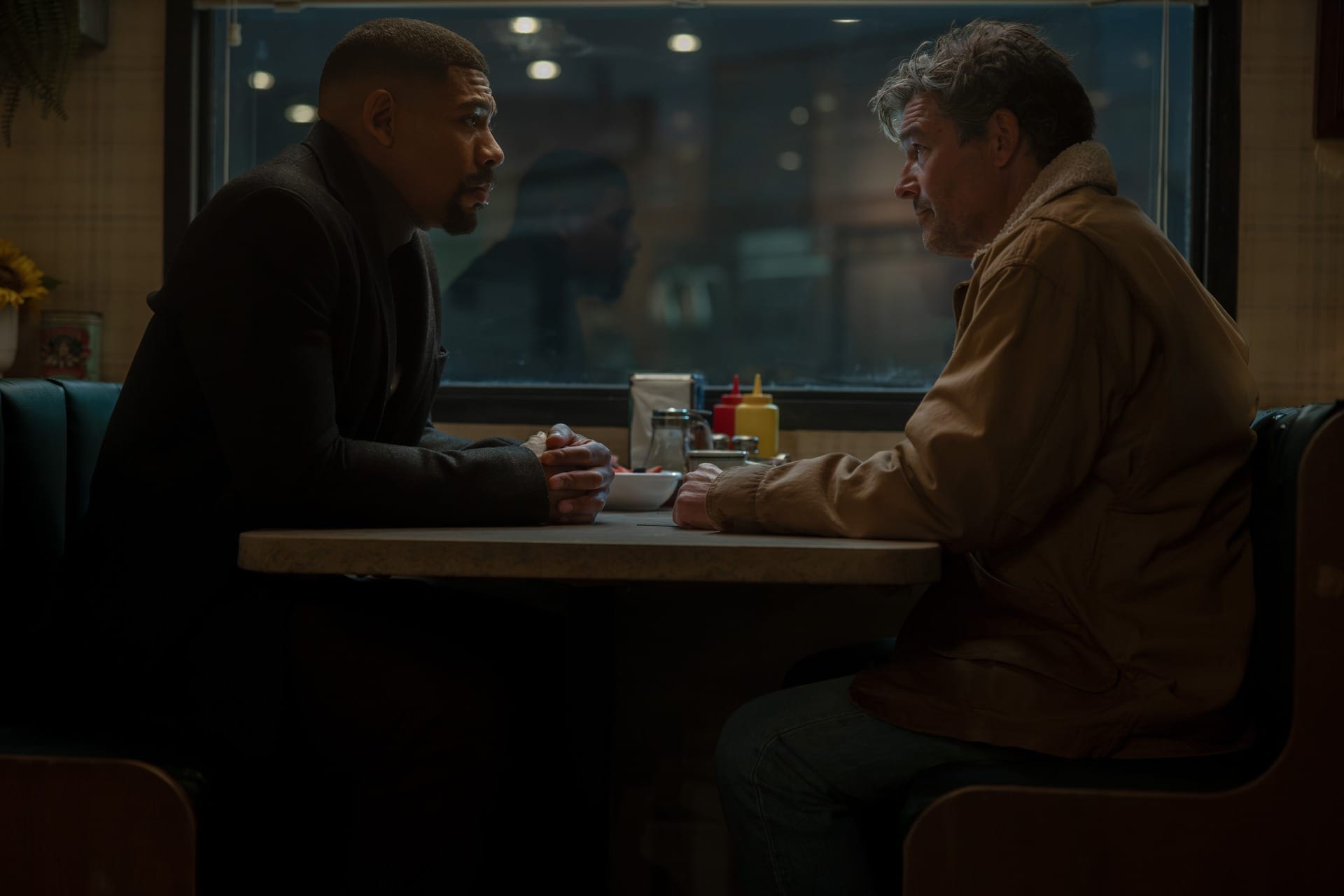
The only thing John and Hal can agree on is their shared scorn for the new Green Lantern, Guy Gardner, who Hal disparagingly refers to as “that gym teacher,” noting that Gardner ripped off Batman by setting up Green Lantern signals around the world. (Actually, that sounds like a pretty reasonable idea.)
But this moment of fellow-feeling doesn’t last long, as Hal tells John that he must have turned down the ring because he’s scared, provoking John into punching him in the face. In a peculiar conclusion to their reunion, Hal urges John to tell no one that he came to Rushville tonight, leaving John to drive back to Midway City, sulking in his stylish but sterile apartment until he receives a call from none other than Kerry Kane. She needs him to come to Rushville ASAP, because Hal Jordan is dead.
So now we know that the crime scene from episode 1 takes place just hours after John and Hal had an argument where John assaulted Hal—making John an obvious suspect if the police ever learn that this meeting took place.
As Hal’s corpse sits in the stands of Rushville’s football stadium, Kerry explains that there were no witnesses to his death, but, “Whoever broke his nose probably killed him.” Oops.
Since moving to Rushville after his stint in prison, Hal had been attempting to make amends, going door-to-door offering to do chores and apologizing to the locals. It hadn’t been going well. Everyone in town hated him—except for Kerry, whom Hal befriended while he was imprisoned, sending her letters until she relented and wrote back. Somehow, this developed into a romantic relationship, with Kerry and Hal quietly dating in the wake of Kerry’s divorce from Billy Macon. She’s invited John tonight because he’s the only other person who might plausibly care that Hal is dead.
Stranded in Rushville overnight, John sleeps in Hal’s house, a rental where Hal’s only contributions to the decor are his carnivorous alien plant Earl and a shotgun rigged to point at the front door. Meeting at the diner the next morning, Kerry deputizes John so he can accompany her to Hal’s autopsy. Ominously, a young diner waitress winks at John when Kerry starts asking questions about Hal’s behavior on the night he died. He was a regular at the diner, and this waitress was there when John and Hal met the previous evening. However, she chooses to keep this fact a secret from the sheriff, telling Kerry that Hal was sitting alone.
Hal’s autopsy scene emphasizes just how unpopular he was around town. The M.E., Betsy, describes him as “a piece of shit,” and is visibly uninvested in solving his murder. Which is just as well for John, because Betsy has already sent off forensic samples from Hal’s broken nose, but refuses to fast-track the DNA testing that would confirm John’s presence within the window of Hal’s death. The results won’t come back for months, by which point John will hopefully have figured out the real culprit.
In the meantime, all we know is that Hal was shot in the head at close range, and his body wasn’t moved afterwards. The only useful piece of forensic evidence is an item from Hal’s personal effects: a key to a storage unit, whose bird keychain suggests that Hal intended John to find it. But when John and Kerry visit the unit, all they find is a massive black safe that’s keyed to Hal’s voice, and fails to open even when Kerry replays one of Hal’s cloyingly affectionate voicemails. With no obvious leads to investigate next, John suggests that they should be the ones to arrange Hal’s funeral. There is, after all, no one else to do it.
Kerry invites John over for dinner that evening, but when John goes out to pick up some beer, he runs into trouble. On the way out of the liquor store, he passes the Green Lantern beacon and decides to activate it, which immediately pisses off a group of local guys—including Kerry’s ex-husband, Billy. Rushville never fully recovered from the battle between Zoe, Hal, and Antaan, leaving the town in disrepair following the loss of its Manhunter benefactor. The locals have serious motives to hate Hal specifically and Green Lanterns in general, leaving these men itching for a fight. John tries to calm things down, saying that calling Guy Gardner is a “last resort.” But his opponents aren’t interested in listening to reason, resulting in a brawl that John predictably wins.
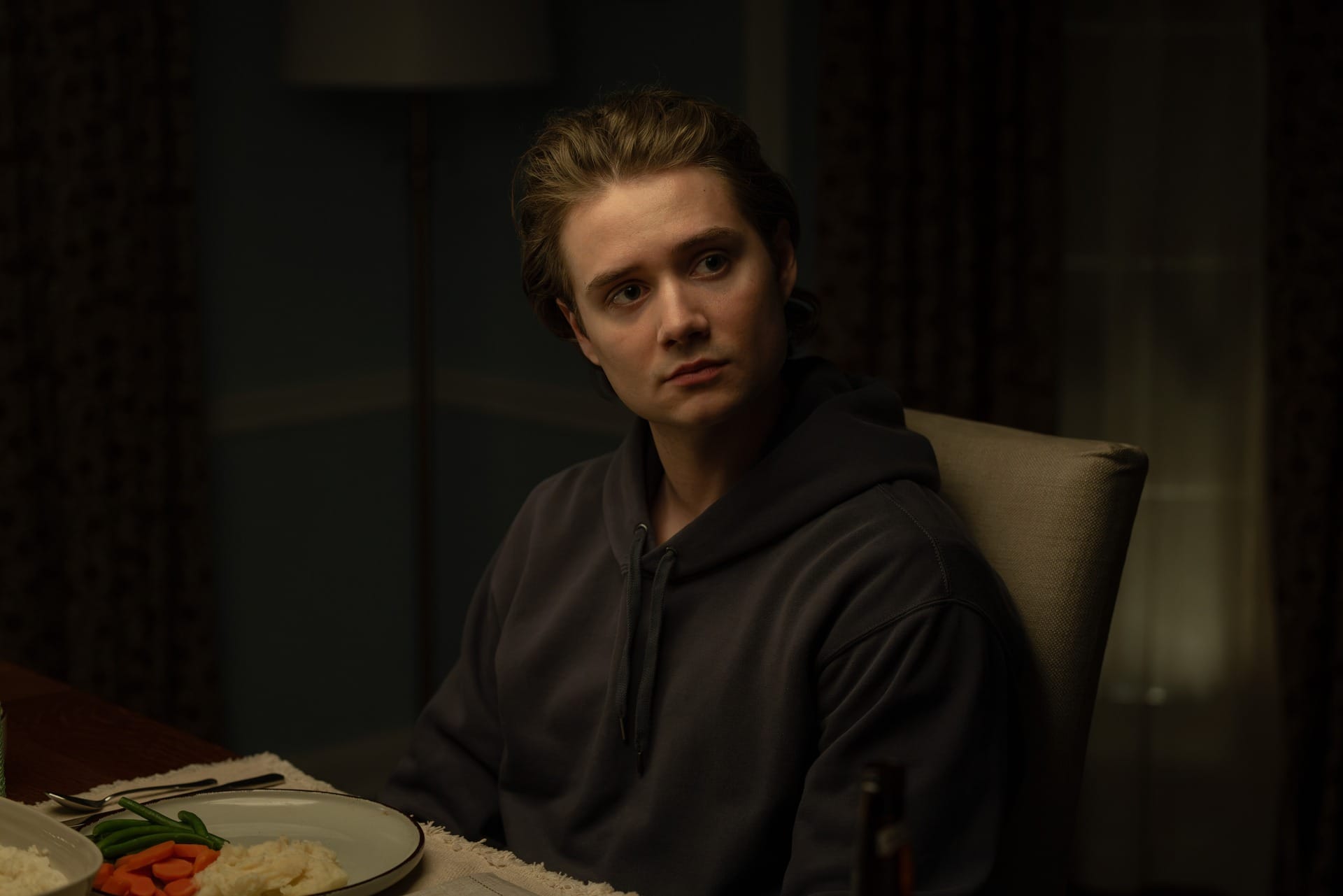
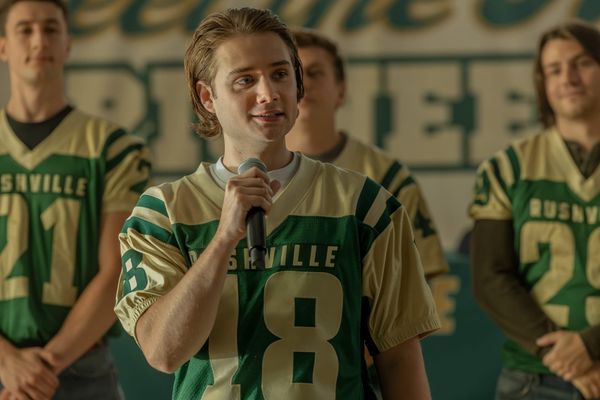
At Kerry’s house, we’re reintroduced to Noah, who is no longer the timid child we saw in the 2016 sequences. Nearing his high school graduation, he’s now the town’s golden boy, a star football player who wants to go into politics. After Hal and John left town, Noah spent months petitioning FEMA to rebuild Rushville’s school. Now he’s getting ready to announce his choice of college at the school’s hat ceremony, an American tradition with which I am admittedly not familiar. The town is so invested in Noah’s future that later in the episode, a man literally stops his car in the middle of the street so he can ask Noah what school he’s going to pick.
We see John and Noah getting along surprisingly well, but this domestic scene is interrupted by an awkward phone call, as the sheriff’s office informs Kerry that John has beaten up a group of men in a public street. She has no choice but to drive him over to the local jail, where he’s forced to call his brother Marcus for bail money—another awkward conversation, because they have an important meeting scheduled to discuss federal funding with the Colonel. With Hal’s body lying in the morgue and John having to spend the night in a small-town jail, John’s life is getting very messy.
Guy Gardner touches down the next morning, reiterating his role as a distinctly unserious superhero. There’s no love lost between him and John—in John’s case, because Guy is a risible egomaniac with a weak moral backbone, and in Guy’s case, because he’s spent years cleaning up the Green Lanterns’ disastrous reputation on Earth. John and Hal’s actions in Rushville “really damaged the brand,” Guy notes.
Guy also has a snide reaction to the discovery that John has landed himself behind bars, quipping that it’s become a “recurring theme” for John’s Green Lantern lineage: first Sinestro, then Hal, now him. Although Guy also has a concerning update in that regard, revealing that someone recently sprung Sinestro from his own prison cell—a location that Guy refers to as “Spazkaban,” i.e. Space Azkaban. This marks the second Harry Potter reference in Lanterns, following the interrogation scene in episode one. And while one example might feel like a casual callback, two feels like a distasteful display of brand synergy from Warner Bros., emphasizing the ubiquity of the studio’s other big franchise juggernaut. In other regards, this show isn’t exactly overflowing with pop culture references, which is why the two Potter callbacks—both coming from childless middle-aged men—seem more noticeable in context.
Shocked by the discovery that Hal has been murdered, Guy tells John that he can’t help him with the investigation: “Bad optics.” John replies that this wasn’t why he activated the beacon. He just wanted to invite Guy to the funeral—and to ask him to steal Hal’s old uniform and decommissioned ring from Green Lantern HQ, so Hal can receive the Lantern version of a military burial. When Guy argues that this isn’t a real thing, John makes the valid point that Hal was Earth’s first Lantern, and they can do what they want. Also, Guy owes him. Guy only has the ring because John turned it down, and helping him to arrange Hal’s funeral is the least he can do to even the score.
Once John makes bail, his phone lights up with dozens of missed calls. His dad’s retirement home informs him John Sr. is being kicked out after pulling a gun and shooting out one of his windows. Bernadette wants to tell him that Hal secretly did want to apologize, so she arranged their meeting “for your own good and his.” And Marcus passes on the news that the Colonel has scheduled a call for tonight, so John will have to take the meeting remotely from Rushville.
John is now juggling multiple problems at once, and only one of them can be solved from a distance, by calling his other brother, Aaron, to pick up their troublemaking dad. Unlike Marcus, Aaron is clearly on poor terms with John, calling him by the resentful nickname “Chosen,” and complaining that everything is always all about John. But John has been bankrolling Aaron’s music career, and when John threatens to cut him off, Aaron begrudgingly agrees to help out.
Back at Hal’s rented house, another problem is waiting to disrupt John’s day. The young waitress from the diner is here to blackmail him. She grew up in Rushville, and witnessed its destruction at a young age. Now she wants John to pay, to the tune of $314,000 in “reparations” plus interest. It’s a great little role in a show that doesn’t generally give much personality to its side-characters: a snarky Gen-Z asshole who describes herself as “a bit of a watch perv” as she scopes out John’s expensive timepiece. If John doesn’t deliver the money within 24 hours, she’ll tell the sheriff that he was in town at the time of Hal’s murder, ignoring John’s argument that he’s unlikely to receive fair judgement as a Black man in rural Nebraska. She responds that the townspeople aren’t racist; they have entirely valid reasons to hate him.
Hal’s funeral is a lonely affair, preceded by a scene that seems designed to annoy me personally: Noah showing up on John’s doorstep with a formal black suit, which he helpfully located so John would have something to wear for the funeral. Is it plausible for a teenage boy to find a suit with John’s Superman-like measurements in a dinky little town like Rushville? No it is not, and it actually would’ve been appropriately uncomfortable to dress John in a suit that doesn’t fit.
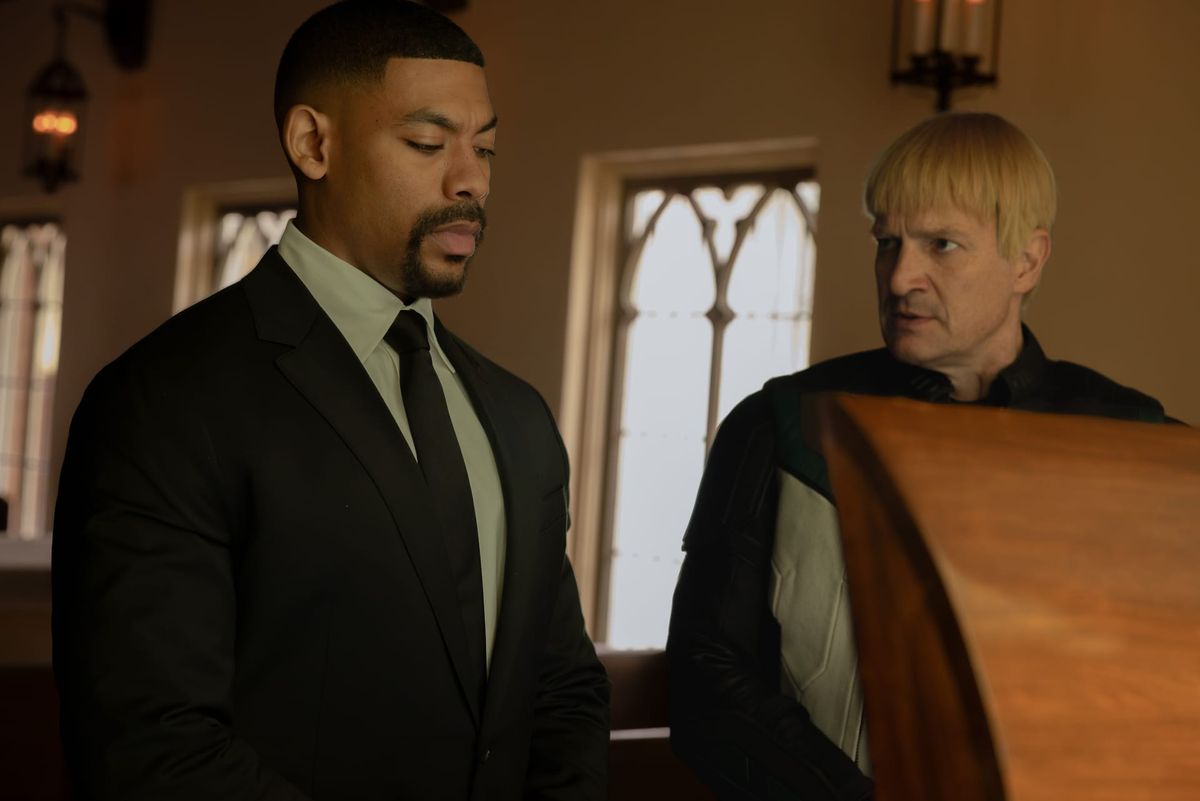
Over at the funeral home, Guy Gardner has successfully delivered Hal’s old uniform and ring, leaving John, Kerry, and Carol Ferris as the only guests in attendance. A recurring figure in the comics, Carol is presented here as an estranged friend of Hal’s, arriving with a print copy of a eulogy that she asks John to read aloud.
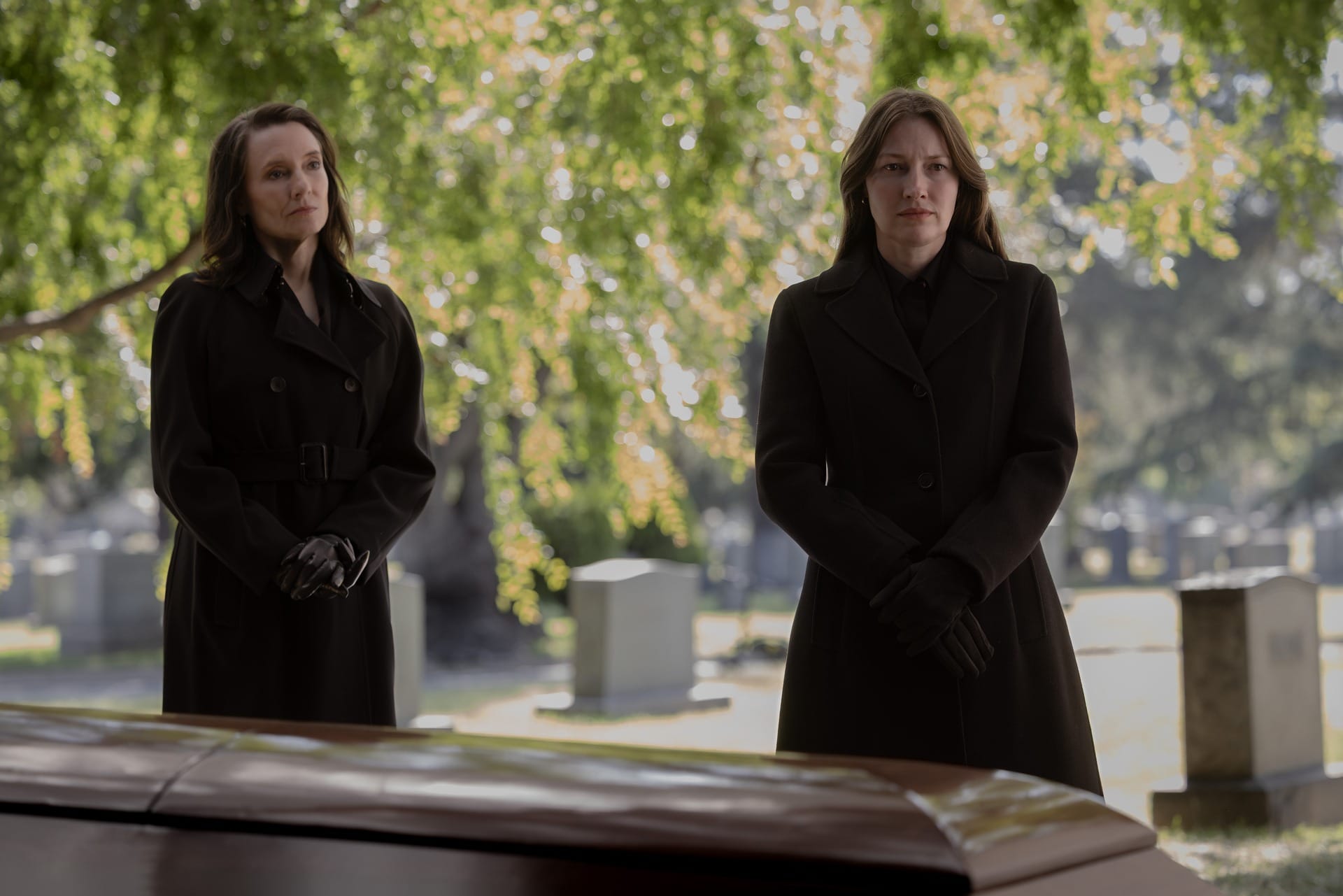
Amusingly, Hal wrote the eulogy himself: a self-aggrandizing speech that assumes his funeral will be attended by crowds of visiting dignitaries from across the galaxy. He must have penned it well over a decade ago, running down a greatest-hits list of Hal’s personality traits: boastfulness, overconfidence, chauvinism, poorly-articulated vulnerability. “I hope I mattered,” it concludes. This earlier version of Hal had no idea how depressing his final years would be, spending a full decade being publicly discredited and personally loathed, with his defining achievement stripped away and handed over to Guy Gardner, a replacement who is, it must be said, just as undeserving as he was.
As Hal’s three mourners stand over his grave, John announces that he’s thinking of sticking around in Rushville for a few more days, foreshadowing the real reason why he was so keen to give Hal a proper burial. In the dead of night, he returns to the grave and begins to dig it up, pausing only to take a call from Marcus and the Colonel, who promptly hangs up on the grounds that John is “unworthy of his time.” The Midway City deal is off, and Marcus is rightfully angry, accusing John of being mentally stuck in Rushville for the last ten years. He makes a good point.
Over the past 48 hours, John has basically blown up his entire life by reuniting with Hal and then lingering around in the aftermath of his death. Instead of moving on to prioritize new ventures, he still feels a compulsive need to get involved in Lantern business—even if that business lands him in jail or runs the risk of tanking his lucrative new career.
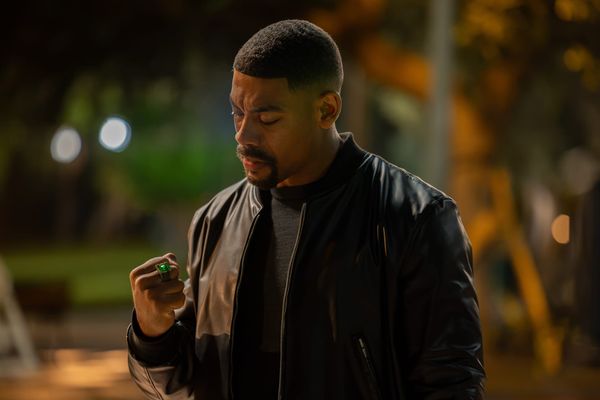
When John reaches Hal’s coffin, viewers can likely guess what will happen next. Despite his earlier assurances that the ring has been decommissioned, it’s still able to do one last thing: activate the Halogram. Pulling the ring off Hal’s finger, John knocks it against a nearby gravestone to awaken the last few drops of battery life, a trick he learned from Hal himself. Then he resurrects Hal’s holographic ghost, who looks straight down at his own grave and exclaims, “Goddammit!”
We’re now left with two episodes to solve Hal’s murder and provide a satisfying conclusion to John’s conflicted Green Lantern ambitions. At present, the Halogram serves two purposes: one practical (using his voice to open the safe in Hal’s storage unit) and one narrative (reuniting the show’s central partnership). Whether he’ll be remotely useful during a murder investigation is anyone’s guess.
This episode already hangs a lampshade on Kerry’s role as a probable suspect, acknowledging that while she was close to the victim and theoretically had the means to tamper with evidence, she’s also noticeably keen for John to stick around and investigate. Not the likely actions of a murderer. Meanwhile, the recently escaped Sinestro is another obvious option, while Rushville itself is full of random civilians who might have wanted Hal dead. I actually like the idea of 18-year-old football star Noah as the killer, avenging the deaths of his grandparents and the damage caused to his hometown.
But this murder mystery storyline is really more of a framework for other questions. John’s entire life has been shaped by his quest to earn the ring—and that desire didn’t just vanish overnight. As he ignores Marcus’s increasingly urgent requests to forget Hal and leave Rushville behind, it’s clear that some part of John is still obsessed with the ring and what it represents, leaving him incapable of moving on.