The AO3 Outage Exposed Fanfiction’s Deep Divisions
The Archive of Our Own was resting on increasingly visible fault lines. Over two weeks in November, they split wide open.

The basic facts around the Great AO3 Shutdown of 2026 are well-established by now. Early on Thursday, October 29th, the Archive of Our Own was first reported as “down for maintenance,” updated with a predicted duration of 12 hours. But after a full day of investigation, AO3 dropped the bombshell: the site had actually been taken down due to a “security incident,” and would remain offline for an estimated two to four weeks while their developers determined the scope and repaired the damage.
AO3—whose devs, like the rest of the people who work on the site, are largely volunteers—has gone down for both planned and unplanned stretches semi-regularly in recent years; the longest is believed to be the 2023 DDOS attack that took the site offline for 30 hours. These periods are always meme-able, with a jokey sort of panic spreading around fannish corners of social media. It’s easy to do an overdramatic “Whatever will we do without our stories!” when the site will be back online tomorrow.
Two to four weeks, by contrast, wasn’t really a laughing matter. Amid shock and dismay at the news, many people seemed genuinely panicked at the prospect of an entire month without the website—or, more specifically, without access to its 18 million fanworks. Less than a week out from the U.S. midterm elections—and, coincidentally, the same day we learned of the death of Patrick Stewart, an icon in multiple long-running fandoms—it was that panic that appeared to fuel the head-spinning days that followed.
Massive communally sourced Google Drives of fanfiction; vibe-coded mirror archives spurring thousands of takedown requests; vitriolic debates about readers versus writers; clashes over ideas about engagement, community, and who fanfiction is for. The tenor and focus of these conversations varied from platform to platform, but fundamentally, they all swirled around a major disconnect between the stories people were missing and those stories’ authors. The discourse seemed to escalate at an extraordinary speed—and by the time the initial furor had died down, some fic writers were saying that when AO3 came back online, they’d be deleting their works entirely.
The outage wound up being closer to two weeks than four: on Sunday, November 15th, millions woke up to the news that the site was back online, albeit seemingly crashing under the weight of everyone trying to log back on at once. Amid celebratory posts and effusive thank-yous for AO3’s volunteers (Tumblr, with its deep love of site-specific holidays, proposed that November 15th be added to its calendar of observances), these conversations about readers, writers, community, and consumption continued across my feeds; I quickly got the sense that whatever was exposed by the outage wasn’t easily paved over by the site’s return.
AO3’s two weeks offline weren’t the cause of these rifts; these dynamics have been building for years. It took an incident of this scale to illustrate them so starkly: deep ruptures along the pre-existing fault lines of the fic landscape in the 2020s. At the end of 2024, I wrote a piece called “The Endless Appetite for Fanfiction” about multiple industries trying to strip-mine AO3, huge influxes of new fanfic readers with few connections to the fandoms in which the stories were written, and an increasing framing of fic as “content”—and this pre-dated the explosion of Heated Rivalry by a full a year. “A decade and a half after decoupling where the fanfiction lives from where the people live, we’re seeing what happens when fanfiction scales—but participatory fan communities do not,” I wrote at the time. “As the appetite for fic seems to be increasing exponentially on all sides, where does that leave the writers who create it?”
Today, these questions feel more potent than ever. As I assessed the fallout from the AO3 outage and what it means for fanfiction going forward, I reached out to a host of longtime fandom analysts to help make sense of it all. I also put out an open form for comments from fans, specifically fanfic writers; I was curious to see what people would share outside the context of social media posts (especially posts on heavily algorithmic sites, where the loudest and most inflammatory voices are carried furthest). The form was quickly flooded with lengthy, thoughtful responses—I capped it at 100 respondents, but the collective commentary totaled 42,000 words! (#Fandom, haha.)
It’s now been nearly a week since AO3 came back in some capacity (minus another outage on Thursday, something the site’s devs said was likely to happen as they worked to bring the site up in full). People have resumed posting, reading, commenting, and kudosing. But the events of the past month feel like such a fundamental tipping point for fanfiction that it’s hard to feel like things are back to normal. How did the fanfiction world get to this place—and what comes next?
“What’s been most amazing to me is the celerity with which all this unfolded—though maybe it shouldn’t surprise me, because it’s fandom, which never sleeps.”
In the initial days of the AO3 shutdown, fan studies scholar JSA Lowe was watching fandom reactions closely. Early on, she says, she saw “fic writers remarking that they hoped readers might perhaps remember this feeling of panicky desolation when it next came time to leave kudos and comments.” But it quickly became clear that the focus of this period would not be on fic authors, but on the fic itself: within hours, shared repositories started popping up, and by day two, the mirror sites would come online.
AO3 has a download button on every story, and readers have long utilized the feature for a variety of reasons: accessibility needs, or preferring e-readers or physical print-outs to web browsers, or simply wanting to save stories offline. Many fans—myself included—have passed around EPUBs and PDFs in a personal capacity, 1:1 or in closed-group settings. Among these exchanges, it’s common practice to share works that have been taken offline; alongside AO3’s orphaning feature, which allows an author to anonymize a work and essentially donate it to the commons rather than deleting it, fanfiction communities have long been invested in keeping works available beyond their original context online.
In the immediate hours post-shutdown, people started doing a very brisk—and very public—trade in downloaded stories. Readers requested titles across social platforms; people began to pool resources, compiling large drives, often on Google, with hundreds and even thousands of fics. The owners of these drives put out further requests for contributors, and advertised them as resources. Many of these efforts appeared to be in good faith, with a “we’ll get through this together” spirit in a lot of the language—which made some of the responses to author objections all the more ironic.
Because a significant number of authors did object to the inclusion of their works in these drives—some on the grounds that they didn’t want them on Google specifically, but more often because they didn’t love the idea that fic meant to be downloaded for personal use was now being re-uploaded and shared at scale without their knowledge or consent. Defenders of the drives framed them as archives, created for the public good, invoking transformative fandom’s history of migration and work deletion, from rights-holder takedowns of the ’90s and early 2000s to LiveJournal’s Strikethrough in 2007. I saw more than one comparison between people asking that their own fic not be re-shared on Google Drive with Anne Rice coming after fanfic authors.
But while takes on redistribution were flying at a breakneck pace, the scale of available fic was growing dramatically larger—because within a day of AO3 going offline, the mirror archives began to emerge: ao3refuge, ao3o3, fanfic.party, ao4.lol. (A non-exhaustive list; they just kept coming.) Cobbled together from a mix of sources, largely public Google Drives and previous direct scrapes of AO3, including, most notably, the 2025 scrape of nearly 13 million works by HuggingFace user nyuuzyou, these sites weren’t just redistributing fic, they were outright republishing it. A little jankily, mind you—titles cut off, formatting stripped out—but republishing all the same. And on arguably the most notorious of the mirror sites to emerge that first weekend, ao3.life, you could pay money for an AI-generated audio version of a fic, too.
Fandom’s collective concern rapidly pivoted towards these sites: while drives with EPUBs seemed to split opinion, outright republishing (while using AI-scraped data and especially charging money in the process) was a great unifier. Muddled information also spread rapidly: Can you actually copyright fic? (Yes, the fic author automatically receives copyright in their fic when they write it.) Should you register the copyright? (You don’t need to do so to issue a takedown.) Do the rights-holders of the source material have any say? (It’s complicated, but the copyright holder is the fic author.) Can the Organization for Transformative Works do anything here? (Not re: your individual fics, to which, again, you hold the copyright, but yes regarding things like the AO3 trademark and related URLs.)
One by one, the mirror sites went down—some seemingly due to public pressure, others with the more formalized language of forced removals. The moderators of fanfic.party appeared to be in the former group, writing in a lengthy apology: “To be frank, we did not realize how many works were uploaded to these Drives without the consent of authors. Looking back, we should have recognized that with such a large number of works, it would’ve been implausible for authors to share them all willingly. However, in the spur of the moment, we failed to recognize these warning signs.”
ao3.life was in the latter camp. Taking the main site down with a statement in which he self-identified as a 17-year-old from India named Ganesh, ao3.life’s owner announced that the OTW’s “legal team has filed a URS complaint against this domain to protect their trademark, and the domain will be taken down in 14 days if I don’t respond. I concede, and I’ll let it be taken down without any fuss.” “Ganesh” wrote about the exercise as a fun project, and said he’d charged money for audio versions of fic to recoup his costs. Some fans questioned his identity, suggesting that the details of his background were false and being used as a cover to deflect criticism (while inciting racism and putting targets on South Asian fans in the process).
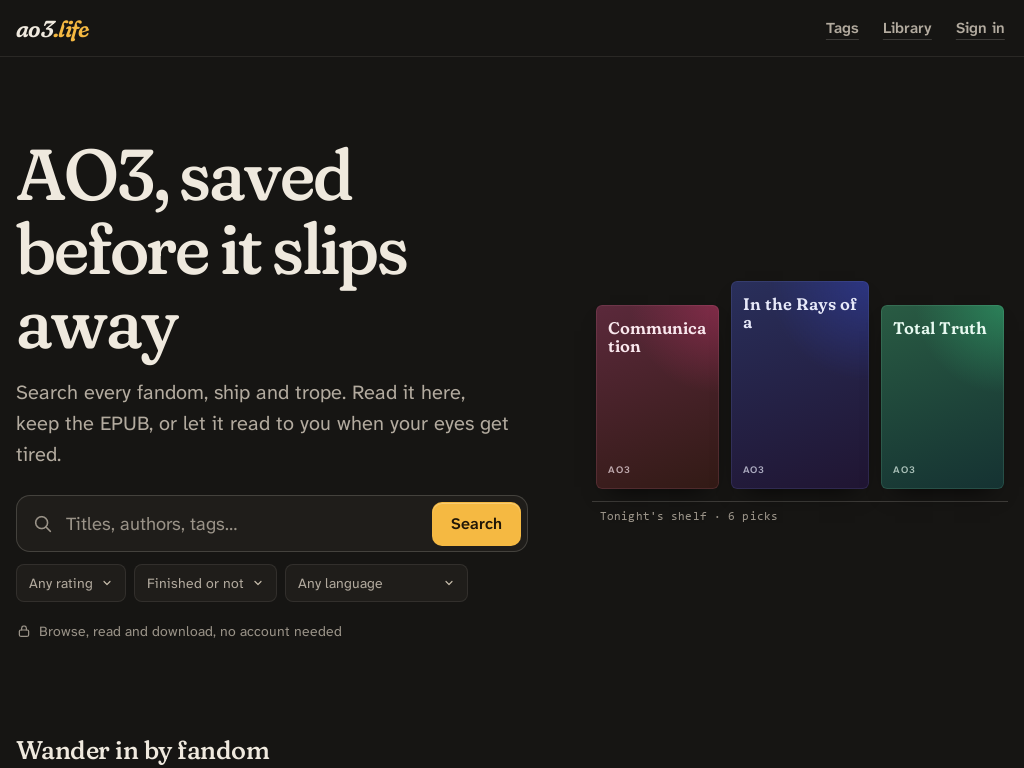
But the ao3.life updates also included a list of more than 77,000 source files to individual Google Docs and Drives that “Ganesh” had harvested. (These remained available up until the URS takedown took effect late this week.) The truly massive list underscored the fact that regardless of any individual motivation, fic-sharing existed on a spectrum of scale: small folders to large collective drives to something like ao3.life, which was put together with an army of AI agents scanning sites like X for publicly available files.
The mirror sites dramatically heightened writer outcry—there was a sense, a few days into the shutdown, that we’d spend weeks playing whack-a-mole with one scummy site after another. But disagreements over fic-sharing more generally continued to swirl, growing to a fever pitch on X in particular. Fanfic readers, some of the loudest voices claimed, were there for the stories only, and didn’t care about the authors—they were “micro-celebrities,” angry that they were losing clicks and clout. Some extended their disdain of fic authors to suggest that because they were writing about other people’s worlds, they lost the right to claim any sense of ownership over their own work.
There was also, among the jokes about AO3 as a load-bearing mental-health support, a real sense that for many, the shutdown and the threat of turning off the tap of unlimited fic was genuinely destabilizing—and the idea that any individual writer wouldn’t want their story wantonly re-shared threatened that further. One Tumblr post that crossed my dash seemed to encapsulate the general vibe I was encountering in this realm: “Some people don’t seem to understand that the world is a better place with their writing in it. When your writing really means something to someone, they aren’t just going to let you take it away from them.”
While many of the mirror sites went down after just a few days, ao4.lol remained up until AO3 came back online. Unlike some of the other sites, ao4.lol seemed to take a specific editorial stance on their homepage: “AO3 said four weeks. Unfortunately, we are a ‘read all night’ fandom, not a ‘wait patiently’ fandom.…A temporary fan archive, because ‘go outside’ is not a recovery plan.” While they justified the site’s continued presence with a fair-use claim, suggesting they were doing something akin to the Internet Archive, these specific framings lent a particular kind of tone to the act of republishing. “We save lives,” they wrote. “Mostly fictional. Occasionally yours.”
“Across all of these conversations, what has really sunk in to me is that a lot of people are not here for the community of fandom, they’re here for the stuff in fandom.”
Stitch—fandom scholar, journalist, and co-host of the Pages and Prejudice podcast—partly spent the weeks of the shutdown comparing responses across platforms. Much of the early panic centered on Reddit, though attitudes and approaches did vary by subreddit; TikTok, arguably the site of the most extractive behavior in the fic-as-content era, saw its share of panic, too, ironically sitting side by side with classic anti-AO3 sentiments about the taboo subjects permitted on the platform.
But X was where the bulk of the virulent discourse was centered. When fans on other sites—and especially journalists—discussed the meltdown, they were often exclusively talking about reactions on X, which, it should be underscored, has a fairly specific, opt-in user base in 2026, and where the heavily algorithmic platform rewards high-engagement posts (if you pay for a blue check, you’re even rewarded monetarily).
Stitch notes that while fic “reader” versus “writer” is not a binary distinction—nearly all fic writers are also readers, and fanfiction is generally written in communal, intertextual conversations—on platforms like X, the two categories were framed as a fundamental divide. “Twitter is where really the brunt of this discussion about authorial rights and reader entitlement has come up,” they explain. “It’s really interesting because you are seeing a space where readers and writers are on the same platform and apparently never interact, according to both sides.”
Tumblr, by contrast, is built for far longer posts. People have always published shorter fics directly on the site, but during the shutdown, more chapters and even whole stories went up there. Much like on LiveJournal—a center of 2000s-era fandom—Tumblr fic during the shutdown sat above and below posts about people’s lives. “It’s really hard to escape that there is a real person writing your fanfiction on Tumblr,” Stitch says. Of all the spaces they were watching during this period, they say Tumblr had the most fandom community in action.
We’re in an era where fic readers vastly outnumber writers—and where many readers have few connections to any sort of fandom community. On brand-friendly sites like Instagram, the shutdown was met with wholly reader-focused responses: bookstores, libraries, and publishing apps offering up “read with us in this trying time” sentiments. Meanwhile, on fan-heavy microblogging sites like X (and, with a different flavor, Threads), it was relatively easy to escape the idea that a real person is writing your fic.
“I’ve seen people say ‘fandom is a hobby,’” says Stitch. “No. Fandom is supposed to be a community. The things you do in fandom are your hobby. Reading fanfiction is a hobby. Writing fanfiction is a hobby. The fact that you’re here, that you’re all trying to cope with the loss of AO3 in community, means something. And instead of understanding that, what I’ve seen is a lot of people kind of going, ‘Well I just come here, read my little bedtime stories, and leave.’”
The huge numbers of read-only AO3 users reflect the rapid and somewhat uneven way millions came into the fic world over the past decade; in recent years, drivers have included Booktok crossover hits like the big Dramione fics, or explosively popular source material like Heated Rivalry. “AO3 also did not grow to scale,” JSA Lowe explains. “Each successive piece of media IP that broke containment…has brought with it new enjoyers of transformative works who may or may not themselves create fanworks, and who may not have been acclimatized to fandom’s foundational values of participating enthusiastically and fully in its gift economy.”
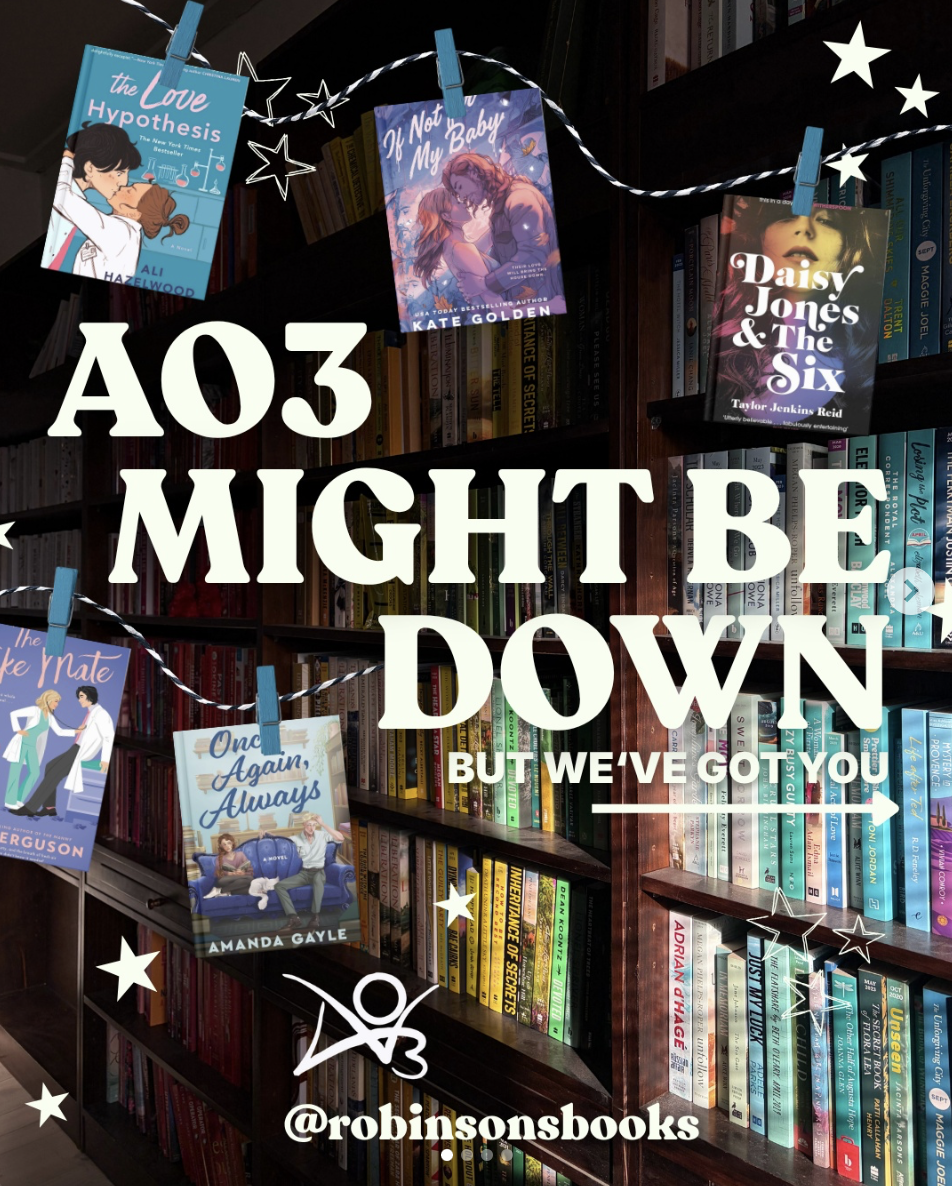
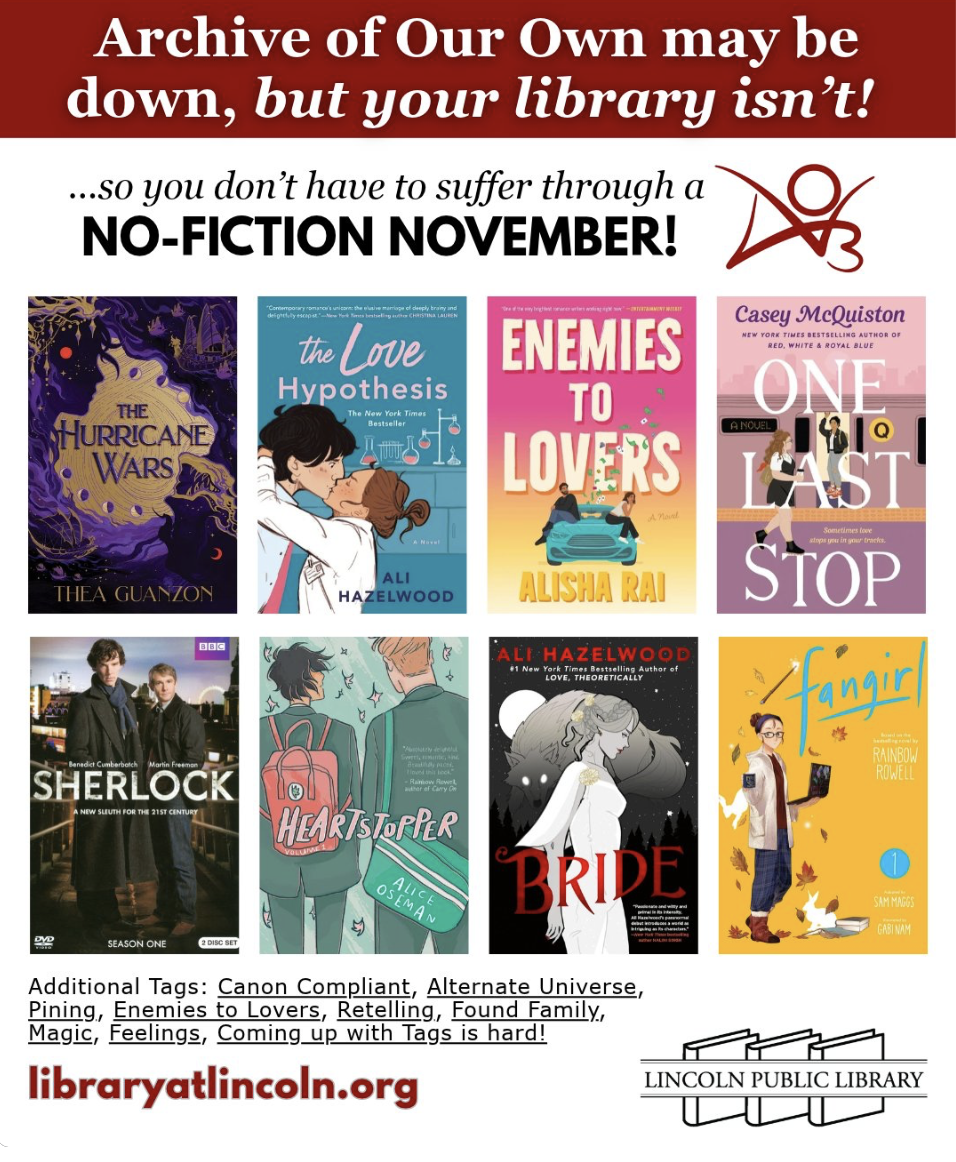
On Instagram, many brands and institutions put out reader-focused messages around the AO3 shutdown. A sample here: Robinsons Books from Victoria, Australia, and the Lincoln Public Library in Lincoln, California. Images via Instagram (Robinsons, LPL).
The gift economy is an anthropological framework in which things of value are given away within communities without monetary compensation or something like a direct barter. The framework was first articulated in the fic context by fan studies scholars in the late 2000s; today, it’s often invoked around the non-monetized norms to which most fic writers adhere. AO3 deserves much of the credit for these norms, with their strict bans on language around commissions, tipping, and money more broadly. (Fanart, by contrast, is now heavily monetized in a variety of ways, even though fanart and fanfic both sit in the same legal grey area.)
In conversations around the fandom gift economy today, people often discuss writers wanting some kind of measurable engagement—kudos, bookmarks, comments—as “payment” instead of cash. These transactional framings tend to miss the core fact that gift economies are about community, with the gifts freely given to underscore those bonds. Gift-economy contributions in fandom aren’t singular works of art like a fic or a vid; they include commenting, reccing, organizing fests, and being in conversation with other fans to talk through the source material and spin up new ideas. But we’ve wound up with a world where the vast majority of AO3 users are wholly divorced from the communities in which fic is being written. They’re taking their bedtime stories and leaving, but they’re not actually lurking—they’re talking about said gifts with their own communities, like X mutuals or TikTok followers or Discord members.
This widening gulf, Lowe says, is “what we’re seeing, I think, when within just a few hours we witnessed polar opposites of behavior, as well as rationalization for those behaviors. On one end of the spectrum you find readers sharing personal archives, jeering ‘Oh, you’re upset about your fic being saved from the fic-saving website? When it literally has a download button?’ (Which is, as it happens, not what authors are upset about.) The same group also often claims that fic writers are behaving with entitlement if they desire or request thanks or recognition. Meanwhile, on the other end of the spectrum, are fans who have poured dedicated life energy into acts of creation, who are now dismayed to see their work passed around like a bong at a frat party without acknowledgement, or a conversation.”
For longtime fanfiction writer and fandom analyst Saathi Press, much of this comes down to the design of AO3 itself. Historically, she says, fanfiction was “often found in either community spaces (mailing lists, forums, LiveJournal, etc) or archives explicitly linked to the same. Even Fanfiction.net has forums. But AO3 doesn’t have any inbuilt community-building architecture, probably because it was founded when LJ/[DreamWidth] were the archetype of ‘fandom spaces’ and it was hard to imagine what the rise of social media and other opt-out internet architectures would do to our ideas of engagement and connection with each other.”
As AO3 was being conceived and built in the late 2000s, the broader web was reaching the height of the blogging era; AO3 could be a core archive to make sure fics had a safe place to live, but fandom could continue elsewhere. But as blogging gave way to social media (first microblogging, then video) and fan communities fractured, AO3 remained stable and central, while the places fans talk did not. That gave its design choices even greater weight in fandom.
Last month, I wrote about how AO3’s tagging structures have fundamentally reshaped both how people read and write fic—and not necessarily for the better. Saathi sees the same patterns repeated more broadly: the Archive, she says, “became so big that its architecture became its own influence: people could find fanfic based solely on searches/filtering, and finding fanfic became less about finding communities, authors, or trusted reccers. You could say that removing the burden of finding those ‘gateways’ has democratized fanfiction in a way, but when so many people sort by kudos, popularity edges out unique personal tastes and pushes experimenting and rarepairs/crackships even further into the margins, especially in big fandoms with ‘obvious’ central ships that focus on attractive white men.”
I reached out to Saathi after reading her analysis of the outage conversations, and asked about an assertion she’d made that “the kudos button was a mistake.” The statement, she says, was “somewhat an extreme and hyperbolic distillation of my musings, but I do think that the one-click-and-done form of engagement—and being able to sort via hits/kudos—flattens the sense of genuine community engagement with fanfiction. Authors watch ‘number go up,’ but is that truly rewarding beyond the rare ‘oh I can tell someone just plowed through all my fics in 12 hours’—which can just as easily be reflected by a simple comment chain by the same reader in the same time!”
With the site offline, so much reader reaction was about restoring that endless tap of content—turning the site back on, exactly as it was. But for many writers and other fans invested in the community components of fandom, the outage spotlighted the many ways in which fanfiction feels fundamentally broken in 2026. While some have talked about moving fandom activity to other spaces, others—Saathi included—have focused on AO3 itself, trying to imagine the changes that could minimize the site’s role in fueling fanfiction’s scaled-up, consumption-at-all-costs era.
“People who think AO3 descended from On High, without flaw, have passionately rejected (sometimes to the point of harassment) even the vaguest notion of changing the site,” says Saathi. “But I think that ‘imagining something better’ is what got us AO3 in the first place, and being thoughtlessly bound by the goals and priorities of a small number of fans from almost 20 years ago holds us back from embracing the current (or future) needs of fandom.”
Across the public conversations around the AO3 shutdown, it was obvious that the loudest voices were carrying the furthest. Social media, after all, is largely designed to fuel and amplify the strongest feelings, and not necessarily the most sincere ones; on X in particular, where a great deal of commentary took place, algorithmic reach is regularly manipulated by bad actors. Compounded with the speed at which all this unfolded, the easiest way to get a sense of fan feelings was looking at posts with a lot of likes or notes. But I wanted to hear from fans outside the context of these platforms—and more importantly, I wanted to hear from fic writers.
About 10 days into the shutdown, I circulated a call for responses on Bluesky and Tumblr, the platforms where both Fansplaining and I personally are most active. I gave respondents a free-response box to share thoughts about the shutdowns, the drives, the mirror archives, engagement, community, etc., and shared a link to my “En dless Appetite for Fanfiction” piece so they could see what this one would build on. I also gave a free-response box to share personal details: the respondent’s background, how long they’d been in fandom, and what fandoms they write in. I didn’t set out with a particular number of respondents in mind, but when dozens submitted lengthy responses in just a few hours, I knew I already had far too much to include, so I set it to close at 100 submissions.
The 42,000 words these fanfiction writers shared are an incredible snapshot of this moment: part sadness and frustration, part inspiration and hopefulness. If I had to summarize the entire thing in a word, I’d pick: nuance. There were so many smart thoughts—frustratingly far too many to ever highlight in this piece. If you’re interested in reading the responses in full, you can explore them here:
For some, the big conversations felt distant, distorted by the effects of platforms amplifying particular voices. “To be honest, I’ve seen far more discussion about the fallout than the actual fallout itself,” says Manny, who’s been writing fanfic since 2019. “I don’t necessarily think it’s overblown, but I have known Tumblr to give tens of thousands of notes to posts about one person complaining [about] one event/incident.” Kiwi, who’s also been writing fic since 2019, put it this way: “Much of the drama I’ve seen has been more like hearing an argument two grocery aisles down and not knowing what’s going on. It’s definitely been...an experience.”
Generally, respondents fell on a spectrum of attitudes around the fic sharing: fine with all of it, OK with the fan-distributed drives but not with the big mirror sites, or unhappy with all of it. “I know I’m in the minority here, but I (as a fic author) actually didn’t really mind the fic sharing!” says liketolaugh, who currently writes in the D.Gray-man, Danny Phantom, and DPxDC fandoms. “In my mind, finding my fics on a shared drive was the same as a rec.” JajaLala, who’s been writing fic for nearly a decade, raised themes of ownership: “When fanfic writers try to demand all-encompassing rights to complete control of their publicly released work and how it’s engaged with, I think they should take a step back and imagine whether they want to emulate the corporate desires to control all distribution and engagement with their work.”
But regardless of where they fell on fic-sharing itself, respondents expressed far more frustration and sadness over the fallout—and with the disdain some fic-sharers expressed towards writers unhappy with the redistribution. Many respondents underscored the broader themes of fracturing communal norms. “Fandom is ultimately not just about creating but about sharing and being welcomed!” says Withy, a fic writer and fanbinder who’s been in fandom since 2012. “I think it is totally fair to be upset about it, and wish that you were treated as a friend rather than a content mill.” Mad, who’s been in fandom and fanfic spaces since 1998, put it succinctly: “Fandom is a community, and this is the opposite of community-oriented behavior.”
“I do think this is a symptom of the wider trend of diminishing engagement,” says Sam, who’s been writing in fandom for 12 years. “The people who see no issue with utilizing these drives (and vehemently defend their right to do so/the whiny nature of writers who disagree) are often the people least engaged in community.” Fazmid, who’s been publishing fic for a similar length of time, expressed parallel thoughts. “Many of these people clamoring for fic PDFs that say they can’t live without AO3 didn’t bother to engage with authors before and tell them what they meant to them. Engagement with fic (comments in particular) are trending downwards as far as I can tell, with way more passive consumption these days. It just really sucks to see fic turning from a community of gifts and exchange into something closer to consumerism/mass media.”
Many respondents noted the shifts in culture around fanfiction reading that have come with the massive scale. “It’s very interesting to see how fandom spaces are shifting,” says Amanda, who’s been in fandom for over 25 years, “but it’s also a little sad to see things like AO3 treated as little more than a place where someone can download ebooks rather than a place where fans can post, comment, and share in their love for a particular IP or character.” As Cko, who’s been writing fic since the 1990s, put it: “So many people think of AO3 as the place they plug in the right keywords and they are rewarded with the fic they wanted, or close enough, zero thought given to the people who actually created the works.”
“I was texting with a friend of mine who’s a reader only about what fics we had downloaded,” says Harper, who’s been in fandom for two decades and currently writes Baldur’s Gate 3 fic. “She told me that her stash has her favorites, the ones that changed her world. I asked if she ever told the authors that and [she] seemed confused at me asking. Even if guest accounts could comment, she didn’t seem to understand why it was so important to engage with the work.”
“The compact of trust between author and reader was broken during this downtime, and it’s going to be hard to repair. Fandom, as always, will survive—but it certainly isn’t going to be the same.” —Aewin
“Fanfic authors like myself do not post our hard work for numbers, we post it for community,” says Tali, an FFXIV writer who’s been in fandom since 2009. “But this new generation of readers do not want community, they want to consume, consume, consume.…They assume all we care about are the metrics, because that’s all we are to them.”
But this metrics-driven mindset exists on the fic-writing side, too. V, who’s been in fandom a little over a decade, says, “I think there’s a fine line between lamenting the loss of community engagement and acting entitled—one tweet called readers ‘freeloaders’ which is so very capitalist in nature—readers aren’t the only ones commodifying fandom either.” Nat, who’s been writing fic for the past five years, ties some of this back to ideas that fanfic and fandom are immune from critique. “I am a fic writer and I feel like I occupy a weird space where I think fandom culture is FAR too indulgent towards fic writers. The gdrive/epub thing has stirred up a lot of muck when it comes to fic writers demanding engagement from readers.”
A number of respondents drew parallels to extractive behavior around fanart; one who wished to remain anonymous wrote, “We’re all in the same shitty boat, and I do not wish this on anyone, but I dearly hope fic writers who hated seeing their works reposted without their knowledge or consent on other websites will gain new perspective and sympathy for all the fanartists who have been having their fanworks stolen and reposted without their knowledge or consent onto other websites for years.” Amki, who describes their stack of fandoms as “a particularly unstable Tower of Pisa,” writes that, “as someone who is also mainly an artist and has gone through this multiple times, it is extremely violating to have your work reposted so casually, as if it’s just a mere product and not a result of my hard work and passion.”
Both artists and writers know what it’s like to have work fed into AI—and many respondents mentioned AI, often drawing parallels between AI companies and the people resharing fic. “It’s so upsetting to see this wave of entitlement become rampant with how accessible AI is now,” says Feo Sul, who’s been writing fic for a decade. Zacharie, who’s been in fandom for more than 20 years, says, “If you only see authors as machines, then what difference does it make to you whether a fic is written by AI or a real person?” As MajorEnglishEsquire, who’s been in fandom since 1997, put it: “Disassociating fanworks with their artists and writers does essentially what the billionaire tech-bro demons do: It says that our works of art are worth taking, but not worth even crediting us.”
For some respondents, the feelings go beyond frustration—they’re considering stepping away from fanfiction entirely. “I am going to be honest, it’s made me consider just pulling all my work from AO3 when it returns,” says B, who’s been writing fic for more than 20 years. One anonymous respondent said the same: “I felt so othered and disrespected by the people I tried to connect with that I cannot say with confidence that I will ever post on AO3 again. I’m not even sure I will continue sharing my stories or ficwriting.”
“It’s not worth it for a handful of kudos and three comments, two of which are bots and the other being my friend who’s already squeed with me over it in private,” says Jane, who writes in the Fire Emblem fandom. “I’m uncomfortable with my work being perceived now, knowing it may be being hoovered up by unscrupulous consumers instead of fans.” “I don’t want to feel like this,” says Aewin, who’s been in fandom for more than two decades. “I want to be on the same page....The compact of trust between author and reader was broken during this downtime, and it’s going to be hard to repair. Fandom, as always, will survive—but it certainly isn’t going to be the same.”
For others, this whole episode has made them recommit to the community elements of fandom. “When AO3 comes back up, I’m not changing anything about how I share my own work,” says constellarium, who’s been writing fic for over 25 years. “But I think I’m going to try to make a stronger effort to leave comments on fics I enjoy. I hope other people will take the same lesson from this, and do the same. I hope they won’t delete their works, although they certainly have every right to.”
“People still want to help each other find the fic they crave,” says Sunnyrea, who’s also been writing fic for over 25 years. “As a writer it reminds me how much people care and connect with fanfic, characters they already love and how what we write people don’t want to have a month without.” Miz, a “38-year-old multifandom single dad,” expressed similar sentiments: “Legitimately all this outage has done is make me want to write more fanfiction, because it shows how loved these fan works are.” Or as Rhyolight—who first wrote Star Trek fic in high school in 1973—put it, “If we were not aware how great a gift it was before, I hope we are now.”
Beyond covering fandom for a decade and a half and now literally running a fan culture publication, I have a personal stake here: I saw my own fic on at least one drive, and I found it on the mirror sites, too (titles cut off and formatting stripped out, naturally). The latter just felt gross, but the former left me a bit more troubled. While I absolutely felt they were acting in good faith, the person advertising the drive didn’t seem to have ever engaged with me or my work, but still appeared to like my fic enough to download and reshare it. My fandom is on the smaller side these days, and though I like to say I don’t particularly care about comments (and truly don’t care about kudos), I still sort of wanted to scream, “Hey, the person who wrote that is right here, you know!”
I write fanfiction because I’ve always written fanfiction; as I often mention, it was something I did even before I knew other people did it, too. For several decades, I kept it to myself; getting the ideas down on the page was more than enough. But I wouldn’t want to go back to that—I like publishing fanfiction. I share it now because I feel I’m writing it in community: these are my thoughts and arguments and desires about these characters and this fictional world, offered up to see if they resonate with anyone who has similar interests, especially people who have written their own takes in fic. The texts are in conversation with each other—we are in conversation with each other.
When I wrote that 2024 piece, there was a feeling that for fic authors, the idea of “fanfiction” writ large was slipping between our fingers. I couldn’t have predicted how much worse things would get over the past two years. The massive new body of readers who treat AO3 like a giant free library has somehow gotten even larger. The shoddy AI sites that yanked our work are now ones like ao3 .life, which, for all the cut-off titles and formatting problems, still got to a pretty workable state in a matter of hours. The overwhelming AI-ification of everything outside of fandom underscores this. Two years ago, I said these sites could only get better; this time, I’m keeping my mouth shut.
The extractive forces encircling fanfiction today—the silent readers, the AI grifters, and don’t even get me started on the publishing industry—are only likely to get stronger in the coming months and years. To me, the only bulwark against these forces seems to be making fandom community bonds stronger. We are the architects of our own fannish spaces; we can actively choose to reject broader trends like the culture of content consumption. I, too, don’t blame anyone who wants to delete their work right now, but you can also choose to keep your fic up as a response to all of this. (Yes, I am suggesting you don’t delete your fic primarily out of spite.)
Over the past few years, I’ve personally witnessed the ever-widening gulf between passive and active engagement around my fic; there’s barely time to connect with most people, who seem to cycle into and out of my fandom faster than ever. But in that same time period, I’ve written and published a bunch of stories that I’m extremely proud of, gotten many comments that genuinely moved me, and made new fandom friends in an era of social media in which that feels increasingly difficult. Even if the past few weeks left me with a pretty sour taste about the fanfiction world on a whole, I’ve still got my WIP open in another tab right now, ready to be continued. Even if I’m shouting into the void, I want to keep the conversation going.
Many thanks to Aja Romano and Lin Codega for their help reporting this piece, and to Aja for their hard work editing it. Additional thanks to Fansplaining’s longtime legal explainer, EarlGreyTea68, for copyright info. And, of course, thanks to everyone who took the time to share their thoughts in our survey.
Due to the communal nature of this piece and the importance of the subject in the fanfiction community, we plan to keep it in front of the paywall for all to freely read. If you’re new to Fansplaining, please check out our other fandom reporting and criticism (as well as the decade-long back catalog of the podcast). Our writers’ work is paid for by subscribers. If you're interested in supporting this project, please consider joining us with a subscription or a one-off donation.