Every Trope Everywhere All At Once
A decade after our big survey on fanfiction tropes, they’ve spread, evolved, and been co-opted by capitalism.

It was October 2016, and many voters were preparing to make very important decisions: How exactly did they feel about enemies to lovers? Found family? Coffeeshop AUs?
The Fansplaining podcast was just over a year old at the time, and these “voters” were the thousands of fans who were participating in our Fic Preferences Survey. Compared to some of the surveys my co-host Flourish Klink and I would run in the years that followed, this was one of the simplest: respondents were given 144 fic tropes, themes, and formats and asked to mark their sentiments (“Yay,” “Nay,” “Meh,” or “I don’t know what this means”), with free-response boxes for thoughts about the exercise or tropes more broadly.
The survey was born out of conversations we’d been having on the podcast (including with my other collaborator, Gavia Baker-Whitelaw) about the ways that tropes—shared shorthands for story elements—had become central to how people were talking about fanfic. It was also inspired by the often strident declarations we were hearing about What Fanfiction Fundamentally Was, both from within and from outside fandom: a place for the heartbreak of canon to be smoothed over with low-conflict fluff, or a playground to explore your darkest thematic desires, or a vehicle to to write emotion-laden porn for your friends. (Of course, these things aren’t mutually exclusive, despite how much some seemed to insist that they were.)
Stats via fanfiction sites like Archive of Our Own could tell part of the story; on AO3, popularity metrics (hits, kudos, and bookmarks) are right at the top of the page. But many fics contain a number of elements; I might click on a story because of a tag or in spite of one, or it might not factor into my reading decisions at all. Leaving kudos or publicly bookmarking are also visible declarations; even when using a pseudonym, people might be hesitant to signal an interest in more controversial topics, for example.
To understand what fanfiction readers actually liked and disliked, Flourish and I decided to go right to the source. That October, it seemed as though people were eager to think about something—anything—other than the upcoming U.S. presidential election; in the end, 7,610 fans participated in the survey, which, across the 144 questions, wound up giving us more than a million data points. “Friends to lovers” took the prize for most-liked; coffeeshop AUs didn’t even crack the top 50.
Over the years, the analysis Flourish and I wrote about the results has been one of the most-read things on the site—aided, I’m sure, by “fanfiction tropes” being a very popular search term. We were asked many times if we would run another round; we always said it was Creative Commons-licensed, and anyone was welcome to do a version themselves. (They still are!) Flourish and I would go on to analyze individual tropes in our “Tropefest” series, and continue to read and write plenty of tropes in our own fanfic. But I hadn’t actually revisited the results in years—until now.
Almost exactly a decade later, we’re once again trapped in the hellish limbo of waiting for a deeply consequential Election Day here in the U.S.: it’s the perfect moment to look back and see how our respondents felt about omegaverse in 2016 (actually a pretty polarizing one!). But as I started to consider the idea of “fanfiction tropes” in the mid-2010s versus the mid-2020s, I was struck by how much has changed in the broader culture in the intervening years.
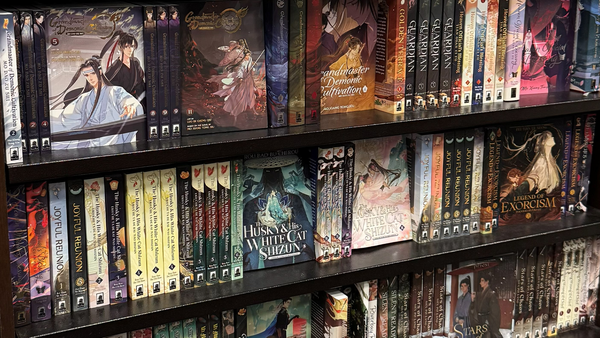
Think of all the places we find trope labels today that might have seemed…surprising in 2016. Book marketing with lists of tropes in cutesy lettering. Bookshop displays pegged to things like “slow burn” or “only one bed.” Pages upon pages of Etsy results for a given trope—yes, these days you can sit down to read your favorite enemies-to-lovers novel attired in head-to-toe “enemies to lovers”-branded apparel. Terms that were once mainly associated with character-based tropes and romantic fanfic have leapt to pro romance, science fiction, fantasy, and other crossover genres; now, we’re even seeing them invoked around television and film. And alongside this massive mainstream spread—and for many, embrace—of trope language, there’s also a steady counter-chorus of complaints from fans and non-fans alike about tropes’ reductiveness, and disdain around the “AO3-ification” of pro-publishing genres.
But the idea that AO3 tags somehow took over all creative pursuits ignores the history of these other genres, and the ways readers and writers have always worked in tandem to identify, refine, and subvert known story structures and elements. It also erases the way these terms are used in fandom: not to sell things, but as public-facing metadata, meant to help readers find work in a non-algorithmic world. Rather than helping, this trend arguably creates greater problems for both fics and published works—while ignoring the real elements that make fanfiction unique.
The original definition of “trope”—a figure of speech—dates back nearly a millennia, but somewhere over the past few centuries, it began to move towards the definition we mostly encounter today: a collectively recognized and defined story element or structure. The term is meant to be neutral, but for many, it’s often far more loaded, invoking something pat and overdone, perhaps synonymous with “cliché.”