The Growing Pains of Global Danmei Fandom
As danmei's popularity skyrockets outside China, translators are getting caught in the crosshairs.

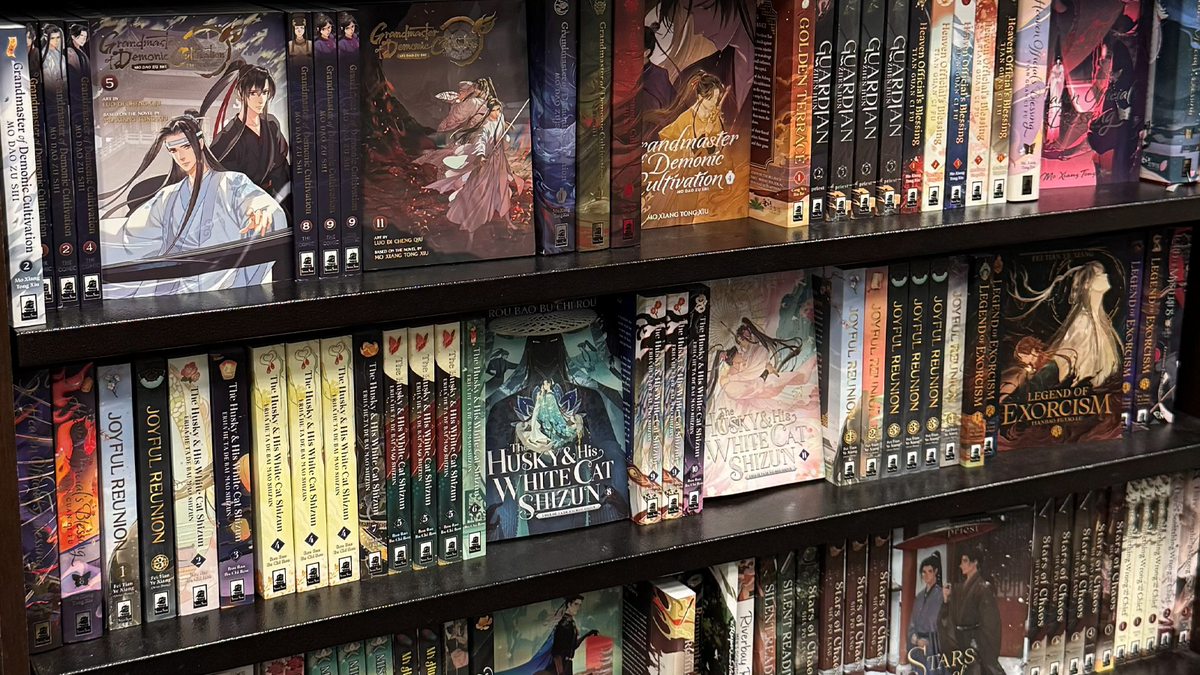
On January 2nd, 2022, the New York Times released a bestseller list that introduced a surprising mode of Chinese literature to mainstream U.S. readers. Alongside expected heavy-hitters like Colleen Hoover and Ali Hazelwood, a pair of newly released volumes appeared on the list: English translations of three works by the author Mo Xiang Tong Xiu, or MXTX, which had already amassed a large following in Asia.
Featuring sumptuous cover illustrations of two long-haired, beautiful Chinese men, the books showcased male/male romance in historically based fantasy settings. Their entry on the list was a huge moment for fans who had championed and popularized these books online for years before their official English publication. However, not everyone could openly celebrate this achievement: author MXTX had reportedly been arrested and imprisoned in China two years prior for distributing those same novels.
Danmei (耽美), which translates to “addicted to beauty,” is a category of Chinese male/male literature primarily published as webnovels and influenced by Japanese Boy’s Love fiction, or BL. (The term “BL” has since spread to encompass international M/M media, and often gets interchangeably used with “danmei” as well.) With roots in online forums in the late 1990s, danmei is increasingly accessible via online webnovel platforms and print publishers.
Yet while the medium faces government oppression at home, it also faces intense scrutiny abroad from, ironically, the one group that should be on its side: fandom. Official translators—who are working hard to bring their marginalized literature to a global audience, and who are typically members of danmei fandom themselves—often face disagreement and even vitriol from their own communities online.
The risk of criminalization that danmei authors face in China means that international fans often feel an extra level of investment in ensuring that work is accurately translated. But fans’ discussions can often devolve into unproductive bickering over linguistic interpretations. Hostile fan debates endanger companies’ ability to publish danmei, work against the translators’ intent of honoring the author’s original words, and erode progress made in the international space. Between the legal pressures in China and the fraught online discourse, the tensions are high for everyone involved—and danmei’s global expansion could be in real jeopardy as a result.
Danmei encompasses many genres, including contemporary drama, science fiction, wuxia (stories with martial arts and fantasy elements), and xianxia (Chinese high fantasy). Mainstream webnovel platforms typically only allow non-sexually explicit danmei, while erotic danmei, though popular, is usually harder to access. Unlike Japanese BL, which has been officially published in the United States since the early 2000s, it’s taken almost 20 years for the first danmei novel to be licensed and published in the U.S.
Danmei first caught fandom attention on U.S.-based social media sites in the mid-2010s. As it was rising in domestic popularity, international fans were sharing fan-translated danmei webnovels and illustrated manhua (Chinese comics and graphic novels), familiarizing themselves with common danmei tropes like spiritual cultivation.