Lanterns: The Last Manhunter
In episode 2, John has a surprising alien encounter while Hal continues his investigation in Rushville.

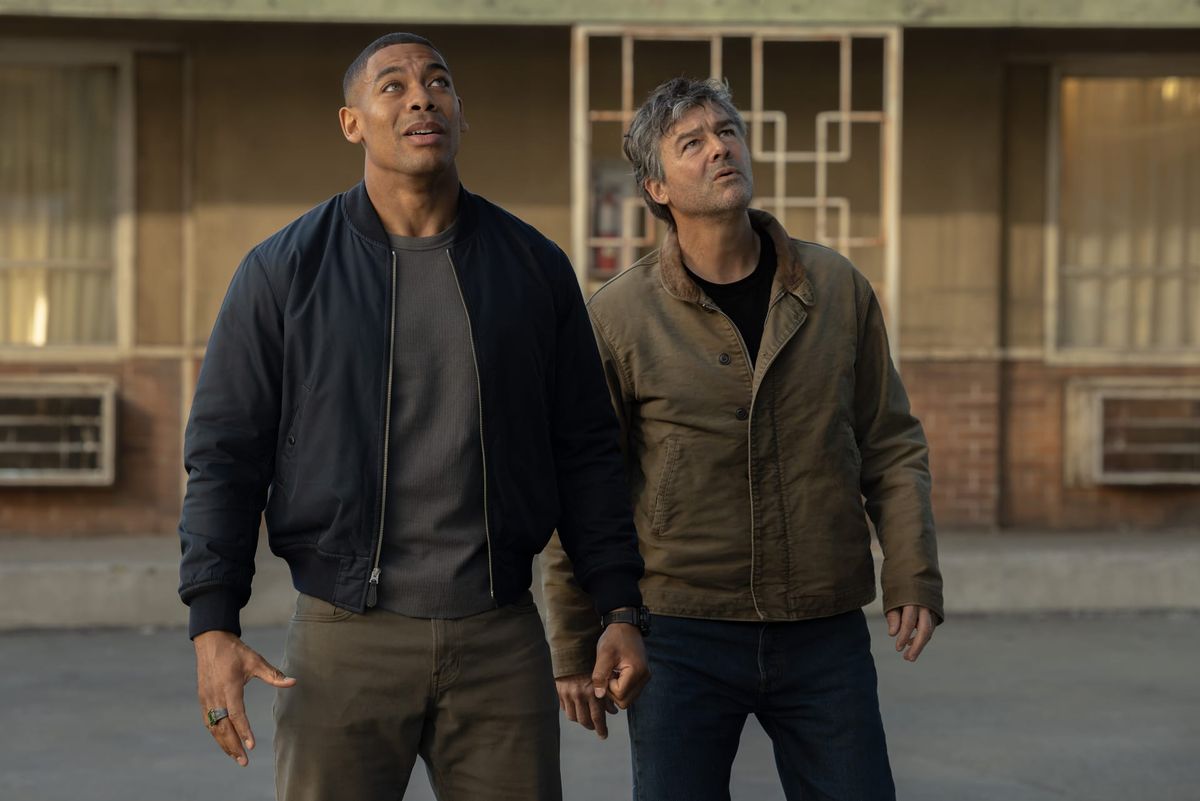
John Stewart’s next Green Lantern lesson—if you can even call it that—does not go well. Standing outside the motel where they slept overnight, Hal hands John his ring and tells him to fly. For Hal, a former pilot, this action is instinctual, but John can’t even get himself off the ground. Instead, he accidentally manifests a bird out of Green Lantern energy, embodying flight in a different way. John is understandably frustrated, but he’s also exhibiting an impressive command over the ring’s powers. Even after he returns the ring to Hal, the bird keeps flying around, which simply should not be possible.
What, exactly, does this mean? Hal has no idea, but he has other priorities, starting with the fact that his ring is running out of juice. It needs to be recharged every few days using a lantern-shaped battery, so Hal orders John to travel to Coast City and retrieve the lantern from his house. In a training exercise that Hal invents on the spot, he also tells John to keep the bird construct alive throughout his trip. Conveniently, this sidequest gets John out of the way so Hal can continue the investigation in Rushville alone, starting with a plan that involves stealing several fresh corpses from the morgue.
In Coast City, John discovers that Hal lives in a colossal, gleaming McMansion, almost entirely unfurnished. His bedroom resembles one of the more concerning images from r/malelivingspace, but when John phones Hal and asks him when he’s planning to properly move in, Hal reveals that he’s been living here for eight years. In all that time, he never bothered to install any furniture aside from a bed, a folding chair, and some photos of himself with dignitaries like the Pope. The house itself was a gift from a rich guy, thanking Hal for saving his son’s life. Green Lanterns don’t get paid much (if anything), and this empty mansion is another signal that without the ring, he’s got nothing. (We also have to wonder how John is supporting himself through what basically amounts to an indefinite unpaid internship. Maybe he has a military pension, but either way, he’s putting his life on hold for a job that may never materialize.)
Retrieving the lantern from a safe in Hal’s bedroom, John lingers by a wardrobe containing three identical Green Lantern uniforms—all, naturally, with the subdued color palette and generic body armor design you’d expect in a gritty adult superhero show. John peruses the uniforms with a reverent expression, holding one up in front of the mirror and asking Hal whether he should bring it back to Rushville. Hal says no, but John packs it anyway.
Back in episode 1, Hal claimed that he rarely wears the suit anymore because he’s already earned the public’s respect, implying that wearing a superhero costume all the time would be a bit of a try-hard move. But you may wonder if there’s something deeper going on here, with Hal making excuses to distance himself from the Green Lantern Corps and the heroic image of his 1990s heyday. It’s not quite as drastic as the contrast between the two eras of Matthew McConnaughey in True Detective (i.e., clean-cut detective vs. alcoholic burnout), but it certainly feels like another point of inspiration.
While John runs errands in Coast City (including feeding Hal’s carnivorous alien plant, Earl), Hal continues to scope out the situation in Rushville, where the locals have gathered for a town hall meeting to discuss the shooting. In characteristically disruptive style, Hal walks in halfway through and strikes up a conversation with his temporary lawyer, Billy Macon (William Macon’s son), who encourages him to leave town now that his bar fight charges have been dropped. Hal isn’t having it. In addition to the alien known as Waylon Sanders, the four victims in yesterday’s mass shooting were also aliens in human form, seemingly shot by members of William Macon’s militia. The question is, how did Macon’s men know who to aim for? “You don’t shoot people because of a gut feeling,” notes Hal.
His next stop is the crime scene. Rushville’s football field is surrounded by metal detectors, and a quick test proves to Hal that they don’t actually detect metal. Working on a hunch, he breaks into the morgue and steals the alien corpses, dragging them into his car and driving across town in a kind of morbid slapstick heist. And wouldn’t you know it: when he carries one through the detectors, it sets off a subtle alarm. In turn, this raises a whole host of new questions, most of which lead back to the town’s resident anti-alien fanatic, William Macon.
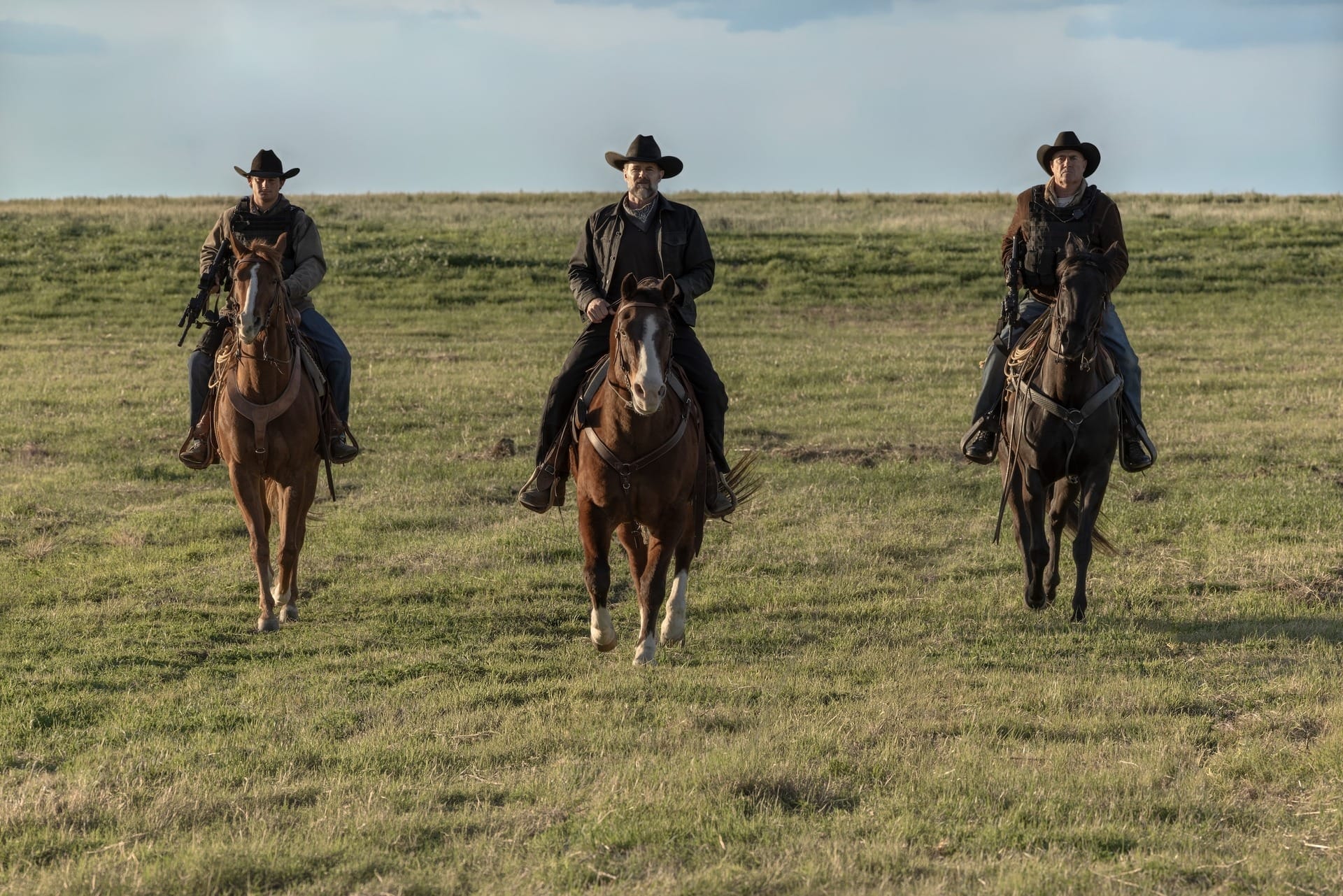
Not only is Macon paranoid enough to train a militia to protect his home—he’s also connected enough to get his hands on high-tech alien detectors. Unsurprisingly, Hal receives a chilly welcome when he returns to Macon’s compound to continue his investigation. A guard stops him at the gate, and when Hal tries to ask about the detectors, Macon just tells him they were a gift from his anonymous benefactor. He’s done with answering questions, promising that one of his guards will shoot Hal if he refuses to leave the property. Exhibiting a characteristic level of poor judgement, Hal calls his bluff and gets a bullet through the shoulder, landing him in hospital. (This show is a real gift to DC fans who love to hate Hal Jordan, whose defining personality trait is being an annoying jackass.)
Garret Dillahunt has had a prolific career, but he’s particularly known for Western roles. Similar to the way Kyle Chandler’s casting plays around with his legacy as Coach Taylor in Friday Night Lights, Dillahunt is playing to type as Macon, arriving on horseback to deliver speeches about his passion for border control. The show isn’t subtle in the way it connects him to the iconography of conservative American politics, but this scene emphasizes the fact that, like a lot of supposedly grassroots right-wing groups in real life, Macon’s actions are partially dictated by some unseen patron pulling the strings. His benefactor has access to technology that Hal identifies as being unusually advanced for Earth, making it doubly obvious that Macon’s cowboy persona is a facade for something more complicated.
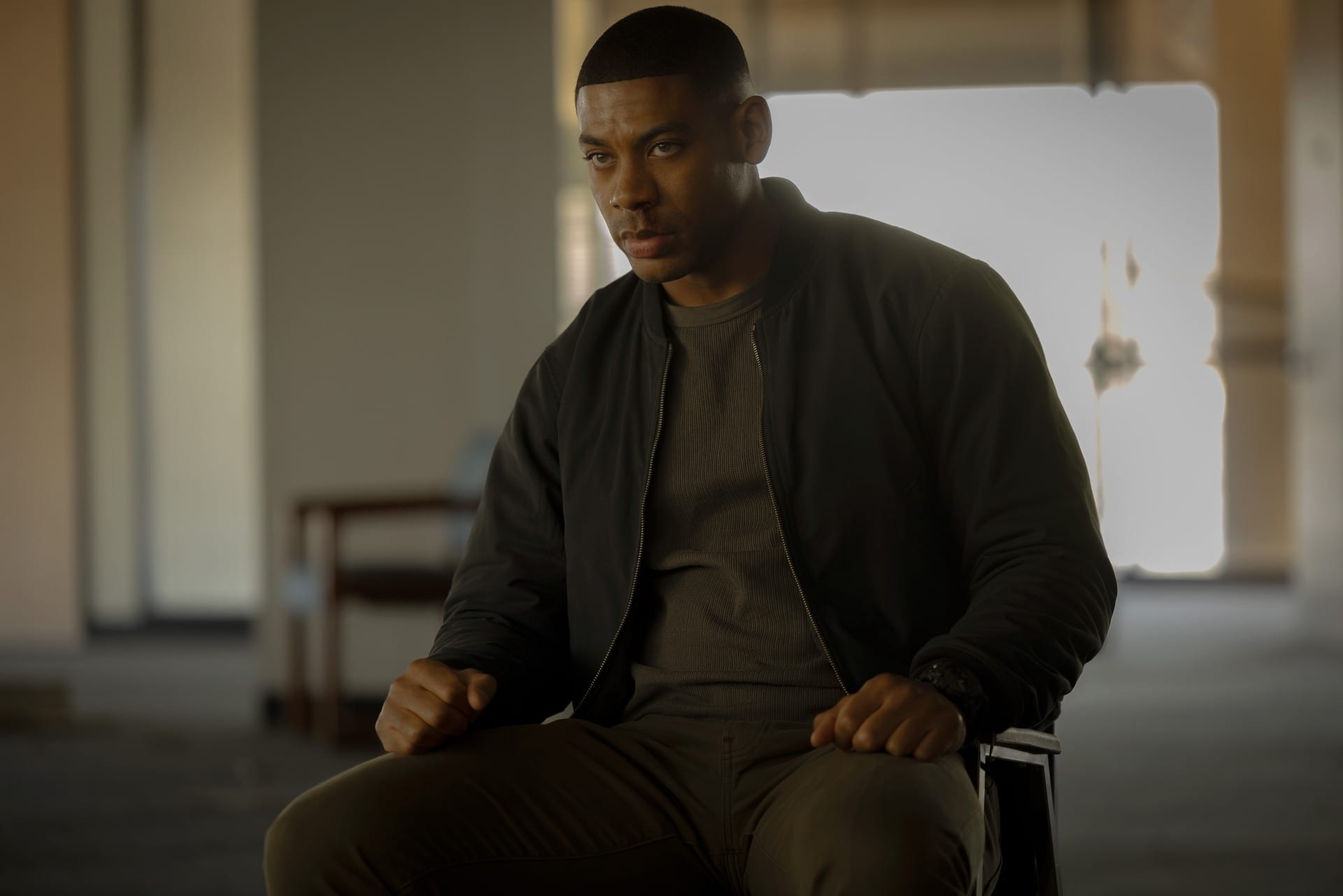
Meanwhile in Coast City, things are going just as poorly for John, who gets kidnapped on his way out of Hal’s house. Dragged into a van with a bag over his head, he ends up tied to a chair in an abandoned building, facing up to a tough-looking guy named Antaan: another alien who, like Waylon Sanders, can disguise himself as a human. Even after getting knocked unconscious, John’s bird construct is still flitting around overhead, an achievement that Antaan labels “wildly impressive,” believing at first that Hal is somehow controlling it from hundreds of miles away. When he learns that John is manifesting it without even holding the ring, he’s shocked.
Given the circumstances, John assumes that he’s about to be tortured for information, but it turns out that Antaan actually wants to tell him something. Specifically, he wants to talk about Manhunters—and he’s surprised to learn John has never even heard the term before. In a bitter tone, John informs his kidnappers that they’ve overestimated the closeness of his relationship with Hal, who has taught him virtually nothing about galactic politics.
Not to be confused with DC’s Martian Manhunter, who’s a member of the Justice League, the Manhunters are a long-running element of Green Lantern comics lore. Created by the Guardians, they’re a synthetic race of robot cops who Turned Evil and were replaced by the Lanterns.
Antaan describes Manhunters as the most dangerous beings in existence: brutal, deceptive, and able to infiltrate any society and sabotage it from within. Appearing without warning, they’ve destroyed entire civilizations in the name of “justice,” including Antaan’s homeworld. “Have you ever been deceived by someone you loved?” he asks John. So this is personal. The rest of the Manhunters have long since been wiped out, but one last survivor is hiding out on Earth: the Manhunter who betrayed Antaan and committed genocide on his home planet. That individual is now in Rushville, and Antaan’s team will stop at nothing to find them.
This means William Macon was correct in his theory that the men at yesterday’s football game were an alien advance team. However, we now know that their mission had nothing to do with Macon’s apocalyptic fantasies of colonial invasion. In reality, they were there to locate and kill the Manhunter, with little interest in the humans nearby—or indeed in conquering Earth, which Hal has already described as “a shithole planet” of no importance to the galaxy at large. Hence why it would be a good hiding place for an alien war criminal, in fact.
Unable to circumvent Macon’s alien detectors, Antaan offers John two options. Either he helps them to identify Rushville’s secret Manhunter…or in 48 hours, Antaan’s team will blow up the town. To make sure John stays on side, they use a device that looks like a nail gun to “imprint” his mind with memories of their planet’s destruction, giving John some personal motivation. Antaan also tells him to keep the whole thing secret from Hal, a tall order given John’s loyalty to the chain of command.
In last week’s recap, I mentioned that it felt like a bit of a throwback (or perhaps even a copout) to make a superhero show with such a low volume of superhero stuff onscreen. The focus on humanoid aliens feels like a similar phenomenon. Traditionally, human-looking aliens have been a strategic way to get around budgetary issues for makeup and VFX, and to allay concerns about looking “too sci-fi” for mainstream audiences.
Lanterns probably isn’t hurting for money (some of which went toward digitally removing California mountains from the background of their shooting locations), but while the Green Lantern comics are full of weird and wonderful sci-fi imagery, this adaptation is going the Battlestar Galactica route of making everyone look human—and tying that choice into the plot, creating a whodunnit scenario around the identity of the Manhunter. (Who, by this point, we can strongly infer is also Macon’s benefactor, an anonymous figure with untold wealth and access to advanced technology, who is directly encouraging Macon to keep aliens out of town.)
In Battlestar Galactica, the threat of undercover cylons fueled some fantastic paranoid psychodrama, but Lanterns will face an uphill battle to create that level of mystery or tension. From a practical standpoint, this show has less to work with. The season is only eight episodes long, and its supporting cast is limited, leaving us with a short list of characters who would be dramatically meaningful to reveal as the Manhunter. A more interesting question is, perhaps, whether Antaan is even telling the truth. Watching this kidnap sequence, I immediately started wondering if this Manhunter deserves to be hunted at all.
When Hal wakes up in hospital with his new bullet wound, Kerry is sitting by his bedside—not necessarily a cozy scene, because she’s primarily here to keep an eye on a troublemaker. Her first question isn’t about his recent brush with Macon, however. Apparently Hal has been talking about someone named Sinestro in his sleep, provoking Kerry’s curiosity.
Adapting a key character in the comics, Sinestro is a former Green Lantern who attempted a coup, killed a Guardian, and was ultimately taken down by Hal. Hal tells Kerry that he isn’t authorized to say anything further, but this appears to be an obfuscation. His connection to Sinestro is clearly public knowledge, because Kerry reads this information aloud from her phone. Hal would just prefer not to talk about it.
This hospital scene reveals some new factors in Hal’s investigation, beginning with Kerry confirming that she knew about Macon’s alien detectors all along. She didn’t mention them yesterday because she assumed that they’d already identified all the aliens in town. Describing Rushville as a powderkeg in the aftermath of the shooting, she shares her husband Billy’s belief that it would be better for everyone if Hal just left Rushville as soon as possible. Suspicious, to say the least!
On their way out of the hospital, we’re left with another puzzling question about Rushville itself, as Hal realizes that he’s the only patient in the building. There are no other names on the signout sheet, and the rooms are full of unused medical equipment. Kerry dismisses this by joking that most people aren’t stupid enough to get shot like Hal, but that’s not actually how healthcare works, and Hal is entirely right to feel suspicious.
Set free by his kidnappers, an exhausted John arrives back in Rushville later that night and heads straight to the diner. In what may or may not be another coincidence, he happens to bump into Zoe.
Awkwardly, he tells her that he wouldn’t have hooked up with her if he’d known that she was married, asking if she’s “into that kind of thing,” i.e., having an “unconventional marriage.” More than anything, Zoe seems amused, saying that she loves her husband, but sometimes she needs a break. Offering a peculiarly analytical and clear-eyed view of their relationship, she notes that white men like William Macon have the privilege to be eccentric. She enjoys the security of being married to a wealthy, powerful man, but she’s aware that she and William face different societal expectations. She then changes the subject to ask after Hal, echoing their first meeting at the bar, where her brand of small talk sounded suspiciously like information gathering in disguise.
I confess that I’m a little puzzled by how Zoe and John’s relationship has played out thus far. Lanterns is not a difficult show to understand in general, but its creative team don’t have a particularly good handle on how to depict the sexual and/or romantic tension (or lack thereof) between these two characters. Most viewers will surely have some suspicions about Zoe’s motives by now, thanks to her connection to Macon and the confident way she controls her interactions with John. Yet John doesn’t seem overly suspicious of her, which feels out-of-character for his otherwise observant nature—especially in a moment where his guard should be up around any Rushville resident.
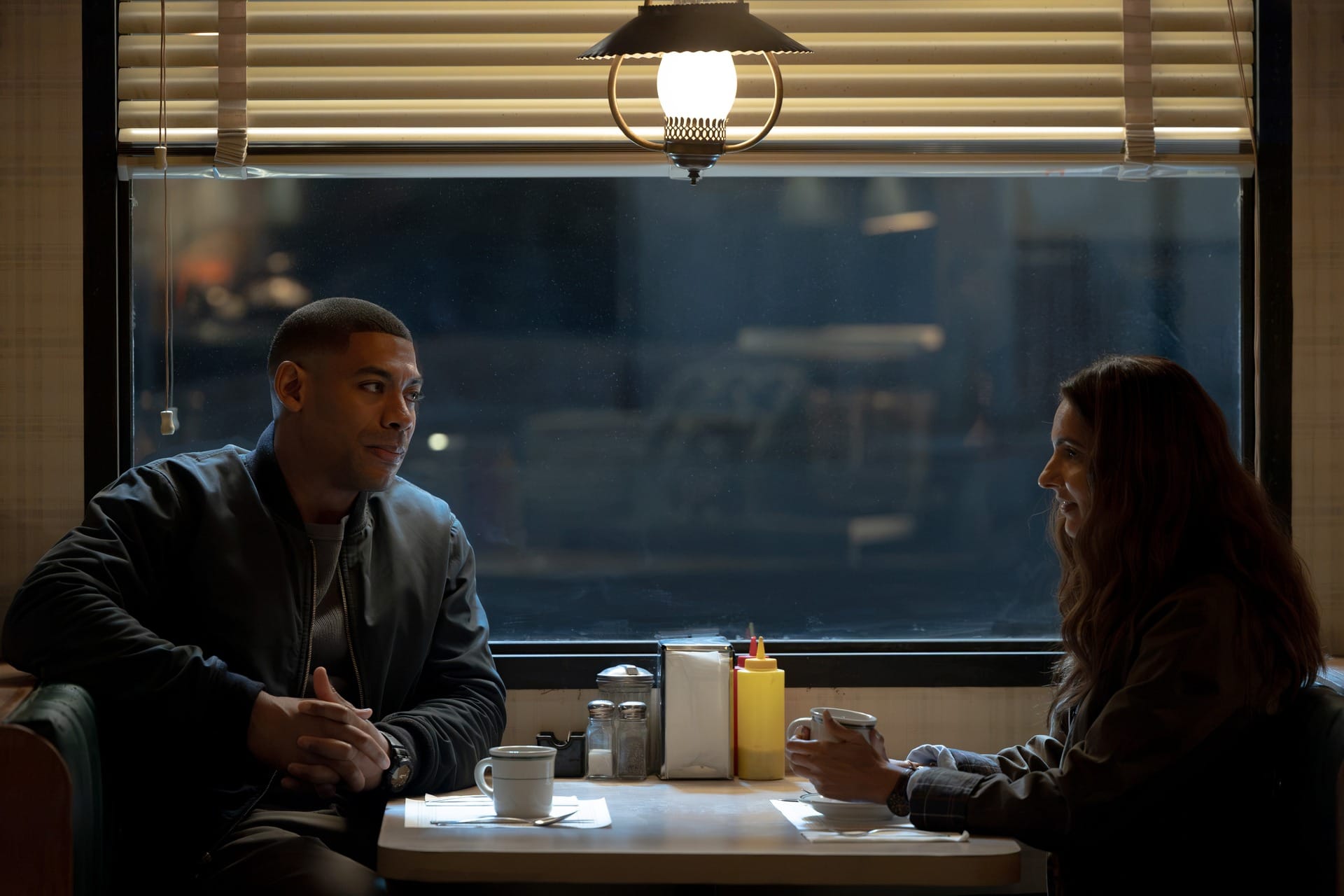
This would all make a lot more sense if there was palpable sexual tension involved, but that isn’t really the case. The first episode’s sex scene was a brief, fully-clothed encounter in a truck, and basically just felt like two strangers blowing off steam. And while it’s refreshing for a superhero show to pair its hunky protagonist with a woman twenty years his senior (Poorna Jagannathan is 53 to Aaron Pierre’s 32), the direction and acting choices don’t convince me that these people are all that attracted to each other. Yes, there’s a bit of a flirty vibe here, and Aaron Pierre plays up the cute and bashful side of John’s responses. But when he talks about feeling like he “sees” Zoe and understands her motives, I just wish we had another scene to two to actually witness that connection onscreen.
During this episode’s conversation, Zoe subtly encourages John to see her as a peer: two people of color attached to powerful, exasperating white men. In episode 1, she even joked that the Green Lantern ring was a wedding band, comparing John and Hal to a dysfunctional couple. Yet when John concludes this encounter by confiding that he isn’t sure if he can trust Hal, that moment of vulnerability doesn’t entirely ring true. Consider all the surrounding context: the alien murders, the secret Manhunter, Macon’s militia, the fact that Zoe lied about having a husband. After knowing her for less than two days, why would he open up to her? Especially given the way John confided in his father during episode 1, confirming that he already has a support system in place.
Coming full circle from the episode’s opening scene, John and Hal reunite in the motel parking lot, where John hands over the lantern and Hal uses it to recharge his ring. John’s bird is still flying around, and like Antaan, Hal is startled by John’s ability to keep it alive so long—although much to John’s annoyance, Hal refuses to give him any kind of praise. Reluctant to admit that John may have a natural talent with the ring, Hal asks whether birds have some special subconscious significance to him. But John says the bird is just a bird, and vanishes it with a brush of his hand.
Incredibly, Hal still hasn’t managed to completely alienate John as his mentee. Despite voicing his doubts to Zoe in the previous scene, John tells Hal all about Antaan and the kidnapping, and about his deadline to locate Rushville’s hidden Manhunter within 48 hours. As usual, though, Hal stonewalls him, failing to offer a similar sign of trust.
Once John goes to bed, Hal dons the Green Lantern uniform that John helpfully retrieved from Coast City, and jets off into space, flying to an alien prison planet. There he meets Sinestro, who, like all good supervillains, is locked up in solitary confinement. Hal’s here to ask him about Manhunters, a choice that feels telling in itself. Why ask this guy instead of another Green Lantern, or one of the Guardians? This is who Hal chooses to trust?
“If one [Manhunter] still existed, it’d be the second-greatest threat you’re currently facing,” says Sinestro. “So why don’t you tell me about John Stewart?”
There’s no good reason why Sinestro should even know who John is, and the fact that he frames John as a threat is a worrying sign. Sinestro understands Hal’s fear of losing the ring, highlighting Hal’s warped priorities by describing John and the Manhunter as two equally dangerous enemies. We have to assume that this isn’t the first time Hal has visited Sinestro for advice, adding another link to the show’s chain of unhealthy paternal/mentor relationships.
This scene marks our first foray into a more conventional sci-fi setting, reminding us that we’re still in the same universe as James Gunn’s Superman. In the same way that the MCU’s TV and movie projects pivot between small-scale storylines and big crossover events, Lanterns echoes the kind of standalone DC/Marvel comic that focuses more on character development than action.
Is that vision actually working? At present, Lanterns feels like neither fish nor fowl: not as sophisticated as a prestige drama like True Detective, yet less interested in superhero imagery than most comic-book adaptations. Now the first act has wrapped up, what we really need next is a deeper look at what makes the two lead characters tick, with this episode dropping some troubling hints about Hal’s priorities.