What Spider-Man Can’t Save

In which our hero contemplates a career writing about superheroes and pop culture—and imagines an ending.

Share
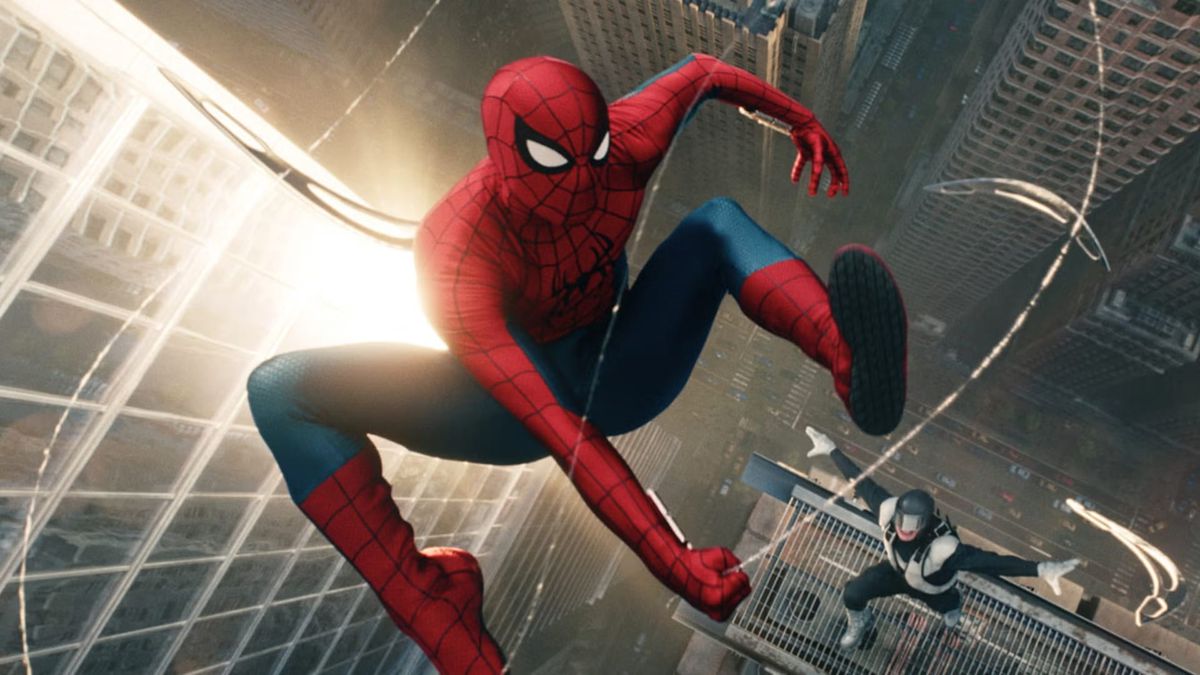
Against a bright back light, Spider-Man swings a web in mid-air high above a cityscape. Another uniformed character in a helmet stands on a platform below him in the background.
Spider-Man swings into a new future in the upcoming film from Marvel—but can we follow him there? Image courtesy of Marvel Studios.
“These people stole your future. These people robbed you of your destiny. The question is…do you want it back?”

—Ultimate Spider-Man
(2024) #1, Jonathan Hickman and Marco Chechetto

Superhero comic books don’t have endings. They can’t—they’re meant to extend indefinitely from their point of origin, as the writers and artists who carry them come and go. Sometimes, however, they pretend to, because endings give a story meaning, especially in a genre that is constantly producing beginnings: New first issues, jumping-on points, primers, adaptations. Everyone wants you on the ride, and no one wants to tell you to get off. Endings, however, give a story meaning. I’m going to pretend: this is the last time I write about Spider-Man. So you should probably know about the first time. 

Call it an origin story: I was out of work and filing for unemployment and bored out of my mind, and I had some opinions about Spider-Man. This is the sort of hubris it takes to be someone who writes on the internet for a living. It’s not that different from the kind that Steve Ditko and Stan Lee might have had when they imagined a kid who put on tights and swung from buildings. It’s why I’ve always related to Peter Parker a little bit. It’s why I still do, even though, as I suggested, I’m trying to put a stop to that. 

See, this is the first of many great things about the character. He calls himself Spider-Man, even though, famously, Peter Parker is a teenager. He gives himself a name that is also an aspirational lie, the way someone (not me) who writes for a living might try on a more specific title, like “essayist” or “critic.” Of course, if you are stubborn enough and persist, eventually the rest of the world will call you what you call yourself, which means that becomes who you are, whether or not you feel you’ve earned the identity or not. 

None of this was on my mind when I banged out roughly a thousand words at the kitchen table about Why Spider-Man Comics Suck Right Now. I could not tell you what possessed anyone to read it, but a lot of people did, including one editor who would find it a full year later, and eventually hire me to write opinions about basically all of pop culture. It’s kind of stupid, really. A spider may as well have bitten me.

Lately, I’ve been thinking about quitting what I started with that piece. Walking away from culture writing, seeing what kind of person I might be without it. (You know, like in Amazing Spider-Man #50, homaged in Spider-Man 2.) It was never just about Spider-Man, Spider-Man was just where I figured it out: stories meant the world to me. They helped me articulate what I believed, and learn what others believed. They were how I would wrestle with the world, try to get to the truth of it. Stories just don’t feel like enough right now. 

“He believed that if there were things in this world that you had to offer, things that you did well—better than anyone else…well, he believed that it wasn't just a good idea to do those things…he believed it was your responsibility.”

Ultimate Spider-Man (2000) #4, Brian Michael Bendis, Bill Jemas, Mark Bagley

When you take a step back, the mantra “with great power, there must also come great responsibility” is a weird one to deliver to children, a demographic with zero power and few responsibilities. It is genuinely odd that I can hardly think of a time where I didn’t know those words, and more or less always understood what they meant. Perhaps that’s a testament to how raw and perfectly composed the Spider-Man origin story is. Overexposure has diluted the impact, but it’s still horribly tragic, especially if you are new to tragedy. Peter Parker becomes powerful enough to finally be the kind of entitled jerk he previously suffered under for one night, and that single act of selfishness costs him one of the people he loves most in the world. 

I’m not sure why that immediately resonated with me as a kid, but I never forgot it. The idea that any power must be wielded responsibly seemed obvious, and became a source of great disquiet within me as I grew and learned how few seemed to bother. In church sanctuaries, in workplaces, in the news, I saw people reckless with authority, careless with their mandates, abusive to their charges. 

And so the mantra became a creed of defiance: whatever status or respect or platform I gained, I would do everything I could to do right by the people who did not have what I did, who could not say what I could. Even with something as frivolous as covering entertainment, people deserved the best from me. The second I take this for granted, the moment I am selfish and think I am owed something—well, that’s when I stop helping to make things better, and start helping make them worse. 

A man in a bathrobe with tousled hair heads into a laundry room. In the foreground, a red Spider-Man costume lies limply atop a pile of laundry.
An adult Peter Parker walks away from the uniform. (Variant cover for Ultimate Spider-Man #3, art by Mike Del Mundo.) Image courtesy of Marvel.

Believing this demands that I constantly ask myself if I am doing the right thing, writing about superheroes, trying to find meaning in some of the most corporate of corporate art. 

Being a fan of superhero stories as an adult with a modicum of self-awareness means constantly juggling their rich history of exploitation with whatever deeply held feelings they inspire in you. Because there is a romance to superheroes: they turn tragedy into inspiration, imbue symbols with meaning, articulate their morals, deny themselves. Ingrained in their origins—their actual origins, sprung from the minds of immigrants and hucksters and cigar-chomping blue-collar draftsmen—is the ethos of strivers, oddballs, and idealists. While it sounds preposterous to say after nearly 20 years of the MCU, these comics were outsider art, in that they were made by those shunned by the establishment, and most—with the notable (and ultimately tragic) exception of Stan Lee—never got to share the fruits of their ascendance.

I place myself in that lineage. Those scrappy, stubborn outsiders, banging at typewriters and scribbling in notebooks, who wouldn't let themselves be shut out, who would scrawl their stories on the backs of cereal boxes if that meant they got them out there. I identify with those who love the stuff that's eschewed by the masses, misunderstood or looked down upon, because running my mouth about frivolous four-color characters got people to notice me. And it turned out I had a lot more to say. 


“Spider-Man is…he’s a good guy. Mostly. He tries to do the right thing, and—you know—hopefully people see that. But he’s also—he's human. He makes mistakes. He…he can’t save everyone.” 

Peter Parker: The Spectacular Spider-Man (2017)  #310, Chip Zdarsky 

There’s a new Spider-Man movie out this week, and I don't know if I can do this sort of thing anymore. I mean, I can—in the trailers, I spot dozens of references, recreations of comic-book covers, a few fun B-list villains, some hints about the wider Marvel Cinematic Universe. Everyone thinks Jean Grey of the X-Men is in this one. Weird choice. 

I spent a considerable portion of my career making sense of this stuff, explaining things to the uninitiated so that they didn’t feel left out, and knew all they felt they had to know. But I’ve always believed none of that was necessary. There is no beginning to superhero comics—and there is no end. You find them one day and learn that there is a world in progress, colorful, thrilling, and strange. You stay for weeks, months, years. And one day you just stop. The story doesn’t end, but your time in it does. And then you’re left to sort out what it meant to you; if you got something from it, or if it was a waste of time.

These days I’m tempted to think that so far, it’s been the latter. It’s unmooring to spend any energy interested in stories about a character who is committed to this central mission of power and responsibility in a world where no one really seems to believe that anymore. Politics in the United States have been overrun by people who call empathy a sin, who believe power is there to be abused, who abhor responsibility, and do not seem to think blowback is real. The world has coarsened, and I’m not sure that stories that presume we care about one another carry the same weight anymore. We are in a world run by people who see nothing wrong with Peter Parker’s indifference.

There are no shortages of horrors on offer, but one in particular lands as terribly symbolic: the demolition of the United States Agency for International Development (USAID). The glee with which it was done by the world’s richest man, his perverse pleasure literalized with a gilded chainsaw swung around onstage in front of a crowd of cheering sycophants. It was garish comic-book villainy in the flesh: Elon Musk thrilling at the prospect of pulping a government agency with a humanitarian mission, his successes quantifiable in plague and death. A villain in the purest sense, enabled by a government indifferent to the idea of responsibility, of owing anything to the world—and too stupid to consider USAID wasn’t an inherently altruistic effort, but a self-interested one, too, predicated on the notion that fostering goodwill abroad was as useful, and sometimes more effective, than broadcasting military might. 

Evil isn’t shy these days, and arguing for goodness via fiction feels terribly indirect. The metaphors of comic books and fantasy heroes and fiction interested in appealing to our common humanity are becoming uncoupled from our lived reality, where we cannot take it as a given that those around us believe in virtue, in public good, in owing each other the best of ourselves. It is too hard to convince some of our fellow citizens to care about their neighbors, killed on camera, right outside their homes. 


“And a lean, silent figure slowly fades into the gathering darkness, aware at last that in this world, with great power there must also come—great responsibility!”

Amazing Fantasy (1962)  #15, Stan Lee & Steve Ditko

Into this world arrived Jonathan Hickman and Marco Chechetto’s Ultimate Spider-Man. In this version of the story, Peter Parker gets his powers in his mid-30s after an evil genius travels through time and makes it so the accident that would have turned Peter into Spider-Man never happens. He’s lived a normal life, married to Mary Jane with two kids and the sense that something is missing, wrong. Then he gets a message that tells him he’s right. That he was meant to have another life entirely, and that life was taken from him. The message comes with a costume and a spider—doesn’t Peter want to seize what was missing? 

It is a version of the story set in a world gone wrong, where all superheroes—not just Spider-Man—were denied their destiny, where robber barons dismantled democracy and carved up the world to suit them. Hickman and Chechetto are very much commenting on our world, but they also built a new Peter Parker for the people who grew up loving Peter but know they won’t stay young forever, know that they must keep moving lest they fall out of step with the world. It’s a good last Spider-Man story: Spider-Man fighting for his existence in a world where he doesn’t make much sense. Where everyone is out for themselves by default, or subdued by the fear of an oppressive state, keeping their heads down, not wanting to make waves. 

This is familiar to me. There is a nihilism that infects discussion of current events, the steady march of cruel, well-funded people determined to take more and more, to attack and dispossess an increasingly diverse group of targets. Evil people seem to have all the agency in the world, and everyone else seems to have none. I refuse to believe that. I guess I blame that on Spider-Man comics. 

Spider-Man, tucked into a crouch in mid-air, leaps off to the right of the composition against a bright pink-and-orange sunset cityscape.
Spider-Man swings into a different world. Fanart by pkblitz/deviantART.

The words take a different tenor when spoken between adults. This time around, it’s Harry Osborn saying them to Peter. He’s been leading a one-man insurgency of his own, and while Peter has begun his work as Spider-Man, he’s still not fully committed. 

“These people, they’re playing god, and they’re playing for keeps,” Harry tells Peter. “And worse than that, they've been doing it our whole lives. It’s institutional. It’s systemic. It’s the whole damn world. And you have great power, Peter…and with great power comes great responsibility. It’s such a gift…but only if you use it.”

I don't think we repeat stories solely to comfort ourselves. The corporate exploitation of intellectual property has worked to make comfort a primary goal, to commodify nostalgia and make it a thing we yearn for. To associate our childhood memories with products and characters that are owned by companies, to create a sort of museum in your mind, a place you can go to associate warm feelings of youth with superheroes or Disney princesses. Something you can retreat to, instead of moving forward. 

But we can move forward with stories. That’s why we tell them to children, because it’s the only way we have to communicate that we have a history, that humanity has faced these challenges before, that there are lessons hard-won and truths painfully learned. That we are a part of something greater, regardless of whether we choose to see it or not. That’s why we repeat them: to reinforce ourselves and each other. Remind the world of what we believe. 

Superhero stories don’t end, but our time with them can. It usually isn’t dramatic, like a breakup. You just stop one day, maybe because you got what you needed, or maybe because you found it somewhere else. Life is like that; we rarely get to decide when or how a thing ends. It’s what makes fiction resonate, why we find meaning in stories: they get to end. 

The strangeness of superhero comics and their perpetual second act is out of step with this, which makes their enduring appeal unique. It is also part of why it is so tempting to dismiss them as meaningless. Why I struggle with continuing to spill words over them, and question if I am using my gifts, my opportunities, responsibly. 

So I will pretend this is an end, to give this story closure, a shape I can hold onto and carry forward. If this is the last time I write about Spider-Man, you should know what it meant to me, and that it is different from what it did as a child: This power, this responsibility? It’s something I need to embrace until the wheels come off. To continue to find meaning everywhere I can, to encourage others to not let callous times turn us into callous people. To add my voice to the chorus. 

They took something from me, from us. I want it back.