The Queer-Normative World of Killing Eve
In a new book, Clare Sears talks to Killing Eve creator Phoebe Waller-Bridge about gender, kink, and queer relationships.

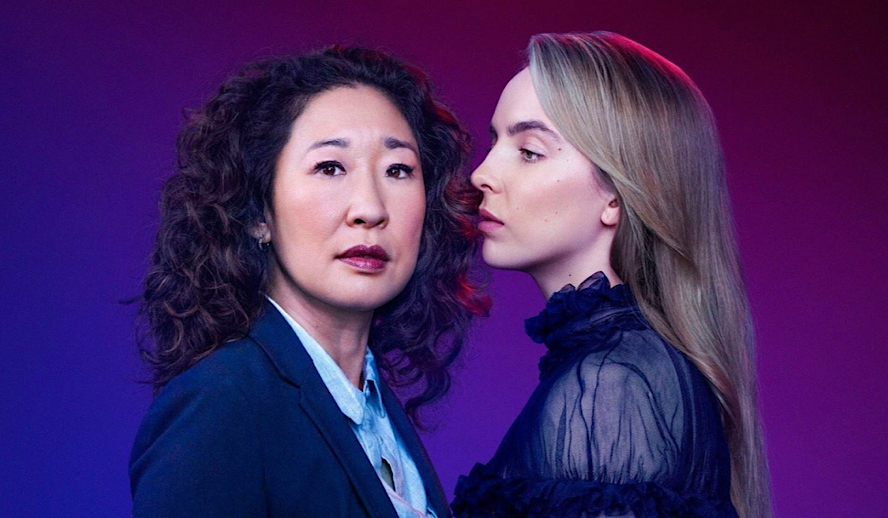
Killing Eve is set in a fundamentally queer universe where same-gender desires are ubiquitous. Villanelle is the central queer character, regularly engaging in hookups, flirtations, and threesomes with women. Her sexual history also includes long-term relationships, most notably with a prison girlfriend (Nadia) and a teacher during her adolescence (Anna). She even has a wife (Maria), although the marriage ends abruptly when their wedding reception devolves into a chaotic brawl. Villanelle has sex with a man (Sebastian) early in season 1, after Konstantin encourages her to do something “normal,” but her subsequent sex life centers on women, and her fantasies home in on Eve.
Killing Eve also features a wide array of supporting queer characters. These include Eve’s friend Bill; several assassins (Felix, Gunn, Nadia); high-ranking officials within the Twelve and MI6 (Hélène, Paul); a vicar’s daughter (May); and multiple partners, flings, and exes (Anna, Pamela, Maria, Fernanda). Same-gender desires are also referenced in conversation, including those that verge on taboo. Carolyn, for instance, explains to Eve why her father used to frequent the bathing ponds of a London park: “Very popular in the fifties with spies. Ideal place for a sensitive conversation. And to have sex with boys, of course, which would have been an added bonus for Daddy” (“Do You Know How to Dispose of a Body?” 2.1). Unlike previous shows that required queer characters to assimilate into a heteronormative world, Killing Eve flips the script by rewriting the world as deeply queer.
Despite centering a wide range of same-gender desires and relationships, Killing Eve has little interest in sexual identity. An early exchange sets the tone, when Eve learns that Bill—a man in his sixties, married to a woman—has had extensive sexual experiences with men. When Eve asks if he is gay, Bill casually shrugs. “I just fall in love with whoever I fall in love with,” he replies (“Don’t I Know You?” 1.3). Bill’s disinterest in sexual identity, combined with his ease in describing sex with “hundreds” of men and his familiarity with queer culture, points toward a distinctive approach to queer representation that guides the series as a whole.
Bracketing questions of identity, Killing Eve dives deep into the complexity of desire, specifically between Eve and Villanelle. As [Phoebe] Waller-Bridge explained to me:
I didn’t want either woman to be ashamed of her desire. Confused, intrigued, frightened of it absolutely but I was so much more excited by the complexity of their attraction than the identity of it. Eve’s pull towards Villanelle was a surprise to her and totally intoxicating. She both worshipped and reviled this exquisite murderer. Villanelle is beautiful, of course, but she is also living an outrageous life, rejecting the inexplicably guilt-ridden, apologetic version of modern female existence that Eve had adopted. She broke all the rules and Eve wanted to be near that.
By putting aside the shame/pride binary that often organizes media narratives of same-gender attraction, Killing Eve stages desire in its full, messy complexity, laced with contradictory emotions: intrigue, fear, confusion, surprise. Eve’s attraction to a literal murderer also makes room for desire to be conflicted and ambivalent, without the shadow of homophobia. In this way, the series’ fun and fantastical premise enables its deeper theme: the life-changing force of complex, illogical, embodied desire.
Killing Eve also explores same-gender desire in unusually expansive ways. As Waller-Bridge indicated, Eve’s attraction is not only driven by Villanelle’s beauty, but by the freedom she represents. This approach does not deny Eve’s erotic pull but stretches the idea of the erotic itself. Waller-Bridge elaborated when describing Villanelle’s attraction to Eve:
For Villanelle, aside from the overt physical attraction she had for Eve, she was also basking in Eve’s attention. She loved being hunted, could feel she was being obsessed over and she liked it. Villanelle’s job required her to go unnoticed, which was painful for a woman who considered herself so extraordinary. Suddenly someone was fixated on her, studying her, acknowledging her skill, trying to catch her . . . which is very sexy to her. I think desire, when really explored, is often so much more to do with the self than the object. I got to really explore that with these two.
Killing Eve’s expansive exploration of women’s same-gender desires is rare on television, where those desires are often reduced to indicators of identity or subsumed within conventional romantic arcs. Without those familiar organizing forces, Killing Eve opens space for new formulations: desire entangled with impulse and fantasy; desire exceeding logic and reason; desire that hits like a ton of bricks.
Killing Eve does more than center longing, however. It also foregrounds kink dynamics that are stunning to see on mainstream television. In recent years, kink has become the preferred term for a wide range of non-normative sexual practices, including sadism, masochism, dominance, submission, exhibitionism, voyeurism, fetishism, and more. Within Killing Eve, these dynamics not only drive Eve and Villanelle’s relationship but permeate the series’ fictional world. Throughout the show, characters talk about BDSM practices, cultures, and venues as unremarkable parts of their sex lives, while jokes about “safe words” straddle the worlds of kink and MI6 surveillance. Woodward Gentle explained to me how kink assumed its central role: “A lot of it came from Phoebe’s lead that was picked up by Emerald. We had a room full of women that just naturally lent into it. There’s a conversation in Germany before Bill dies about kink and how you just happen to love who you love. That was just the world of Killing Eve.” Like its approach to same-gender attractions, Killing Eve normalizes kink by adapting the world to conform to its characters, rather than the other way around.
Killing Eve’s depictions of kink also break from thriller conventions that often rely on sadism, bondage, and voyeurism to “spice up” scenes of sexual violence. As Woodward Gentle explained, she aimed to avoid the genre cliché where psychopathic killers, typically men, derive sexual pleasure from murdering women:
I was fed up with seeing labeled psychopathic killers getting a huge sexual hit from killing. I think it’s a cheap trick within television. With Villanelle, it was more like, “I can do this and I’m really good at it, and it’s gonna give me whatever hit I want.” Quite often television does that to bring in an audience and I didn’t want this to be a show for men to get off on. I think it’s much more interesting to explore sex and kinks separately from killing. What’s really interesting is the sexual charge that goes on in the gaps.
To support this fresh approach, Killing Eve emphasizes sexual consent from the outset. The pilot introduces the framework when Villanelle tells a mafia boss who tries to fondle her, “You really should ask before you touch a person,” before jamming a hairpin into his eye (“Nice Face,” 1.1). The juxtaposition of Villanelle’s lesson on consent and her lethal violence is disorienting and comedic, yet it also reveals the show’s sexual politics: Within this fictional universe, sexual violence will not be indulged. This not only challenges the routinization of sexual violence on television. It also clears the ground for kink to play a far more interesting narrative role.
The series introduces its approach to kink early in season 1, when Villanelle kills a man at a Berlin fetish clinic (“Don’t I Know You?” 1.3). Initially, the episode treads familiar ground, linking the psychopathic killer to sexual deviance, as Villanelle straps the man to a gurney, clamps his testicles, and gasses him to death. When Eve and Bill arrive to investigate, however, the episode takes a startling turn. Until that point, Bill has appeared in the series as a presumptively heterosexual man. Once in Berlin, however, his personal experiences with queer kink practices come into view, as he flirts with an old male friend, reminisces about wild nights at the Glitter Morgue nightclub, and lectures a Chinese official about the pleasures and etiquette of consensual spanking. Shocked and slightly titillated, Eve asks Bill how he knows about “that kink stuff,” only for Bill to smile and reply that he had previously lived in Berlin for eight years and “said yes to everything for five.” The episode plays a pivotal role within the series, as Villanelle murders Bill in the final minutes, setting in motion her mutually obsessive dynamic with Eve. Bill’s role in the series, however, does more than catapult the women together. It also offers a lens through which to view their collision: one of kinky queer desire.
Throughout Killing Eve, Eve and Villanelle’s relationship is infused with perverse impulses and interactions that upend television norms. Although the women don’t share a romantic kiss until the series’ finale, they take clear and consistent sexual pleasure in one another, through voyeurism and exhibitionism, shared masturbation, sex with substitutes, power play, and the sadomasochist pleasures of causing and receiving pain. Villanelle, for example, communicates her interest in Eve through love notes that she leaves at crime scenes, and gifts laden with sex and violence: decadent clothing to apologize for murder, lipstick concealing a hidden blade, and flowers arranged to spell “Eve” in the style of a funeral bouquet. Villanelle also watches Eve from a distance, and fantasizes about her during sex, even dressing another woman in Eve’s clothing and calling her by Eve’s name. Waller-Bridge explained to me the appeal of integrating kink into Killing Eve:
Kink has so much to do with self-acceptance and trust. To know what you like and to be able to ask for it is so far from what Eve can articulate for herself. She is excited and moved by Bill sharing his sexual preferences with her, which only encourages her to question her own boundaries and desires. Villanelle however explores her kinks so openly and what a joy that is to write! Sex is boring and functional for Villanelle until she starts integrating Eve into her fantasies . . . a really fun way to play with the character’s inner life. I also believe everyone is essentially kinky on some level, but so often too vulnerable to talk about it, so everyone leans in when that conversation comes up.
By treating kink as a common but stigmatized sexual interest, Killing Eve expands both the range of desires depicted on television and the ways in which they are understood. Moreover, it forges a new creative path by mobilizing sexual fantasy as a device for illuminating characters’ inner worlds.
Kink plays a particularly key role in Eve’s character development in season 2. Written by Emerald Fennell, the season explores Eve’s growing erotic agency and deepening investment in the attention she garners from Villanelle. For example, her eager reception of Villanelle’s gifts transforms their meaning from threat to seduction, positioning herself as an equal match in their dangerous game. Most strikingly, when Eve discovers the tube of lipstick that Villanelle has slipped into her handbag, she applies it at home, cutting herself on its hidden blade. Rather than recoil in terror, Eve smiles into the bathroom mirror, caressing the bloody wound, intrigued. Eve also fantasizes about Villanelle during sex with others, even using an MI6 surveillance earpiece to listen to Villanelle masturbate for her, as she initiates sex with a colleague during a mission in Rome (“Wide Awake,” 2.7). Eve’s kinky desires primarily center on Villanelle, but they sometimes extend to other people. In one scene, for instance, Eve’s husband pins her against the wall and demands to know whether she wants to be loved or frightened. Clearly aroused, Eve replies “I don’t know,” before crawling to bed on her hands and knees (“I Hope You Like Missionary!” 2.6). Later that season, when Eve learns that a man she meets at a high-security psychiatric hospital has killed three women, she retorts: “He could kill the shit out of me” (“Wide Awake,” 2.7). Eve’s fascination with power play also attaches to Villanelle’s boss, Hélène, in a season 4 scene that parodies a first dinner date: Eve cuts her finger while chopping vegetables, Hélène sucks blood from the wound, and the women exchange mock pleasantries—“I like holidays, dogs, long walks on the beach”—while Hélène burns Eve’s hand on the stove in a form of torture that Eve later identifies as sexual (“Don’t Get Eaten” 2022).
Killing Eve’s attentiveness to women’s power-laden, perverse desires is unusual for television but aligns with key concepts from queer studies that illuminate the show’s innovative work. For example, queer studies scholars conceptualize the relationship between sexual desire and identity to be a cultural construct rather than an inevitable fact. This scholarship doesn’t question the validity of same-gender desires but demonstrates that their meanings vary across time and place. As such, it emphasizes that sexual desire and sexual identity are distinct phenomena, each warranting attention in its own right.
When focusing on sexual desire, queer theorists also differentiate between object choice and sexual aim. “Object choice” refers to the person or thing a person desires (e.g., women, older people, animals), while “sexual aim” refers to behaviors that give a person sexual pleasure (e.g., voyeurism, sadism, kissing). In contemporary western societies, sexual identities are organized around the gender of object choice, such that a person identifies as lesbian, gay, bisexual, or heterosexual based on the gender they sexually desire. Gender, however, is not a salient characteristic of attraction for some people, and it can be overshadowed by alternate factors such as age. Additionally, sexual desire need not focus on object choice at all, but can center on sexual aim. For example, a person who enjoys exhibitionism or masochism may not be driven by characteristics of their partner(s), as much as by the pleasure and power of the exchange. Despite these variations, most cultural discussions of sexual difference are limited to the identities structured by gender and object choice (lesbian, gay, bisexual, heterosexual) and rarely acknowledge the myriad additional ways that desire can be lived and felt.
In this context, Killing Eve’s exploration of sexuality unconstrained by identity is a significant innovation. For example, Eve’s sexuality is shaped by complex desires for power, excitement, and danger that transcend identity categories organized around the gender of attraction. In turn, Villanelle’s desires center on women, but also encompass her love of attention and showing off. In many ways, the women’s dynamic mirrors the poststructuralist writings of Michel Foucault, which explored the interplay of power and pleasure, as part of a broader inquiry into the history of sexuality and knowledge. Foucault saw power and pleasure as co-constitutive, describing “the pleasure that comes of exercising a power that questions, monitors, watches, spies, searches out, palpates, brings to light” and “the pleasure that kindles at having to evade this power, flee from it, fool it, or travesty it.” Specifically, Foucault found the relationship between an expert and their subject to be rife with power games, as the expert “lets itself be invaded by the pleasure it is pursuing,” while the subject asserts their power “in the pleasure of showing off, scandalizing, or resisting.”
Certainly, Foucault’s theoretical inquiries and Killing Eve’s televised entertainment are radically different projects. Nonetheless, the series’ portrayal of sexuality as enmeshed in power dynamics—often combative, frequently pleasurable, and always in flux—bears greater resemblance to the insights of queer theorists than to the conventions of the “lesbian normal” typically found on television.