The Death of the Artist Alley?
For smaller artists, increased costs and outsized merchandise expectations are putting convention-selling out of reach.

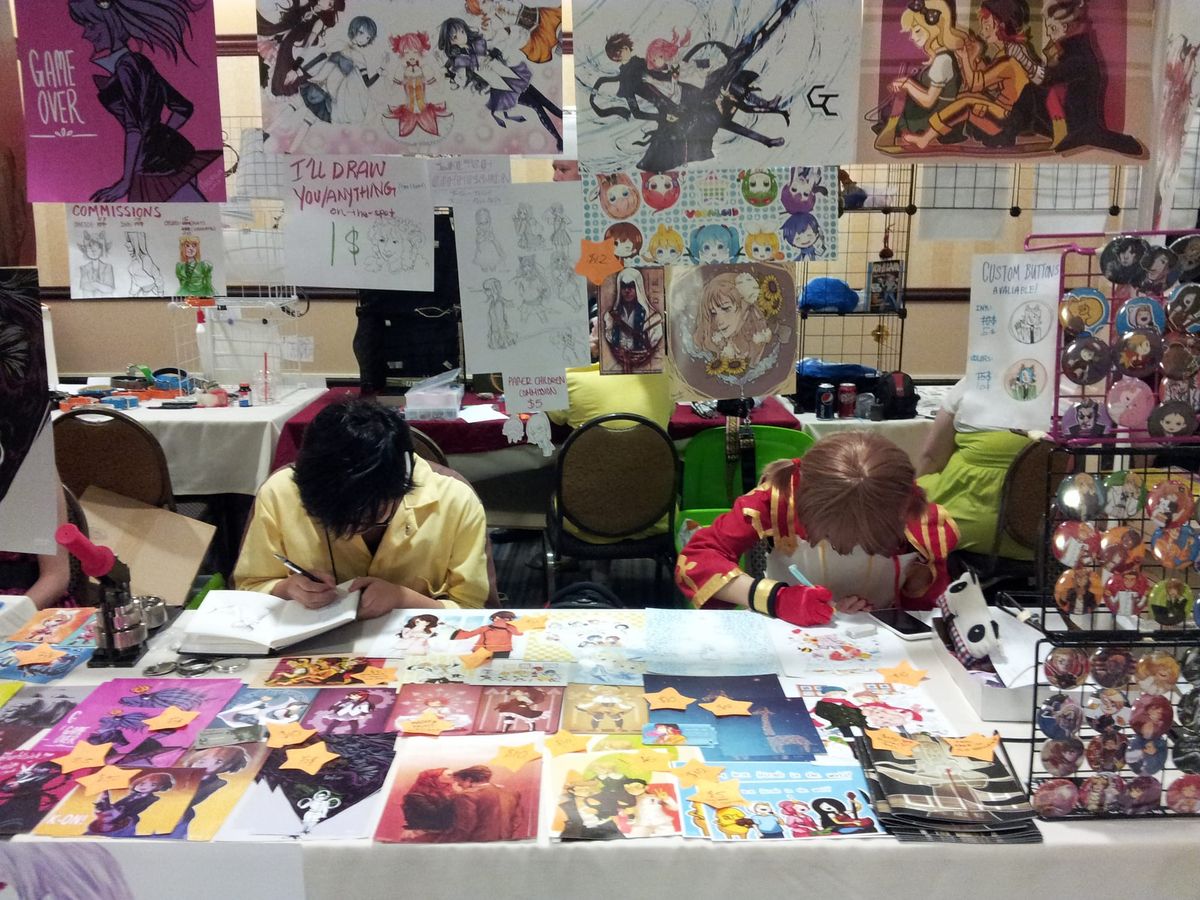
Anime, comics and pop culture conventions often have a section of the show floor dedicated to “artist alley”—a place for independent artmakers to sell their wares, distinct from the dealer’s hall where one would find licensed media and specialty collectors. For many convention attendees, the artist alley (AA) is the primary draw of attending a convention. Dozens to hundreds of independent artists, sharing unique interpretations of established media properties or wholly original work, with a diversity of style and merchandise on offer. There really is something for everyone…or is there?
Over the last 15 years, artist alley tables have gone from something teenagers can do on weekends with homemade merchandise to elaborate, multi-level setups that require thousands of dollars before they can even start. The new realities of the industry make it difficult to continue to table as a hobby—and even more difficult to turn it into a sustainable art career.
I started attending anime and comic conventions in 2012 and tabling at comics and zine festivals in 2018, selling primarily comics, prints, and stickers. I’ve split a table with my friends at Anime NYC and helped organize the first zinefest at the Princeton Public Library. In my years of attending and vending at these types of shows, I’ve made a lot of friends and seen a lot of changes. For this piece, I’ve interviewed a number of fans and artists from all over the country with a wide range of experiences, asking what they’ve noticed about artist alleys over time.
A major reason for the increasing inaccessibility—one almost all of my interviewees mentioned immediately—is the rising costs of attending cons. Since IRL anime and comics conventions came back in full force after COVID-19 lockdowns ended, the events have only gotten more expensive for both visitors to attend and aspiring exhibitors to vend at, at rates far outpacing inflation.
Tabling at cons has become much more expensive and competitive, with many seasoned AA vendors complaining that they’re unable to get tables at shows they used to be able to do every year, forcing them to do smaller, more local anime conventions and other types of events such as craft fairs and flea markets. This, in turn, pushes out the artists who specialize in those smaller events—and this pattern forces hobbyists and newcomers out of the space, leading to a more homogenous, stagnating scene.
When I tabled at Anime NYC in 2019 with my friend, we paid $245 for three days, and we each made back our half of the table fee easily. But when we got accepted again in 2024—just five years later—the table fee had nearly doubled, increasing to $400 for three days. We ended up splitting the table three ways to make it affordable.
Artist and event organizer Faiell, who has been vending at artist alleys as a hobbyist since 2014, told me that, “From a vendor POV, the increase in cost is very obvious—I used to expect tables to cost $100-300 depending on the convention’s size and attendance. Some tables cost $600-700 now. The other main thing is the number of vendors doing AA has gone up astronomically. Acceptance rates are therefore at an all-time low. It’s difficult to lock down anything these days, especially at cons that are more established.”
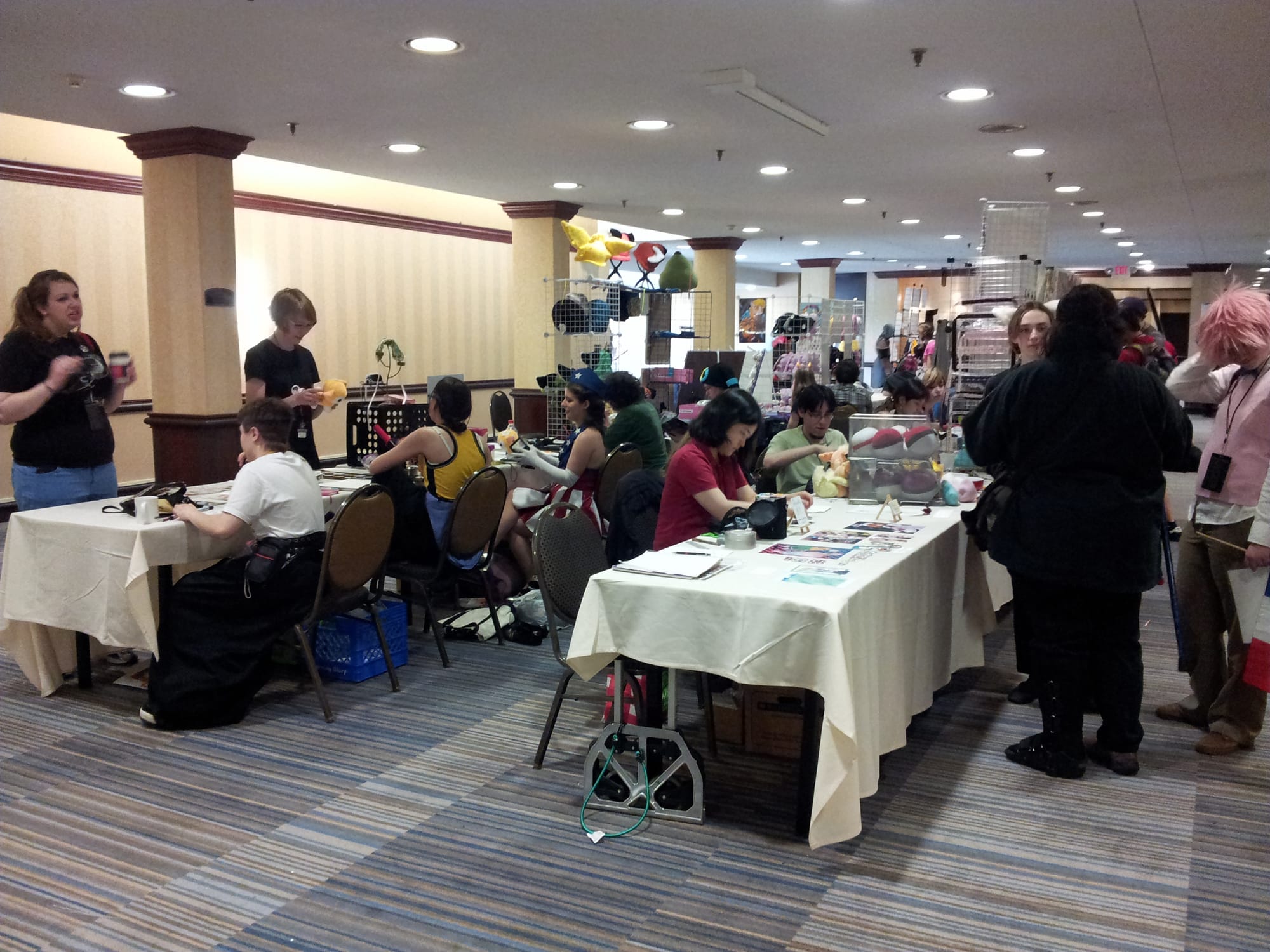
Hobbyist cosplayer Mojito, who has been attending 3-6 conventions a year for over a decade, mentions that even as a fan, “it seems like it can be hard for a newer or younger artist to ‘break into’ the AA scene (especially if they don't have a variety of products yet, or if they don't have a large portfolio) when there are many well-established community artists who appear consistently at events.”
Ryan Dunlavey, a cartoonist known for his Action Philosophers series who’s been vending at comics conventions such as NYCC and ECCC since 2003, believes the increased fees have changed comic convention artist alleys for the worse. “Everyone on every level is just hustling to make bank, and frankly, it’s gross... It’s no longer a comics town square to share and discover new work or a place to get discovered by editors and publishers who can bring talented creators to a wider audience. Maybe it’s because table fees went up so the only people who could make a go at it were the ones who pressed hardest on the entrepreneur gas pedal. Most cartoonists could cover a $200 table fee with sales. But $500+, plus travel and lodging, not so much.”
Bay Area cartoonist Cowlick, who started tabling at smaller anime conventions in Minnesota as a high school student around 2013-2014, mentions that, “Now, AA tablers just look tired and stressed, more so at larger cons. I've seen people have reservations about trading merch/books more often now (which is fine, it’s just a shift I’ve noticed). There’s a greater focus on turning profit. It just feels more antisocial and transactional.”
When a lot of money goes into something, a greater amount of money must come out to make it worthwhile. Rising fees—and rising customer expectations—are forcing artists to focus more on turning profits than they might have needed to just a few years ago.
The artist alley vlogger community on YouTube serves as an entry point not just to vending at anime conventions, but to the concept of anime conventions in general. Many vloggers and commenters credit each other with their discovery of this new way of making art as a career.
In a vlog about Anime Riverside 2026 by AA vlogger Mualcaina, she interviews fellow creatives about how they feel about the state of artist alleys today. The creators she talks to all stress that it’s a hustle that takes as much, if not more, time and energy than a full-time job would. To make it worth it, you have to do as many large conventions as you can, and sell well at them.
Most of the artists I talked to are either hobbyists or do AAs as a small facet of their income, but many of the artists Mualcaina interviews in her vlogs do AA full time or almost full time. When AA is a major source of your income, you need a convention to sell at almost every single weekend of the year, which, as competition and tabling fees increase, is not always guaranteed. In her Instagram reels, Mualcaina says that with the current state of the economy, it’s a bad time to start doing artist alleys as a full-time career.
A disabled artist I spoke to who wished to remain anonymous pointed out that the flexibility and fluidity of art careers can make it easier to do art full-time “when your body tells you no a lot of the time.” While AAs usually make up about 50% of their annual income, they were unable to travel this year, and expect that income to be halved.
The first time I went to a small local anime convention, in January 2012, I bought a pack of Adventure Time stickers. They were printed on a single sheet of uncoated sticker paper by the teenage artist at home, who cut them out by hand at the table, placed them in ziplock sandwich bags, and handed them directly to the customer for five dollars. In 2026, an artist selling stickers produced like that would not be accepted into any convention’s artist alley, because they would be competing with much more polished products and booth designs.
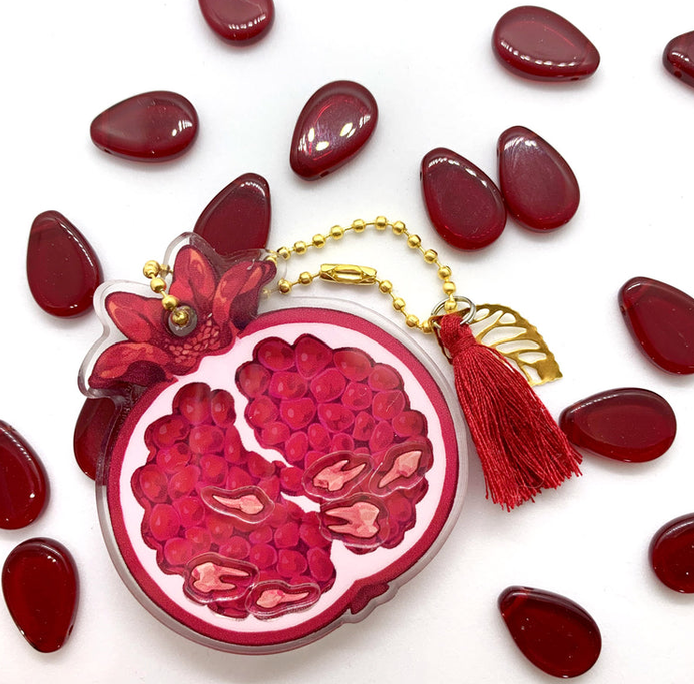
As conventions increased in price and scope, the type of merchandise artists sell in the artist alley also evolved. When companies that produced character merchandise for artists started to appear on the English-speaking internet, artists learned how to order directly from manufacturers in China through Alibaba, creating their own versions of the kinds of official anime merchandise you could find at the dealer’s hall: acrylic standees, charms, pins, and more.
At first, acrylic charms were quite expensive and had high minimum order quantities, prompting many artists to pull together group orders of several designs to save on international shipping. The variety of options for merchandise has only grown over time—and with them, the expectations from fans has grown, too. Right now, the biggest trend is interactive keychain charms: shaker charms with sparkling fluid and smaller shapes inside, multiple-part character charms that link together or spin or run. These kinds of items were impossible to obtain ten years ago, and are now fairly common.
This type of merch cannot be easily produced by artists at home with a basic printer and office supplies: it must be outsourced to factories, often overseas and managed through intermediary companies like Vograce. With one of the most popular types of merch (acrylic charms) being impossible to make by hand, artists new to the scene have to invest significant amounts of money and time on goods they won’t even be able to handle until they’re fully completed—and if there are problems in the production, they may not be able to communicate with the manufacturers to resolve them or get refunds.
The increase in impressive offerings comes hand in hand with an increase in expectations for their presentation. Artist alleys today expect giant color-coordinated arrangements of grids, custom-printed signage, and large quantities of merchandise for every character in a given popular series or franchise. Ashley of Le Spirit Designs, interviewed in the Mualcaina video linked above, says, “I try to make my booth a really immersive experience, and that kind of forces everybody else to step up and kind of raise the bar. I think we’ll always be encouraging and inspiring each other to make it a more immersive event or experience.” Her booth features custom decorated grids arranged in the shape of a cottage.
While some artists view this trend as a positive, others are turned off by “design-maxxed mini storefront” booths, as Cowlick put it. Other artists and attendees I spoke to have called these booth designs busy and overwhelming. These types of booths can be seen at artist alleys of all sizes, from Anime Expo at the Los Angeles Convention Center, which saw 420,000 visitors over its four days this past summer, to much smaller conventions like Capital City Anime Fest in Trenton, New Jersey, a one-day show this past June with 700 attendees.
Such maximalist arrangements are a baseline to vend at most anime conventions today. Conventions now often require a photograph of the applicant’s table setup as part of their artist alley application. This means that if an artist wants to start tabling for the first time in 2026, they would need to spend up to thousands of dollars on grids and branded signage for their booth before they could make a single cent selling at an AA—which makes it even harder for newcomers to break into this scene.
Artist and designer Corviday, who has been vending at artist alleys “sporadically” since 2016, mentioned that, “There’s a lot of video content being made these days about ‘a day in the life of a convention artist’ and the insight is cool, but I can’t help feeling that this is fueling a very specific aesthetic and expectation in artist alleys, where it used to be more diverse in style and content.”
Corviday, who tables at a variety of events, said that, “Convention tabling is so much more extravagant than tabling at, say, an art fair.” Art fairs, zine fests, and more comics-focused festivals are more accepting and even encourage simpler table setups, but when vendors used to AAs end up in a more comics-focused show like the Brooklyn Independent Comics Showcase, their booths end up standing out to a degree that’s detrimental to the other tables around them.
Cowlick says that this increase in table expectations has meant their interest in anime convention artist alleys “started to dip, because a lot of the tables presented an overwhelming amount of options. Paired with an overcrowded convention hall, it became a stifling experience.” Mojito echoed these feelings, saying, “AA crowding has reached the point where my friend group often avoids the room entirely on Saturday [because of] the crowd crush.”
The “design-maxxed” trend is directly fueling AA overcrowding: when every table has large amounts of merchandise, convention attendees need to spend more time perusing the offerings at each table, which causes traffic to slow, lines to form, and crowds to build up. The pressures of competition with other artists and the need to make back the high table fees and costs of overseas merch production all feed into each other to create worse experiences for both vendors and shoppers.
There’s also more for attendees to look at because of the sheer breadth of work artists are now expected to sell. Cowlick identifies gacha games produced by the video game company miHoYo, also known as the HoYoverse (known for the Honkai series, Genshin Impact, and Zenless Zone Zero) as an origin point for the trend of merchandise of every character in a large franchise. “There was another shift I observed after hoyoverse stuff started coming out and that's the increase of the tables with a sticker/charm of every character in a neutral pose.”
Cartoonist Julie Lerche, who has been selling at and attending comics and anime conventions for the past 12 years, points to the “gatcha-ification” of shows like Anime NYC as part of a trend towards homogeneity and away from anime fanart at anime shows. “I was just veryyyyyyyyy disappointed last year when everything was like airbrushed genshin, honkai, zzz, horse girl prints and acrylic keychains and everything, to the point that even [the most popular] animes of the season (iirc dandadan and frieren around then) barely had anything by comparison,” she told me over Discord, referring to Anime NYC 2025.
“Making art, especially comics, can be a very lonely and solitary practice, and while I enjoy that a lot of the time I’ve realized it’s important for me to physically put my work out there for people to touch and look at.”
— Allie Pascal
A gacha game, she explains, “makes [a players’] ‘special guy’ even more special to them because they have spent real money into acquiring them on pulls, so when they see art of them they buy it. And then artists capitalize on this but since the games all look the same, all the fanart looks the same too.”
Many artists simply can’t afford to meet this manufactured demand. “Trend chasing has always been a thing in the con scene, but I see younger/newer artists more than ever overshoot their scope and overwork themselves to meet an imagined demand,” Corviday told me. “Things like stocking every character in a series instead of focusing on a few core favorites, stocking hundreds of high-cost items like shirts/plushes before establishing an audience, putting booth decoration first, etc.”
A few years ago, a friend of mine went to an anime convention we’d both applied to and been rejected from, and she reported back to me that the artist alley was “all Genshin Impact fanart,” something neither of us make. At the Anime Summer Market hosted by Anime Social Nexus in Bridgewater, New Jersey this past summer, I saw a lot of fanwork for the gacha games Love and Deepspace and Project Sekai, in addition to Mihoyo gacha games. My own Project Sekai stickers and small prints sold the best of all the work I had for sale that day.
Faiell told me, “Artists are passionate people, so even if they have the main goal of making good money, they will always be tempted to make merch of their niche interests. And many do—often funding that merch with the profit they make from their bestsellers. If you browse AA closely, niche merch is everywhere, but, on the other hand, if you browse AA closely, you’ll suffer visual overstimulation. So another huge problem preventing people from finding ‘rarer’ fandoms is that there’s no good way to shop, with most tables easily exceeding 100 products.”
Dunlavey, who primarily vends at comics conventions, expressed disappointment that comics seem to have been displaced from the artist alley in favor of plastic merchandise. “10 years ago, an Artist Alley was a viable place for [independent] artists to share their COMIC BOOKS and gain an audience. Now it's a craft fair. Established pros used to just meet fans, sign comics and sell originals—now they produce expensive exclusive variants and charge for autographs. [Independent] comics are rare. Artists selling unauthorized fanart merch outnumber everyone else two-to-one. Even the artists making non-derivative work aren’t making many comics, they’re selling prints and stickers or other items.”
Fanartists tend to view themselves as selling work fueled by passion and love for their fandoms. While some IP holders are notoriously litigious (Disney and Sanrio being two of the largest) and some directly ask fans not to sell fanwork of their properties, most fanartists accept the risks associated with monetizing fanart. Some conventions, such as Otakon, require a certain amount of original artwork to be on the table. Copyright striking is much easier to do online than at an in-person event, so many fanartists don’t sell online at all, or only sell original work online to avoid cease and desists.
As far as generative AI in the artist alley goes, most of the artists I interviewed said they haven’t seen much of it, saying that type of thing is more likely to be found in the dealer’s room. Mojito mentioned that Artist Alley organizers tend to have hard bans on generative AI submissions and enforce those bans in practice. “It was vindictively satisfying to see a few exhibitors get swiftly kicked out of various large conventions last year after genAI use was discovered (with a simple sign placed at their booths to let passers-by know what happened).”
But both Lerche and Gabaghoulish, a fan who frequents artist alleys, reported encountering Nakama Central at Anime NYC in 2025, a booth selling tapestries and acrylic standees with AI-generated artwork on them. Gabaghoulish even purchased merchandise from the seller before realizing it was made with AI. “I go to ARTIST Alley to support ARTISTS,” Gabaghoulish told me. “Cons need to be a lot better about having a zero-tolerance policy for people who aren’t selling their own creations, especially a bigger con like ANYC that has a lot more resources at their disposal.”
In the face of all the market forces making it harder for artists to sell their work, some artists have started to take matters into their own hands—and organize their own events.
In June 2026, Capital City Anime Fest was organized primarily by artist Lucy Camacho, who’d been doing artist alleys since 2017. “Although I was nervous and hesitant to do it, I felt like I could reverse engineer the many cons I’ve been to even before I did artist alleys,” Lucy told me. “I’ve never really seen cons employ or use the consultancy of the artists that keep the fandom spaces they cater to going, so I think that’s why I ultimately agreed to do it.”
In addition to designing all of the branding for the event and coordinating much of the programming and marketing, Camacho curated the artist alley herself. “My tenure in the artist alley was a huge balancing weight when doing CCAF. I knew certain things about our artists that the average person would not. It was my doing to not allow dealers in our convention, low table costs, and curating our artists where they all complimented each other and didn’t compete with each other. Since I have the experience of the artist AND the consumer, I was able to craft an artist alley that was plentiful, but not crowded, with a good mix of fandoms/aesthetics.”
According to Camacho, over 90 artists applied to table at the one-day event, and 23 were selected. 700 tickets were sold for the one-day show, the maximum capacity for its small venue.
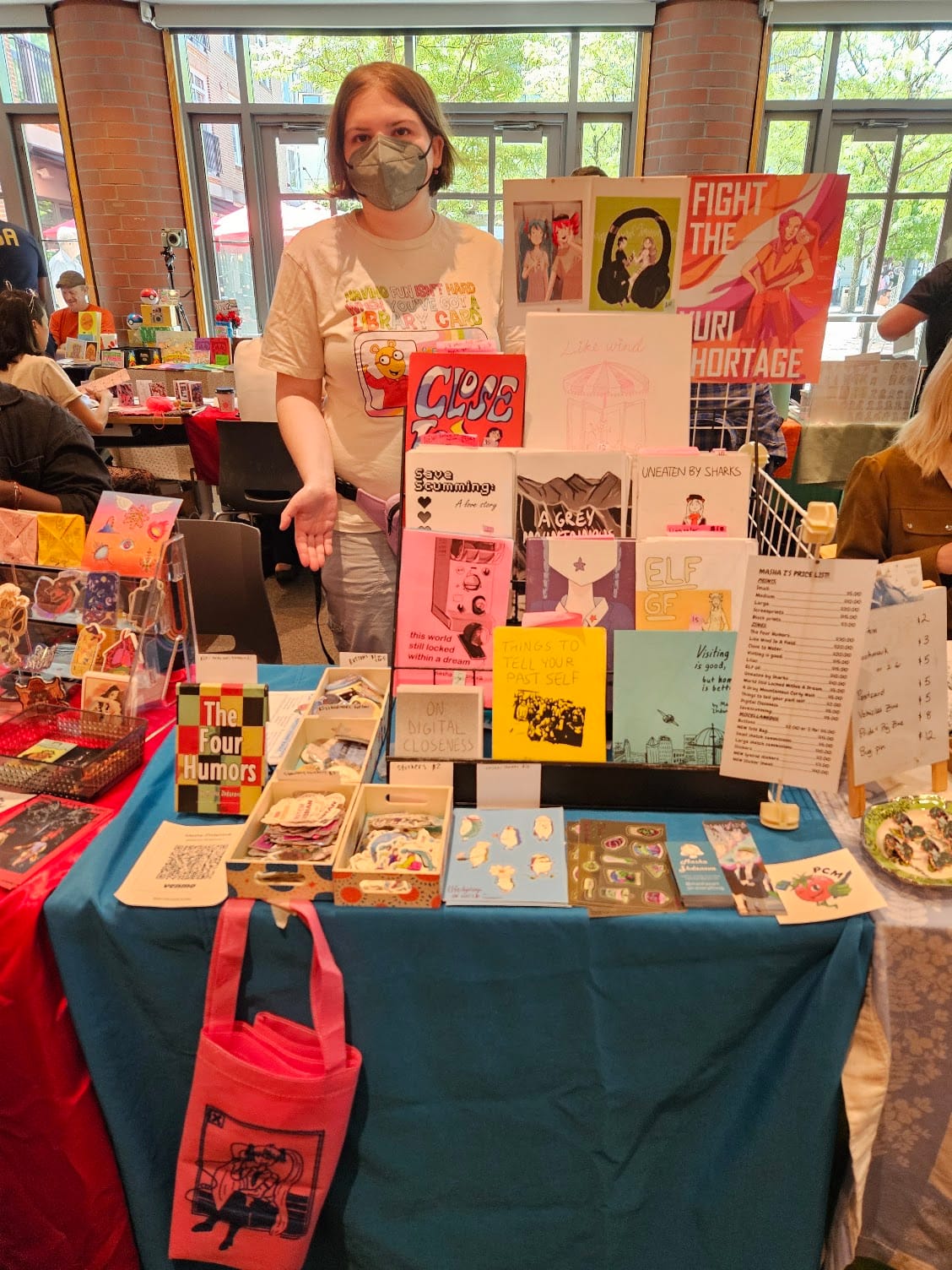
At CCAF, I was representing my local comics collective, the Princeton Comic Makers, downstairs in the same building as the artist alley on the fourth floor. We were selling prints, comics, and small trinkets, but mostly, we were promoting our weekly meetup in Princeton by handing out flyers and talking to guests. I saw a steady stream of convention attendees take the stairs and elevator up to the AA, and when I stopped by to check it out, the room was packed. When I asked a vendor about their sales, though, they said they were so-so.
North American artists more interested in comics than merchandise are looking to East Asian doujinshi (self-published book) fests as possible models for future events. As artist Saba Sabaton put it recently on X, “It isn’t that doujin culture can only exist in [J]apan due to factors unique to [J]apan.”
Doujinshi fests are similar, but not identical, in structure to zine fests in the U.S., the main difference being that artists are expected to produce a completely new book for the event after they’re accepted, and that fanwork of existing IP must not be sold for profit, only at manufacturing cost. They also discourage elaborate booth setups and strictly limit the amount of non-book merchandise that can be sold at a table, which appeals to artists frustrated by the expectations of a typical AA.
The first event marketing itself as a doujinshi fest in North America was held as part of FanimeCon 2026 in San Jose, California, called Manga Ichiba (or, “comic market” in Japanese.) Allie Pascal was one of the volunteers who helped organize Manga Ichiba and created a promotional graphic for it that went viral on social media.
“There were specific rules in the guidelines limiting merchandise, as you could only have up to 7 pieces of merch and it had to be directly related to the books being sold,” she told me in an interview. “I think this rule was very important to setting the tone and expectations for the event. As a result, there were a lot of people who had very plain displays, ranging from just a single pile of books, or decorating their tables with plushies or other artistic decorations for fun, rather than just merchandise.”
For me, as an independent cartoonist, the idea of an event so focused on comics that it limits the amount of merch available is inspiring. It’s disheartening to table at event after event with a shelf full of comics and only sell prints and stickers. Other artists I know would love to make more comics, but are forced to concentrate on merchandise for artist alley, since that makes up more of their income than it does for me.
“I find it to be a very annoying balance,” artist Lee Strawberry told me. “[I] do want to do more freelance work and branch out to try new things, but last year I was unable to do much because I had signed up to so many cons.”
“For doujinshi events, I like how the audience can be very targeted and specific,” Allie says, “and thus can help with bypassing a lot of the ‘explaining’ of what your deal is to your prospective audience.”
Manga Ichiba was the opposite of a typical artist alley, prioritizing specificity over bulk; as such, it attracted artists and fans who were burned out on expensive, overwhelming artist alleys and interested in trying something new. When the doors opened, artists were stunned by huge crowds and long lines. Many were surprised that they sold out of books within less than an hour of their six-hour time slots.
Faiell wrote about their experience at Manga Ichiba, where they said, “To put things in perspective, I personally have never sold more than 10 books at a U.S. con, which usually spans 3 to 4 days of 8 hours each (24-32 hrs total).... For Manga Ichiba, an event where I would be selling only within a single 6 hour time slot, I had decided to bring 30 copies of my original BL doujin. Like I said, I was optimistic!” They’d sold out within the first hour.
I, like most of the other artists I’ve spoken with, value being able to connect with fans and other artists at in-person events like these. Allie emphasized this, saying, “Making art, especially comics, can be a very lonely and solitary practice, and while I enjoy that a lot of the time I’ve realized it’s important for me to physically put my work out there for people to touch and look at.”
For those of us who don’t make a living through the AA, selling our work at events is a way to meet people who like the same things we like, who are interested in what we’re interested in, and who can give us direct, immediate feedback on the art we make and share with the world. At the Anime Summer Market, a customer bought one of my minicomics, then came back several hours later to let me know they’d read it and loved it. Interactions like that are what make it all worth it.
The success of Manga Ichiba has inspired many artists and doujinshi enthusiasts to try their hand at organizing similar events in other parts of the country. In Southern California, the Maji Manga Market was recently announced, and Faiell started a newsletter to keep track of doujinshi-related events in North America. Camacho mentioned an interest in organizing some kind of doujinshi event in Central New Jersey eventually as well.
Doujinshi events likely won’t end up replacing artist alleys at conventions, but having more variety of events will make it easier for artists to create and distribute the work they want—and for fans to find work they connect with.
“I personally don’t think that we can Independent Art Mart our way out of capitalism, and simply buying from small artists and such isn’t the solution to everything,” Allie told me. “But I think it’s great that they can exist, and I hope that there can be a diversification of events where people can share their work and connect to those who desire to see their visions.”