Inside The Vampire Lestat’s Brilliant Production Design

Blood farms and custom guitars: TVL production designer Andres Cubillan shares insights into the season’s most memorable setpieces.

Share
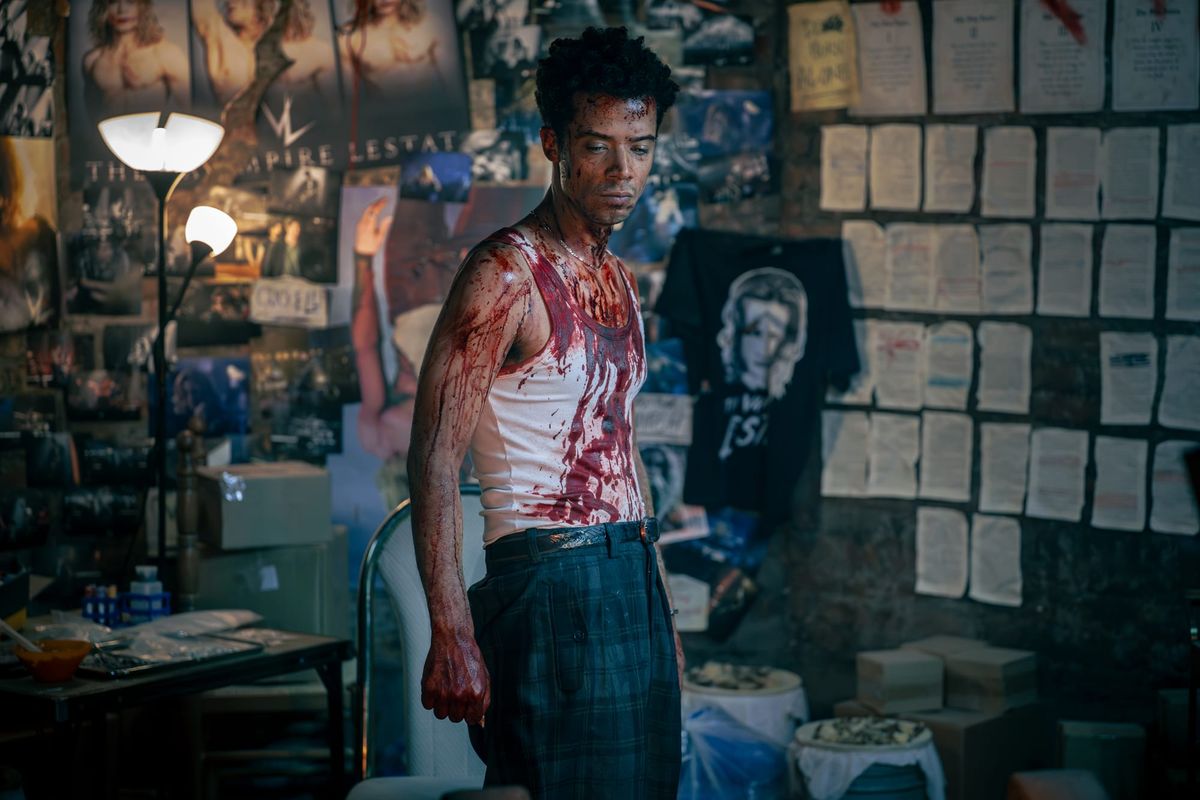
Production still featuring Louis in a white shirt and dark plaid pants, covered in blood, with a wide range of Lestat merch and print-outs on the walls.
The serial-killeresque decorations in the Fang Gang’s “hangout room” provide visual context for the various cults and fandoms building up in the background around Lestat, Armand, and Daniel’s book. Image courtesy Sophie Giraud/AMC.

Mara LaPere-Schloop’s work on the first two seasons of Interview with the Vampire is a triumph of TV production design, from the gothic atmosphere of New Orleans flashbacks to the cleverly curated backdrop of the Dubai interview sequences, where Louis’ and Armand’s penthouse gradually revealed itself to be something between a mausoleum and a gallery of suppressed memories.

Taking over as production designer for season 3, aka The Vampire Lestat, Andres Cubillan offers us a similarly impressive level of attention to detail. In the layout of Lestat’s tour bus, we see a physical manifestation of the tensions among the band and entourage, as the humans sleep in cramped bunkbeds while their vampire frontman enjoys a luxurious floor all to himself. During flashbacks to Lestat’s childhood home in Auvergne, France, the decor offers eerie hints of his violent upbringing and his family’s money troubles. And in the Fang Gang’s dungeon-like basement, Cubillan’s design team created a gory house of horrors, reiterating the show’s ability to pivot between radically different emotional tones.

One of the many recurring compliments paid to Interview with the Vampire and The Vampire Lestat is the sheer volume of information this show can pack into every episode. This season in particular is full of clever creative choices that may only become apparent on repeat viewings, so it was a true pleasure to speak with Andres Cubillan after the finale, sharing his thoughts on some of the show’s most compelling design choices. And yes, that obviously includes Lestat’s blood shower—which turned out to have a rather unexpected origin story.

Lestat’s Montreal apartment

Season 3 is bookended by scenes in Lestat’s beautifully decorated Montreal apartment, a space that reflects the less chaotic side of his personality, as a wealthy aesthete who, like Louis, appreciates the finer things in life. Before now, we’ve seen his shared home with Louis and Claudia in early 20th-century New Orleans; the only time we’ve seen him in the present day is in a barren shack in the season 2 finale. This new apartment is our first real look at his tastes as a single man on a relatively even keel, decorating for himself rather than performing for outside consumption—although there’s a telling moment in the season premiere when he asks Louis via video call if he can recommend a painting to hang in the guest room. So maybe he’s hoping to impress one person in particular.

Sadly, we only get to see a fraction of the apartment’s interior onscreen, but the main living room features a grand piano, a table shaped like a kneeling human body, and an art collection whose most prominent piece is a print of Magritte’s The Lovers, depicting two figures kissing while their faces are covered by shrouds.

Image from TVL featuring Lestat's apartment and Lestat playing on the piano.
In his Montreal apartment, Lestat decorates for himself rather than performing for outside consumption—except when it comes to Louis, of course. Image via Andres Cubillan on Instagram.

“I didn’t want to erase the aesthetic that Mara had set up for him in season 1,” says Cubillan. “I just wanted to pump up the volume and sort of mark out what that evolution of him stylistically would be throughout an additional 100 years later. And it wasn’t so much about popular or famous art. It was just what I thought Lestat would find interesting. I think he finds interest and beauty in mundane things as much as in gorgeous art.” 

Echoing the varied nature of Louis’ art collection in Dubai, where antique treasures hung alongside paintings by lesser-known contemporary artists, Lestat’s apartment features an eclectic mix where paintings by Mark Rothko, Yamin Young and the abstract expressionist Clyfford Still are displayed alongside works by local Canadian artist Max Dean, and by members of the show’s crew: Jaclyn Shoub (from the set decoration team) and Thomas Barker (the show’s head carpenter).

Image from TVL featuring Lestat's apartment, with two chairs and a couch in the foreground, and a sitting area in the distance.
Lestat’s apartment builds on his season 1 decorating style, “pump[ing] up the volume” and imagining the outcome a century later. Image via Andres Cubillan on Instagram.

“I think he is no longer trying to assimilate into society,” notes Cubillan when discussing Lestat’s mindset at the start of season 3. “He’s no longer hiding himself, his sexuality. I think at the beginning, there’s still some hiding of being a vampire, but barely.” It’s hard to imagine Lestat ever being truly inhibited or repressed, but during their time in New Orleans, Louis and Lestat had to hide in plain sight—both in the sense that they were vampires living among humans, and in that they were a semi-closeted queer couple. In Montreal, Cubillan wanted to set the scene for a bold new era of Lestat’s story—which is absolutely what we get once his band goes on tour.

The tour bus

Appearing in almost every episode this season, The Vampire Lestat’s double-decker tour bus plays a roughly equivalent role to Louis and Armand’s penthouse in Interview with the Vampire, full of design elements that speak to the emotional state and divergent tastes of the characters within. Most obviously, its structure explicitly marks out the class divide between Lestat and his band, with Lestat residing in the chic upper level (with occasional visits from characters like Daniel and Dr. Bhansali), while everyone else makes the best of the scuzzy, overcrowded space downstairs. 

Production still featuring Dee, TC, Larry, and Salamander on the tour bus.
The Vampire Lestat’s double-decker tour bus offers a sharp visual contrast between the grimy lower-level band quarters and Lestat’s posh upper level. Image courtesy Sophie Giraud/AMC.

Embracing Lestat’s over-the-top rock-star persona, Cubillan and his design team looked back to Led Zeppelin’s private 747 jet, The Starship, which reportedly had a piano, a bar, a fireplace, and shag carpeting. “The backstory behind it was that [Lestat] bought a hard-partying tour bus off of another rock band, something like Mötley Crüe, and basically just hosed down the bottom floor, and then really decked out the top.” 

Watching the bus scenes, there’s an obvious contrast between upstairs and downstairs, where the grimy lower level hasn’t been updated from the bus’s previous owners. “You still see the leopard print carpet. This like ripped up vinyl stained furniture and formica kitchens. You know, I kept talking to [showrunner Rolin Jones] and saying, like, ‘Should I add a kitchen? Should there be a little stove?’ And he’s like, ‘I don’t think any of these people are actually cooking in here.’ Can you imagine? If anything, someone’s trying to like, melt marbles or something. So we gave them a little camping stove, and it was really just a matter of being able to cram as much booze as we could into that bar.”

Otherwise, much of the downstairs clutter comes from random items that the band picks up on the road, purchased from gas stations or stolen from their latest venue. 

Image from TVL featuring the clutter on the tour bus.
Much of the downstairs clutter comes from random items that the band picked up on the road. Image vía Andres Cubillan on Instagram.

 “We have this papier-mâché dragon head, you start seeing more and more things hanging off of it. I think there’s a bra hanging off of it at some point. Condoms stuck to the wall.” Also, each of the bandmember’s sleeping areas have been personalized by their inhabitants, like TC hanging up her socks in a garland above the bed. 

“We had this idea that Salamander, after every show, he would take out his gum and just stick it to the roof of the bus,” says Cubillan. “So we actually have this sort of Fisherman’s Wharf-type of gum wall that goes up in between the windows and up into the ceiling.”

One of the many logistical questions regarding the bus layout was where Daniel would sleep. Lestat has a beautiful, custom-built coffin with grasping hands clambering up the outsides (just one of many props that Cubillan has discussed on his Instagram page), but while Daniel also needs a vampire-friendly sleeping area, there wasn’t room for him to have a real coffin on the bus.

Production still featuring Daniel sleeping in his purple sleeping bag, positioned vertically.
While Lestat has a custom-built coffin on the tour bus, Daniel is relegated to a sleeping bag: “He’s sort of in the way of Lestat.” Image courtesy Sophie Giraud/AMC.

“Rolin was like, ‘I don’t think we need to give him a coffin. I think he can just be whatever.’ So then we came up with a climbing sleeping bag. There’s one little shot of Molloy trying to sleep when the cop pulls them over, and he’s in the broom closet. We gave him a little fold-down table and some little woolly pockets on the wall for where he would keep his things. He’s a journalist, he knows how to travel light.” At the same time, this uncomfortable arrangement highlights the fact that “he’s sort of in the way of Lestat,” playing into the mutual resentment between these two characters.

By contrast, Lestat’s floor of the bus is in pristine condition, remodeled with bespoke decor including a blood hookah and a hanging chair with mid-century minimalist vibes. The design team aimed for “luxurious materials and elegance, but also that rock-star edge,” with an emphasis on texture. 

Image from TVL featuring the posh decorations from Lestat's level of the tour bus.
Lestat’s upper level of the tour bus is dramatically elegant in contrast to his bandmates’ relative squalor. Image via Andres Cubillan on Instagram.

“We have this really lush green velvet,” says Cubillan. “We have suede-lined cabinets in chrome, a rosewood veneer bar with a pull-out drawer with a record player. His cabinet where the piano and drawers where his rings and his jewelry are. All of that was an overglazed ceramic cabinet.”

Looking closely, the floor’s tiling is decorated with tiny handprints, all pointing toward the three-dimensional hands grasping the bottom of Lestat’s coffin. Then in the middle of the room is a mini recording studio, including a keyboard and a vintage microphone used by the Rolling Stones.

The blood shower

Lestat’s open-plan tour-bus shower is perhaps the most memorable design detail in the entire season, so it was surprising to hear that it wasn’t originally part of the plan.

“There were some things that were in the script from the start, and others that Rolin just kind of let me play around with,” Cubillan explains. “We knew that Lestat peed in urinals. So it made sense to give them a bathroom of some sort. There’s actually a toilet in the beginning. We see the camera operator kind of starting to go to the bathroom, and [Lestat] says, ‘If you do that, I’ll kill you.’”

Meanwhile, the initial design for Lestat’s shower was a kind of hidden closet with a truly delightful conceit: “When you open the closet, double doors would open up, and along the walls would be Botticellis Venus painting, except there would be no Venus. It would just be Lestat in the shower, standing in a mother-of-pearl wash basin to symbolize the shell. I wanted to give it something campy, and Rolin loved that idea just to have some humor with it, and just to really enhance his cockiness at his sort of rock-star persona.” 

However, adding a shower room to the bus just wasn’t camera-friendly, leading the designers to start brainstorming new ideas like hiding a bathtub inside one of the banquettes. But where would the shower head go? How would it work? In the end, concept artist Chris Penna—a frequent Guillermo del Toro collaborator—came up with the idea of water coming out of the chandelier overhead. 

“It made the space completely multi-use,” says Cubillan. “Lestat doesn’t care. He’s just gonna do Lestat. And once we pitched that idea, Rolin of course had to take it one step further, as Rolin always does. He was like, ‘Oh, can we have blood come out of that shower?’”

“Our special-effects coordinator Tim Barraball was a little like, ‘Oh my God! Okay, now we’ve got to figure out the plumbing.’ We even have blood splatter sort of on the edges of the banquette, and we never address it from day one. If fans sort of pause and catch something, and they’re like, ‘Oh, what is that? Why would that be bloody? Has he killed somebody there?’ It’s not until the third or fourth episode that we see why.”

Apparently fans have raised questions about the shower’s drainage system, and Cubillan is happy to elaborate. (This is, after all, a shower with no walls, located on the upper level of a moving bus.) “Down below, if you look at the ceiling between the bunk beds, you can see the outline of [where] the catch basin of the shower would be. There’s actually stains coming down the wall from crappy plumbing. And since none of the band members are allowed upstairs, it’s like, what’s going on up there? We don’t really know.”

Lestat’s childhood home

As established in the novel The Vampire Lestat, Lestat is from an aristocratic family, but not a particularly wealthy one. His childhood home in Auvergne gives the impression of an ancient, formerly powerful family that is now in financial decline—an ignominious status that fuels the macho posturing and cruelty of Lestat’s father and brothers. 

Production still featuring a now vampire Lestat leaning over his brother, who is backed up against the wall.
Lestat’s ancestral home has none of the flowery brightness we might expect from 18th-century French aristocracy, meant to feel both antique and claustrophobic. Image courtesy Sophie Giraud/AMC.

“We needed to find a way of telling multiple decades of this family within a single room, because other than his bedroom, the dining room is the only thing we see,” says Cubillan. “We clearly from the start didn’t want it to be a flowery, colorful, typical 18th-century space that most people expect from that era in France. So we went with earlier styles of chateau, something like the d’Azay-le-Rideau or the Blois Chateau.” The goal was to find something both antique and claustrophobic.

“We ended up with something that would feel more stark, more oppressive, so that Lestat and Gabriella would always feel stepped-on in this space. Really high wainscoting, a really heavy wood beam ceiling, everything is sort of drab and dark. And then, as the decades progress, we started taking things away, things that they might have to sell in order to pay for the rest of their lifestyle. I always pictured that family being heavily in debt.”

As Lestat’s childhood flashbacks move through his adolescence to young adulthood, we’re given hint after hint that the family has fallen on hard times, mirrored by his father’s increasing infirmity, and the rest of his family succumbing to various illnesses. “We see less staff in the house,” Cubillan explains. “We see the food getting simpler. Even the china on the table. We go from a very sort of elaborate multi-piece setting, you know, crystal glassware, silverware, and that starts getting reduced. So you start feeling like they’re really impoverished in their sort of ridiculous aristocracy.”

Another set that Cubillan has explored on Instagram is Lestat’s childhood bedroom, which only appears in one brief but important scene, when Gabriella delivers her unnerving sexual fantasy monologue to a bleeding Lestat. Cubillan tells us that based on the comparatively sparse decor of Lestat’s room, we’re meant to understand that “he’s the runt of the family.”

Image from TVL featuring Gabriella and Lestat in Lestat's bedroom, as he sits against the foot of his bed.
Lestat is a second-class citizen in his own childhood home, with a small, awkward-sized bedroom whose tile flooring is made of a material used in servants’ quarters. Image via Andres Cubillan on Instagram

“They’re not going to give him some large bedroom. It’s going to be sort of awkward in size. I’ve spoken about the tile floor and the fact that it’s a material that would have been used for servants’ quarters or kitchens.” Lestat is a second-class citizen in his own home, and the images decorating his walls make a further statement about the violent undercurrents of his childhood.

“The mural work on the walls, it was a play on the tropes of little boys’ rooms—the trains and the boats, and that heteronormative ideal for a little boys’ room in that era.” But instead of boats or scenes of boyhood adventures, Lestat’s bed is surrounded by “images of war and massacres and conquests,” creating a nightmarish backdrop to the only private space he has in the house. 

Lestat’s role as a “runt” is explicitly connected to the family’s harsh expectations for manhood. His father hates the clearly sensitive Lestat because he stutters and aspires toward literacy like his mother, failing to conform with his brothers’ oafish style of masculinity. Meanwhile, Gabriella makes it clear that Lestat can only “be a man” once he commits an act of bloody and traumatic violence. In their vampire lives, Gabriella and Lestat are both (in different ways) queer and gender-nonconforming characters, but Lestat still carries the scars of this claustrophobic and repressive upbringing.

The Fang Gang’s blood farm 

For Cubillan, whose previous credits range from action movies (Godzilla vs. Kong) to biopics (Being the Ricardos), working on The Vampire Lestat’s horror scenes was something of a new experience. One of this show’s most impressive qualities is the way it shifts between different tones and subgenres, meaning that the design team were simultaneously working on historical and contemporary setpieces, and in a couple of cases, locations that were directly intended to instill fear and disgust. Naturally, I had to ask about Cubillan’s approach when creating two of this season’s goriest sets: The Fang Gang’s house in episode 3, where Louis goes on a murderous rampage and discovers an underground blood farm, and the butcher’s shop from the season finale.

Production still featuring Louis covered in blood entering the room where the human prisoners are being kept by the Fang Gang in caged bathtubs.
The Fang Gang’s human victims are kept in old bathtubs that the production team collected, underscoring the makeshift nature of their operation. Image courtesy Sophie Giraud/AMC.

In the script for episode 3, Cubillan explains, there were no real guidelines for the Fang Gang’s blood farm, so he and his team had a lot of freedom to get creative. “We needed to have these people captive there, and I didn’t want to just put them in cages or have them shackled. It didn’t feel like enough, so I was trying to think of how bodies would be kept fresh or preserved, but still alive. That’s when we came up with this idea of having a series of caged tubs.” His set-decoration staff went out and found old bathtubs that people had thrown away in the neighborhoods nearby, adding to the sense that the vampires were scavenging for equipment.

The final set is damp, filthy, and repellent, with half-conscious human victims lying in bathtubs with IV drips in their arms. Cubillan describes it as “not exactly like a cryogenic chamber,” but more than simple imprisonment. These people are literally being kept in a food-storage system, featuring background scenery including pilfered hospital equipment and a gas station refrigerator full of blood bags. There’s an implication of the Fang Gang attempting (but clearly failing) to keep the room hygienic, like a human form of battery farming.

Through a blood-stained curtain is a second room that Cubillan refers to as the Fang Gang’s hangout spot. The designers initially planned to include a full drug lab, but there wasn’t room in the budget, so it’s more of a casual, messy area where Cubillan envisions various vampires “taking shifts watching over the meat.”

Production still featuring Louis, covered in blood, pointing his finger as he sits cross-legged on a chair.
Louis seems so focused on his revenge quest that he barely registers the Fang Gang’s gruesome Serial Killer Wall dedicated to his ex. Image courtesy Sophie Giraud/AMC.

The hangout room provides a lot of context for one of the recurring themes I touched upon in my recaps: the idea of various cults and fandoms building up around Lestat, Armand, and Daniel’s book. The Fang Gang are obsessed with Lestat, tracking him down to attack him at the Dracula’s Daughter hotel. One has an “Armand told the truth” tattoo, and they’re very loyal to the Great Laws of vampirism, planning to kill Lestat for revealing his vampire identity to humankind. 

Coupled with the Great Conversion and the foreshadowing of Lestat’s attempted assassination, the show mostly keeps this thread in the background of the main story. However, the set design of this basement speaks volumes, making it clear that Lestat lives rent-free in the Fang Gang’s heads—although curiously, Louis seems so focused on his revenge quest that he barely registers the gang’s gruesome Serial Killer Wall dedicated to his ex.

“We had so much fun doing this effigy of Sam on the wall, of Lestat,” says Cubillan. “It had been written into the script that there was an upside-down poster of Lestat where the mouth was a glory hole.” This being the basement, they elected to have the hole be “a drainage pipe that’s dripping mildewy goo.” The gang have also been throwing darts at the poster’s crotch, and the surrounding wall is covered in conspiratorial ephemera, signalling their vicious obsession with Lestat: torn-out pages from Daniel’s book, quotes from the Great Laws, maps of Louis’ vampire-themed hotel, and stalker photos suggesting that the gang have been surveilling their target for a while. “You know, all of these things that would make someone immediately terrified to see the amount of information that they had on [Lestat].”

The butcher’s shop set from episode 7 is disturbing in a very different way. While the Fang Gang’s house is squalid and threatening, the butcher’s shop provides a perversely clinical environment for Armand’s interrogation of Louis, placing Louis’ severed head in the middle of a heavy wooden carving table. “We needed it to feel really sterile, like horrible things have happened in here, not to humans until now, or not to a vampire, but you should be able to sort of smell like it. Things get killed here, things get cut up.”

Behind the scenes image featuring Assad Zaman and Jacob Anderson while shooting the butcher-shop scene.
The butcher shop in the TVL finale provided a perversely clinical environment for Armand’s gory interrogation of Louis. Image courtesy Sophie Giraud/AMC.

“I love that it’s a very clean, everyday set being used for such a horrific thing,” says Cubillan, adding that the conversations around Jacob Anderson’s prosthetic head logistics were a unique experience: “We had Jacob’s head on a pike in the middle of a conference table during a meeting.”

“The table was a particularly interesting challenge because we needed to find a way of hiding Jacob, and also giving him the ability to move around the table for different shots. [Director] Alan Taylor and [director of photography] David Tattersall wanted the head to sort of move from one position to another, to slide down to the other end. It needed to be in front of Armand, but also in front of Regina, in front of his body, trying to reach for it.” Naturally Cubillan had to try it himself, sticking his own head through the table to see how it would look.

Lestat’s LeStrat and the blood decanter

This season is full of fascinating props, and while we sadly didn’t have time to discuss more (I would’ve loved to hear about Lestat’s cabinet from the episode 1 auction scene!), Cubillan did cover two highlights: Lestat’s custom-made Fender Stratocaster guitar—known as the LeStrat—and the blood decanter from the restaurant scene in episode 6. 

Fender customized four cream-colored LeStrats for AMC, charting a progression through the season, as the guitar’s body became more and more bloodstained. “The backstory was that he would sort of tinker with this guitar with bloody hands,” explains Cubillan, with episode 1 introducing the pristine new guitar. “Then episode three, you see the second stage where you’re starting to see his bloody fingerprints on it—how it would come off of his nails on the strings and with the pick, all the way to the last one, which was just horrifying to look at because the blood was incredibly caked on.” 

Composer Daniel Hart was meant to play it at the show’s promotional concert in New York, but by the end of filming, the guitars were so covered in blood that they were no longer usable. They still made it to the Beacon Theater, though, on display and arranged in increasingly bloodier order as concertgoers passed through the lobby.

As for the blood decanter, it plays a less important role in Lestat’s story, yet it makes an impressive impact during its brief screentime. Appearing only once, it’s a symbol of morbid luxury at Louis’ Montreal restaurant, where a vampire sommelier draws blood from a young woman, decanting it into three tiny glasses using an elegant device.

Image from TVL featuring Lestat's descendant with her arm stretched over a goblet, blood pouring downwards.
While there are always complicated thematic dynamics around blood-drinking, the IWTV/TVL creative teams are more interested in the logistics of blood consumption. Image via Andres Cubillan on Instagram

 According to Cubillan, this arrangement pays tribute to a moment from season 1, where Lestat used a rope to hold a man’s bleeding arm over a whisky bottle. Drawing inspiration from vintage absinthe decanters, this singular prop also came with its own accessories—a set of carefully selected knives, and (in an earlier draft of the design) “a silk ribbon-like bondage, tied around her arm.” It’s just one among an endless list of moments that reflect the dedication that went into this season, transforming blood donation into a miniature work of theater.

Much has been written over the decades about the erotic symbolism of vampirism, where pain, pleasure, death and penetration all come together in a single act. Yet for a show that focuses on twisted romance, IWTV/TVL are relatively restrained when it comes to actual neck-biting scenes. The creative team are more interested in exploring the logistics of blood consumption, whether we’re talking about Louis’ restrictive diet in Dubai, Lestat’s “ethical” blood bank on tour, the squalor of the Fang Gang’s battery farm, or the way Daniel goes old-school by chasing people down in dark alleyways. This show loves to dig into the idea of blood as a direct replacement for human food and its surrounding culture, which is how we end up with storylines about vampire eating disorders, or scenes that contrast gourmet dining with the vampire equivalent of trashy fast food.

When Lestat used a rope to hold up that man’s arm and drain his blood in season 1, he was torturing a victim. But this restaurant scene remixes that image with an elaborate set-up that Cubillan describes as “ceremonial” and “seductive.” It’s similar to the aesthetic polish of food service in a fine-dining restaurant, involving a voluntary donor whose blood belongs to a specific vintage—a descendent of the Lioncourt family, tracked down by Louis’ staff so they can sample an echo of Lestat’s human blood together. Despite its limited screentime, Cubillan’s blood decanter is crucial to the scene, illustrating how far Louis and Lestat have come on their vampire journey.


Disclaimer: One of our editors, Lin Codega, worked as the Writers Room Assistant on this season of The Vampire Lestat. Theyve had no editorial input on or interaction with this piece, or the decision to cover the show.