How I Learned to Stop Worrying and Love the Dragons

Working in the Game of Thrones content mines killed my fannish feelings for the franchise. Here’s how I got them back.

Share
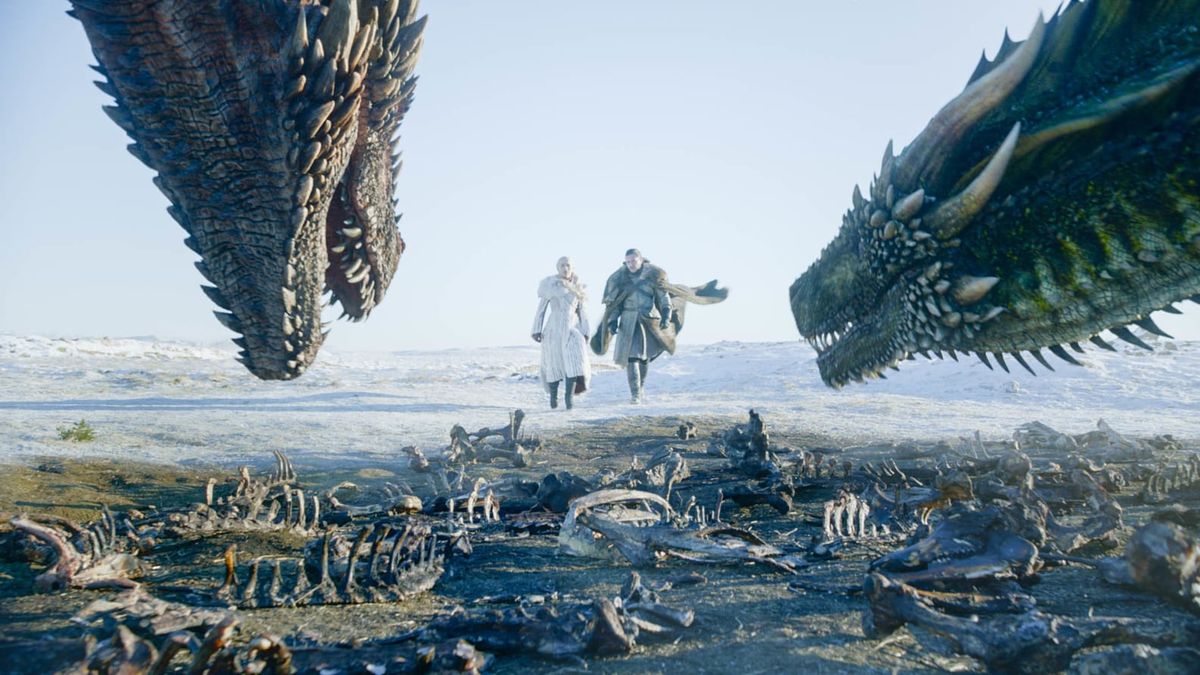
Image from Game of Thrones featuring Daenerys and Jon Snow walking towards a pair of dragons, with many skeletal remains on the ground.
Daenerys, Jon Snow, and the scattered remains of the media industry. Image courtesy of HBO.

I never set out to be a journalist who wrote about TV, Game of Thrones, or fandom at all.

As a budding reporter, I thought I had town council meetings and municipal investigations in my future; eventually, perhaps I could level up into national coverage. Instead, fandom was my ticket in. I was part of a generation of fannish writers and creatives who grew up on the internet, cutting our teeth in now-defunct forums, archives, and social media platforms. My experiences in fandom led to writing articles about my own fandoms—especially Game of Thrones. From 2013 to 2019, countless fans read my work after tuning in every Sunday to watch what happened next in HBO’s lavish adaptation of George R.R. Martin’s A Song of Ice and Fire (ASOIAF). 

This was the era in which fandom was rapidly mainstreaming. The huge success of Game of Thrones alongside franchises like the Marvel Cinematic Universe coincided with the normalization of fans gathering online to talk about the things they loved. For journalists who were also fans, we found ourselves in the unique position of being able to write about fandom spaces without being voyeuristic or making fans the butt of the joke. After decades of genre television being culturally framed as niche and nerdy, suddenly the most engaged and the most casual viewers aligned, ensuring that a show once described as “just tits and dragons” became the biggest show in the world. 

The audience’s appetite for more writing about GoT was insatiable—which meant, for a strange, surreal time, job security. “[T]here will never be another phenomenon like Game of Thrones,” Kevin Nguyen wrote for The Verge in 2024. “There are various theories why—the fracturing of monoculture, the binge model, the fact that there’s too much TV, the fact that it sucks now, TikTok—but it also means there won’t be another Game of Thrones moment for journalistic outlets.” We were past a digital media golden age; we had survived the first wearying cycle of pivots to video, layoffs, pivots to algorithms, re-pivots to video, and downsizing. The enshittification of the internet, chilling censorship, AI slop, the death of Google Search, and a dramatic increase in layoffs were ahead of us, but for the briefest time, I worked near the epicenter of the biggest show in the world, and the sky was the limit.
While I also participated in the GoT fandom, I tried to keep some distance from it, so that it never seemed like I was in fannish spaces only to take advantage of them for my career. It was an ethical balancing act I never quite knew if I successfully managed. At times, the entire experience of covering the show could be overwhelming.

I loved it. I hated it. It made me. It broke me. Covering GoT and then House of the Dragon made me never want to engage with the franchise again. In the end, it took logging off and getting reacquainted with a gentle knight and his royal squire to bring me back into the fold.


Although I only missed the first season by a few months, I felt comparatively late to the Game of Thrones party. By the end of season 1 in the spring of 2011, I had absorbed much of the show via cultural osmosis: I knew exactly what had befallen Sean Bean’s Ned Stark despite having never seen an episode. I had no inkling who Emilia Clarke’s character Daenerys Targaryen was—nor could I properly spell that name without triple-checking my work—but the image of her with her dragons had been burned into my mind thanks to the show’s ability to break containment and spread across social media. After returning home from a semester in London, I figured it was time to dive in.

It only took three days for me to binge the first season and get fully on board with what Game of Thrones was selling. The dragons might have drawn me in, but the well-drawn characters, the gripping writing, and the endless plot possibilities kept me transfixed. 

Photograph of Michelle sitting on the iron throne
Michelle sits on an Iron Throne at Wizard World Philadelphia, June 2017—a rosier time for the Game of Thrones fandom and for fandom journalists. Photograph courtesy of the author.

With the books in hand, I read ahead: I lost myself in the House of the Undying, I threw my copy of A Storm of Swords upon reaching the Red Wedding; I cheered at Joffrey Baratheon’s demise. Then, in a matter of months, I arrived at the same juncture as countless other ASOIAF readers: the endless wait for The Winds of Winter and the rest of the Westeros story. (On the plus side, the ever-growing delay on Martin publishing The Winds of Winter, the next book in his ASOIAF series, does make the Logan Lucky riff funnier by the year.)

I spent more time than I’d like to admit diving down Wiki rabbit holes learning the lore. In just a few years’ time, this accrued knowledge would shape most of my professional career.


Even covering Game of Thrones started out as a fluke.

In 2012, shortly after getting a Reddit account for my job as an internet culture reporter, I started lurking in subreddits like r/gameofthrones and r/asoiaf for fun. Book readers on the subs began proposing a simple idea: They knew that the Red Wedding—the massacre that would wipe out a good portion of the characters—was coming in the timeline of the show, and they wanted to secretly film their loved ones reacting to it in real time. It didn’t take much to convince my editors, who were just starting to cover fandom, to let me write about it.

The Red Wedding—and the legions of viral reaction videos fans made in response to it—would prove to be Game of Thronescultural inflection point. After that, if I had a Game of Thrones pitch, my editors wanted it. My knowledge of the universe guaranteed that I could cover it from that moment until the series ended in 2019, working with a slew of talented editors along the way. 

I knew fandom didn’t just happen online, and I wanted to cover more IRL events in general, so I continually tried to reinvent what a Game of Thrones story could look like. I got fake-stabbed by a Roose Bolton cosplayer at a fan screening of the season 4 premiere at Barclays Center in Brooklyn. I watched Kristian Nairn, who played Hodor, DJ a rave in Times Square during New York Comic Con. 

Photograph of the actor who plays Hodor djing at a rave, a shaft of light hitting his face
Kristian Nairn (Hodor in Game of Thrones) DJ-ing at Rave of Thrones in Times Square, October 2014. Photograph courtesy of the author.

I looked at sections of northern Iceland through a Game of Thrones lens while vacationing there. I feasted upon a six-course meal inspired by Westeros at an East Village restaurant.

From 2017 to 2019, I traveled to Nashville and Dallas for Con of Thrones, where I geeked out with fellow obsessed fans and journalists. It was odd yet rewarding for this lifelong lurker to meet people who had read my work for years—and somehow didn’t think I was a hack who didn’t deserve to be there. 

Over the five seasons I covered Game of Thrones in depth, I got better at writing and being a reporter. I got better at covering fandom, too. I also had deeper experiences as a fan: I made lasting friendships with people I talk to every day. Although I wasn’t doing the kind of journalism I had imagined, I had far more fun than I likely would have at town council meetings. And if I connected with people through something we both loved, even better. 


Closely covering a season of television—especially a cultural juggernaut that everyone has an opinion about—can be exhausting. The massive popularity of Game of Thrones, often considered the last true watercooler show, meant a neverending demand for more articles, breakdowns, and explainers.

In some ways, the Game of Thrones beat was perfect for my obsessive personality. But it also rarely gave me any reprieve—and while the adrenaline high that I got from writing about the show could be intense, the crash could be all-consuming. My Sunday nights belonged to Game of Thrones; as demand for coverage grew, so did Mondays, Tuesdays, and Wednesdays. Ever-skittish about the content of advance screener copies being leaked, for the final three seasons, HBO stopped giving them out entirely. Of course, writers aren’t entitled to them, but having early access meant I could plan ahead. They allowed me to breathe a little and made it easier for me to keep my resolution against overworking myself. Their absence meant I had to pay attention to the early episode leaks from insiders with access that plagued the show. 

The take cycle sometimes bled into the weekend and often expanded beyond the end of the season. Colleagues wanted to talk about it on Monday mornings; friends wanted to talk about it after I logged off. Online, the conversation never stopped. By the time an ex texted me to complain about an episode after I spent hours thinking of little else, I was desperate for a Westeros-free space.

Image of a set of Daenerys cosplayers surrounding a single Khal Drogo cosplayer in a hotel lobby
A group of Daenerys Targaryen cosplayers pose with one Khal Drogo cosplayer at Con of Thrones in Dallas, May 2018. Photograph courtesy of the author.

After a certain point, Game of Thrones became critic-proof: no matter what anyone said or how many narrative shortcuts the show took, people would continue to tune in. 

That’s not to say that people weren’t critical of Game of Thrones during its heyday. Thoughtful critiques of the show’s portrayal of sex and violence, its depictions of female characters, its use of rape as a plot device, the total lack of diversity, and the lack of women involved in the production existed from the start, as did bad-faith actors who used “book accuracy” to justify a mix of media illiteracy and abhorrent opinions.

Yet the further the series progressed, the more defensive the creative team became, and the more they blamed dissatisfied fans for interrogating the text from the wrong perspective. Other fans created increasingly outlandish theories to justify dragon-sized plot holes. Creators David Benioff and D.B. Weiss would make character or plot choices that fans believed were responses to criticism—claims the showrunners would then deny

The end of Game of Thrones drew so much public ire that some fans started a petition for a do-over. The creative team’s response to the finale backlash focused on the notion of individual fan entitlement rather than valid critiques about execution. With so much noise, so much attention, and a show that had grown so big that no ending would truly satisfy anyone, it became overwhelming; the more toxic parts of the Westerosi internet drowned out the parts where people could talk about the series without fighting. I mentally checked out well before the final notes of Ramin Djawadi’s score played in the last episode. I moved on to other fandoms, and still haven’t revisited the series. But Game of Thrones left its mark anyway.


House of the Dragon (HotD), a Targaryen-centric Game of Thrones prequel created by George R. R. Martin and Ryan Condal, premiered in 2022. Based on Martin’s book Fire & Blood—an in-universe Targaryen history with many unreliable narrators—it pointedly depicted the beginning of the end for a royal family who’d rather let the world burn than permit a woman to rule. It was Fine: a success, albeit one with nowhere near the cultural footprint of GoT. It certainly wasn’t worth the level of scrutiny it caused among fans.

By the time HotD came out, three years had passed since Game of Thrones ended, and many fans were still very mad about it (while also insisting that nobody talked about it anymore). The more viewers griped about HotD, the more I turned into the Joker: I wound up defending creative choices that I wasn’t really that invested in, but whenever someone criticized something as if it were a personal affront, like the show’s decision to focus the narrative around its two main female characters, I also just wanted to shout, “It’s really not that deep, y’all.”

Image of a reddish brown dragon roaring
A dragon from the third season of House of the Dragon, dragoning. Image courtesy HBO.

One of HotD’s biggest detractors these days is Martin himself, who had a falling out with Condal after publicly criticizing HotD season 2 in a now-deleted 2024 blog post and objecting to Condal’s plans for season 3. In response, Condal said he was “disappointed,” but clarified: “I made every effort to include George in the adaptation process .... But at some point, as we got deeper down the road, he just became unwilling to acknowledge the practical issues at hand in a reasonable way.”

House of the Dragon debuted to a more polarized internet in which algorithms dramatically amplified drama and discourse, elevating minor quibbles like “they got the sigil wrong” while bolstering racist outrage over Black actors playing dragonriding seafarers. Unlike other creative teams who’ve directly addressed racist backlash—and even though Martin had previously envisioned Velaryon family members as Black with silver hair, just as they are onscreen—he and HBO never repudiated these fans. 

Fortunately, entire ecosystems of the fandom did; while the vocal minority generated buzz, they found no solidarity within the Slack and Discord channels I haunted. But whenever I had to venture outside these semi-private spaces for story ideas, I only heard the noise of right-wing fans. The vocal minority was everywhere with no escape, and I was struggling to keep afloat even in my off time. It didn't help that right-wing fans of large franchises had routinized this type of saber-rattling—the performative rejection of any franchise installment that appeared to be too "woke." It was all difficult to ignore.

By the time season 2 premiered in 2024, the Game of Thrones media bubble had burst—and I and my entire team of culture reporters had been laid off. I was freelancing now, and had to find new homes for my work, all the while shoving down my exhaustion with the franchise I made my name with. It was hard to get pitches placed about other shows, but editors still wanted the dragons. Nothing sells less than a lack of enthusiasm about the only franchise that could consistently get me work, so I kept writing about HotD as the job applications piled up. What started as a hobby and became a job soon turned into a life raft I quietly resented.

Image of an Icelandic landscape featuring grey skies and the mossy banks of a body of water.
A snapshot from a Game of Thrones tour of Höfði peninsula and Lake Mývatn in Iceland, which served as set locations North of the Wall in season 3 of GoT. Photograph courtesy of the author.

HotD’s season-2 audience waned slightly—but I had to keep watching, even if that was the last thing I wanted to do. As a freelancer, having no screener access meant I spent my Sunday nights with HBO and my Mondays scrambling to catch up with everyone else. (Did my commitment to keeping my Mondays open for the two months HotD was on the air cost me that shitty job I interviewed for while looking for something more permanent? I’ll never know, but I still wonder.)

Nor did the reality of freelancing make that pill any easier to swallow: fewer places to pitch as culture sites shuttered or were consumed by media mergers; the Catch-22 of not getting access unless you have an assignment and not getting an assignment unless you have access; and smaller budgets all around for freelance pieces. It was a lonely existence.

Once the season ended, I checked out—so much so that I almost missed A Knight of the Seven Kingdoms entirely. I still chatted daily with my Game of Thrones friends, though rarely about the series that brought us together; they had barely mentioned it. I was a fan of the “Dunk and Egg” novellas the series was based on, but I had low expectations for the adaptation. 

Still, my partner and I didn’t have anything else to watch on Sunday night, so, when it premiered this past January, we went for it—and the result was a bit miraculous.


A Knight of the Seven Kingdoms didn’t purport to be an epic drama like GoT or a visual, dragon-filled spectacle like HotD; it’s much smaller and more human in scope than either of them. Here was a show that never took itself too seriously (not just because of all the toilet humor) yet still had something to say about heroism. Through its focus on the smallfolk who inhabit Westeros, it explores what it truly meant to be a knight. It had a smaller budget than its predecessors, but it reminded me of early Game of Thrones in the best way: putting characters in a room, letting them talk, and adding in a few comedic flourishes. 

Knight also covers a much narrower timeframe: you didn’t need to memorize an entire family tree to access it (although knowing about a few Targaryens helped) or do a bunch of homework to get on its level (although you could if you wanted to). My partner was a casual Game of Thrones viewer who only knew House of the Dragon through my occasional season 2 rants. Once again, I got to be the person to answer questions—but this time I didn’t see it as a burden. It was fun to watch in a way I hadn’t experienced with a Westeros-set series in years.

Image of Egg in a tree looking down at Dunk
Dexter Sol-Ansell as Egg and Peter Claffey as Duncan (Dunk) in A Knight of the Seven Kingdoms. Photograph by Steffan Hill, courtesy of HBO.

For the six weeks the show aired, Sundays on HBO were something to look forward to again. Conversations I used to have online could now just happen with someone in person, without any pressure to perform for page views. I had an audience of one. Sharing media together was part of our love language, and all that mattered to me was whether he was enjoying himself. (I did commit the cardinal TV sin of getting impatient and watching the finale without him. I happily watched it again once he got back from a work trip.)

Best of all, despite being very much part of the Game of Thrones franchise, Knight—so far—has none of its baggage. If there are overwhelming objections to aspects of this show, like the tone or various adaptation choices, I’m not seeing them anymore: I’ve logged off.

The hangups that plagued the previous shows—outlasting the published source material, Martin souring on the adaptation, toxic fans rejecting any hint of diversity—could still one day darken Dunk and Egg’s doorstep. Even now, knowing how much better my mental health is when I’m not reporting on this franchise, I can’t fully turn off the critical lens.

As the new season of House of the Dragon approaches, I think I’m coming to peace with the fictional world that’s consumed so much of my life; sometimes, it feels like another life altogether. After years of being at the eye of a mass-cultural storm, I’m back on the outside again as a viewer, with about as much insight as anyone else. I might still be exhausted by the idea of what may lie ahead, but I’m also relieved that, at least for now, I’m not diving back in. I don’t know if I’ll ever get to cover a show like that again. And I’m (mostly) OK with that.