Heated Rivalry is at the Center of Fanfic’s AI Reckoning
A controversial anonymous document exposing Claude remnants in fics has collided with a fandom culture of production at hyper-speed.

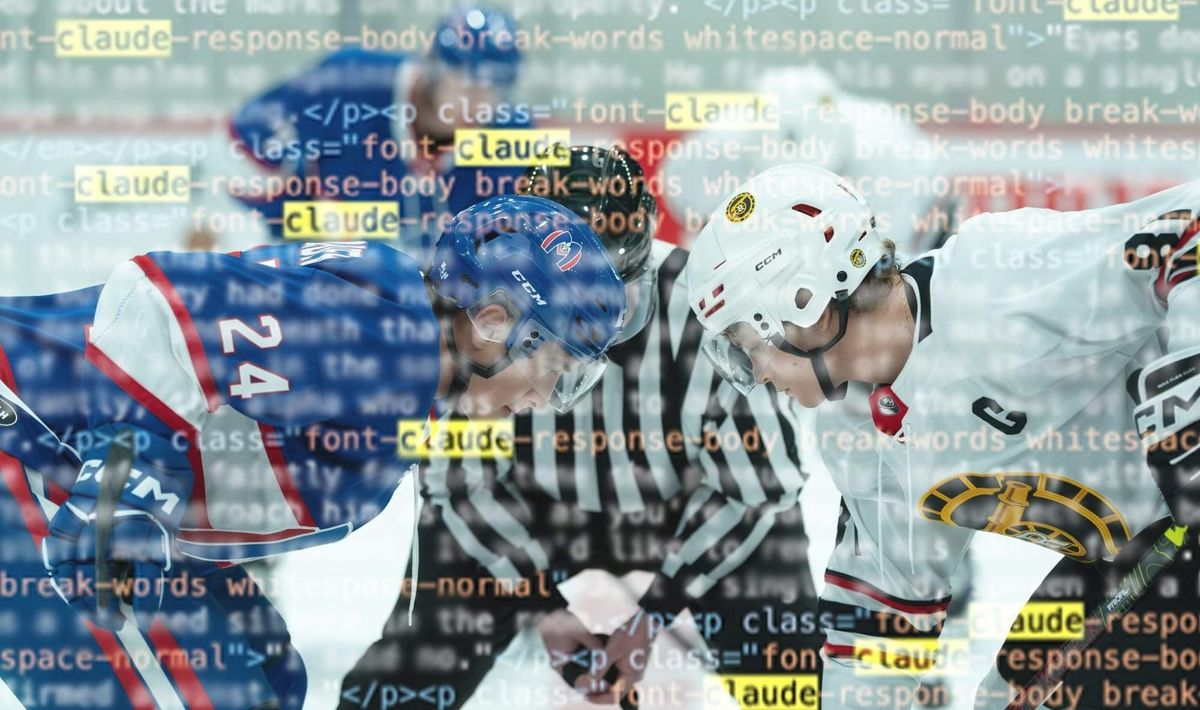
The document was released anonymously on X on June 29th—and it spread like wildfire. Titled “Fandom Has a Hidden Generative AI Problem,” it outlined a way for readers to identify cases in which a fanfic had been directly copied and pasted from Claude, the AI chatbot run by Anthropic, into the Archive of Our Own’s rich-text editor.
“We are fans of Heated Rivalry, a TV show whose rapid popularity surprised even TV executives,” the document’s authors write. “This does not by any means suggest that the issue is limited to this specific fandom.” Much of the 25-page PDF is dedicated to identifying specific fanworks, including some popular stories in the Heated Rivalry fandom, in which the Claude code has been found in the HTML. (As of the time of publication, the original has been taken down, though a version is preserved on the Internet Archive.) It came on the heels of weeks of escalation over AI accusations directed towards some of the fandom’s most prolific authors; some of these authors used those accusations to garner sympathy and support from other fans, and this “proof” seemed to directly undercut that.
The document’s stated purpose was to demand greater transparency from authors as to whether or not they’d used generative AI, so readers could make their own informed choices about which fics to read or avoid. Its authors specifically condemned targeted harassment, bullying, and ostracization of the fic writers identified as having used AI, despite “some [authors having] loudly opposed AI and encouraged friends and readers to rally against it publicly, only to use it under everyone’s nose.” However, as is the way of the modern internet, this hope for a productive conversation was, while taken up by some, ignored by many others—and across a wide variety of fandoms, people lost their shit.
The debate has become ground zero for fandom’s broader, ongoing reckoning with AI use. “There is a lot of policing, and suspecting people's work being AI-generated, and that's a huge source of hate and conflict,” says Regina Cheng, a data scientist who studied fanfiction communities as part of the Human-Centered Data Science Program at the University of Washington. “People are using AI tools to detect if people are using AI to write, and there’s just this endless conflict around AI and plagiarism. Because of the existence and introduction of AI, there is this general anxiety of, should we use AI or should we allow people to use AI in the fandom?”
Many of today’s fandom meltdowns feel much like the ones of the past, just hyper-scaled to match the size and pace of modern online life. But the latest blow up in the Heated Rivalry fandom feels like something new. Conflict has always been a part of online fandom, but generative AI destabilizes fandom at its core by destabilizing the entire idea of community. On an internet in which it is increasingly difficult to determine if the words in the fic you're reading, or the comments on the fic, were even human, what’s left? If we can’t figure out collective ways to mediate the threat AI poses, then fandom’s function as a digital space where we gather to connect and share is at risk of being destroyed.
Heated Rivalry’s explosion feels somewhat rare in an increasingly fractured media environment. Though the book series from which the show is adapted, Rachel Reid’s Game Changers, already had a passionate following, the TV adaptation reached new levels when it aired at the end of 2025. The series finale saw a 300% increase compared to the premiere-week audience, and, by February of this year, the TV show had garnered an average of 10.6 million views per episode on HBO Max alone.
The fandom for Heated Rivalry snowballed, too. On AO3, the "Shane Hollander/llya Rozanov" pairing finished 2025 as the 11th most popular ship, despite the fandom exploding only in the final months of the year. In November, there were only around 300 works for the Heated Rivalry fandom on AO3, according to Fanlore. This number grew to 4,500 within a month, 20,000 by the end of February, and over 40,000 at the time of this writing.
The show and its main ship were a sort of bat signal for many longtime fanfiction writers, but they also brought in huge numbers of fans of all ages who had never been part of transformative fandom before, leading to conflict between veterans and new fans around etiquette, norms, and reader expectations. Gradual shifts in the infrastructure of the internet towards more algorithm- and profit-driven consumption, as well as an increasing dependence on generative AI, made Heated Rivalry’s fanfiction circles—where works are being posted and read at a breakneck pace—primed for a fannish debacle.
In April, several authors of popular works announced they would pause writing their fics—and, in some cases, make their stories private or remove them altogether—due to harassment. In some cases, commenters were demanding faster updates. In others, they were criticizing characterizations, requesting specific plot developments, or taking issue with the inclusion of certain topics (e.g., sex work or BDSM). In the most contentious of cases, authors were being accused of using AI to write their stories without disclosing it.
The trend in authors privating or quitting fics isn’t unique to Heated Rivalry fandom, nor is it new. RPF writers have long locked their fics to outsiders; in recent years, even more authors started making their works available only to registered users in an effort to keep their fics from being scraped and used for training AI models. (This also makes it harder for newer fans to access fandom.) Two years ago, the Dramione corner of Harry Potter fandom saw a slew of writers privating and deleting their work following a persistent issue with people illegally selling bound copies of their fic. Anecdotally, fans have also reported authors deleting works if they failed to get the engagement they were looking for, or if they were simply done with fandom (seemingly unaware of AO3’s “orphan” option, which detaches the author from the story but keeps it online, as a part of the shared archive).
But the conflict over generative AI in Heated Rivalry and other fandoms has higher stakes and broader scope. Authors aren’t just privating their works; some are choosing not to write in the first place. Fans who have used AI in the past to generate fic are now struggling to write without it, prompting advice from others on how to quit AI. Some fic readers report being paranoid that the stories they are reading might have used AI, diminishing their enjoyment of the experience. Others have intentionally sought out fic posted before the public launch of chatbots in an attempt to ensure the stories were not written with the assistance of an LLM.
ChatGPT was released to the public in November 2022, with chatbots including Claude, Grok, and Gemini quickly following. In the short time since, the use of generative AI has become a defining issue of our time. Large language models are trained on massive quantities of data scraped (mostly stolen) from the internet, including from AO3. As companies and countries race to have the best generative AI models, massive amounts of resources are being funnelled away from other uses. (During the recent heat wave in the U.S., AI data centers’ rising electricity and water use intensified grid stress, leading to an increased risk of outages.) In her 2025 book Empire of AI, tech journalist Karen Hao argues that the development of AI represents a new form of empire that is exacerbating global inequalities at a rapid rate.
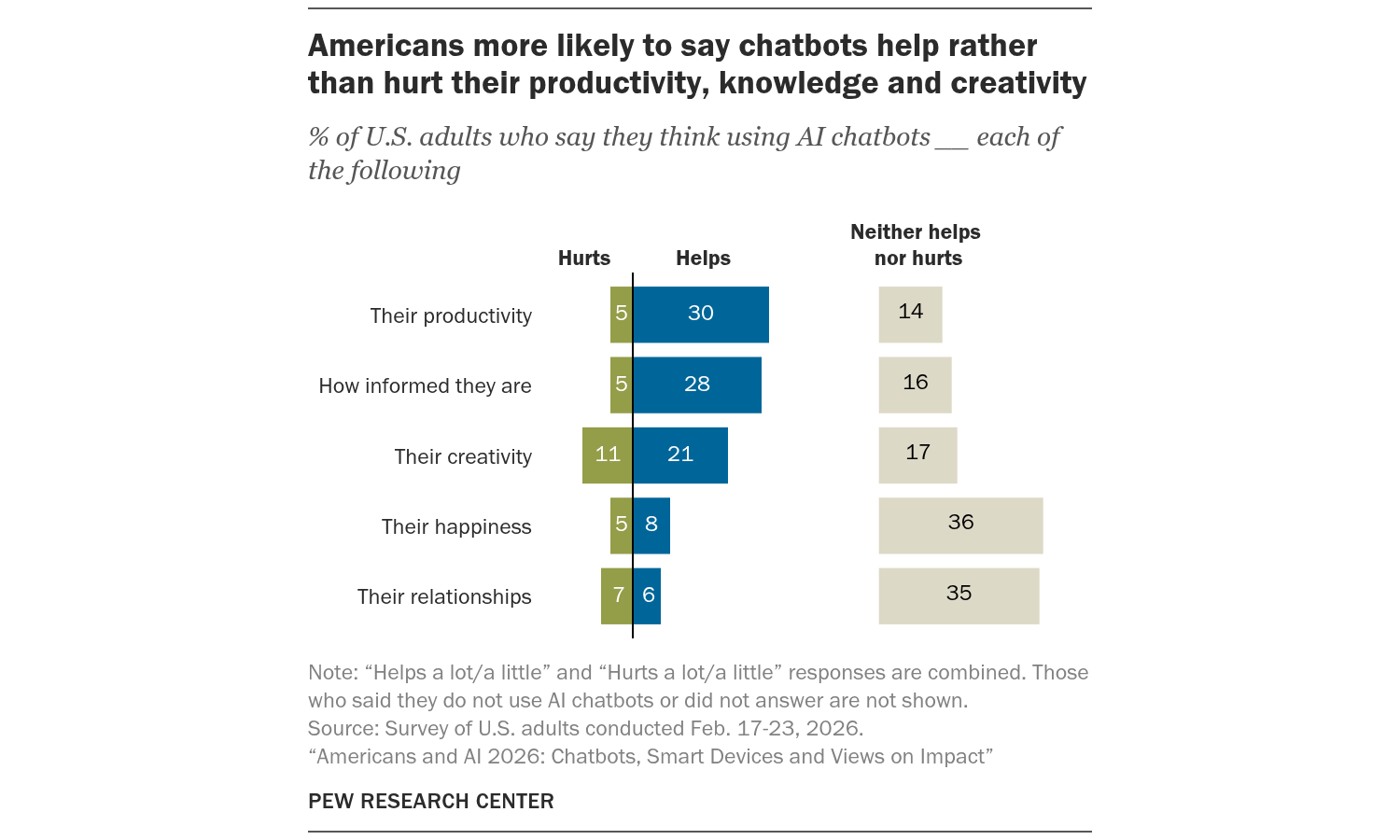
But the broader public seems to be accepting generative AI, begrudgingly or otherwise. According to a survey from Pew Research Center conducted in February and published last month, about half of American adults are using chatbots, and one-fourth use them on a daily basis. The code highlighted in “Fandom Has a Hidden Generative AI Problem” was specific to Claude, but only 6% of Americans use that platform; most choose ChatGPT or Gemini. (Note that these numbers have likely changed in the months since the survey was conducted—after Anthropic directly clashed with the Trump administration this past spring, Claude saw a huge surge in consumer downloads.) Meanwhile, of those surveyed by Pew, about one in five said these tools helped their creativity, compared with 11% who said chatbots hurt their creativity.
A recent survey published by Harvard Business Review points to an increased use of the technology in fan spaces, with “fan fiction [sic] and storytelling” as the fourth most common use case for AI. This signifies a change from the previous year’s survey, when fanfic writing didn’t make the top ten. Whether these respondents are actually members of participatory fandom or simply isolated people using AI tools to generate stories is unknown. But in communal transformative fandom spaces, attitudes towards AI are notably negative—often even hostile.
Amidst this upward trend, transformative fandom has skewed anti-AI from the start. The Organization for Transformative Works, the volunteer-run organization that runs Archive of Our Own, faced early blowback when a May 2023 edition of the OTW Signal shared a link to an interview that the OTW’s Legal Chair, Betsy Rosenblatt, gave in a personal capacity. Rosenblatt spoke positively about AI’s reading and creation of fanfiction—and many AO3 users were very upset.
One user, Mina, commented on the Signal post: “Team, you can’t just drop this kind of AI commentary from your legal chair and walk away without addressing the valid concerns that users and donors have been raising for months. Questions of whether scraping is ethical or not is understandably something OTW may not want to comment on, but that does not mean you can stand idle and refrain from letting users know the OTW’s next steps on the topic.” The OTW subsequently removed the link and article excerpt, stating in a separate update that it “does not represent an official position on the part of the OTW or its Board of Directors” and that “we understand our users’ concerns around this issue and are taking these very seriously.”
In the past few years, AI tools have become normalized in many spaces—and very quickly. The share of middle school and high school students who reported using AI for help with their homework jumped from 48% in May 2025 to 62% in December 2025, according to a study conducted by RAND American Youth Panel. Most students surveyed did not see AI use as cheating, unless it was used to explicitly get answers on homework. At the college level, 57% of U.S. college students admit to using artificial intelligence in their coursework at least weekly, according to a study from the Lumina Foundation-Gallup 2026 State of Higher Education study. As is the case with adults, student-age girls and women report using AI less frequently compared to boys and men.
In the same timeline, public-facing fandom sentiment around AI has remained largely negative. This spring, the writing platform Ellipsus—a favorite of many fic writers that actively markets to fandom—published the results of a survey they ran on creativity and AI with more than 5,000 respondents. While Ellipsus’s stance as an anti-AI tool likely influenced who took the survey, the results were overwhelming: 97.8% said yes to “Do you actively avoid content you suspect is AI-generated,” and 97.4% answered “very important” to the question “How important is it to you that a piece of writing is authored by a human?”
In many corners of fanfiction fandom, the conversation has moved towards how to identify AI use in fics and what to do about it. @tinawithana, a TikTok creator who talks about fanfic, suggests limiting engagement if you are an AI-critical fic reader who stumbles upon a work you suspect to have used AI: don’t like, don’t read. But there have been plenty of examples of pitchforks being sharpened, with some fans going full websleuth in their efforts to singlehandedly root out suspected AI use. The environment of fear and anxiety is reflected in Ellipsus’s survey results: nearly half of the respondents worried their own work would be mistaken for AI-generated.
Within Heated Rivalry fandom, the conflict around AI came to a head with the self-imposed exodus of popular writer OpalApparition this past spring. Their stories had been some of the most-read in the fandom since the series’ release at the end of 2025, and they nurtured a lively following with consistent and frequent updating, robust author’s notes, and replies to comments on AO3, as well as on Bluesky, Threads, and Tumblr. In their chapter notes, they often included details about their life and writing process, including where the inspiration for their stories came from.
As is inevitable with high engagement, OpalApparition was met with some critical comments. These included demands for faster updates or criticisms around story decisions, but it also included accusations of undisclosed AI use due to the speed at which they were posting, and the appearance of some common Claude “tells” (anecdotally: the number 47, the name “Marcus”). OpalApparition denied AI use, with the endnotes for their popular story “Wolfbird” including the disclaimer: “YOU MAY NOT USE MY WORK TO TRAIN AI OR POST ON OTHER PLATFORMS. NOAI — NO DATASET USE — NO ML TRAINING — NOT FOR MACHINE LEARNING — NOT FOR AI.”
At the beginning of April, OpalApparition announced via a “Wolfbird” update that they would not be continuing to update the story publicly, saying, “Hi everyone. Writing is a fun hobby for me and that’s all it’s ever been; lately it has not been fun at all. I’m returning to just writing privately until it is something I enjoy again. This fic will be finished offline with my OG friends and community because I still love this story, but I don’t plan on posting more at this time. My hope is that when the entire story is finished and I’m in a different headspace I can come back and post the rest.”
The announcement garnered sympathy across the fandom, and readers shared messages of support on social media. “I hope Opal is reading all the comments here, on Twitter and on Tumblr and feeling allllllll the love and appreciation for her work,” wrote Reddit user _radish234 on the HeatedRivalryFanfics subreddit. “opalapparition ai allegations is like accusing jane austen of having a ghostwriter,” posted @couplescoffin on X. “Wishing Opal all the best. This is better for both the fic and her mental health; I’m glad that she will finish writing this without the influence of the internet. Her writing is art in that it is such a reflection of her soul and passion, and that is what makes it so good. Trying to cater to idiots and haters on the internet would only diminish the work,” wrote @ali_learns_to_read on Threads.
When the “Fandom Has a Hidden Generative AI Problem” document included evidence that OpalApparition used Claude to write one of their stories—albeit in only a few visible instances—the author became a focal point of the fallout. But OpalApparition wasn’t the only Heated Rivalry fic author going private following accusations of undisclosed AI use. Author passacig deleted their story “Carry the name” after fans found what appeared to be an LLM prompt left in the text of their work. And in June, one writer was reported to have died suddenly following accusations that they had used AI to write their stories, prompting skepticism that their alleged death was instead a “pseudocide” in an attempt to evade criticism.
“Fandom Has a Hidden Generative AI Problem” showed that fic writers are using AI tools far beyond Heated Rivalry: other stories called out included works in The Pitt, Pluribus, Off-Campus, and Stranger Things fandoms. The frequency of the code in the 38 works included in the document varied. OpalApparition’s fic just had two examples of the Claude-specific HTML wrapper, while other Heated Rivalry fics had many more; two examples, both of which have since been hidden by their authors, included 122 and 402 instances, respectively.
The document includes an AO3 site skin—a sort of installable code-detector—for identifying works containing Claude-specific HTML, but both the strategy and skin only work for identifying very specific examples of AI use: stories that have been directly copied and pasted from Claude into the rich-text editor on AO3. It doesn’t include Claude-produced stories that have been copied and pasted into any other doc first, or from which the identifying HTML wrapper has been scrubbed. It also doesn’t include works of fanfiction generated by other chatbots, and isn’t able to specify in what manner Claude was used.
“The absence of this code, whether in the remainder of the fic in question and/or in other works, is not indicative of a lack of AI usage,” the document’s authors wrote. “The presence of this code is a positive indicator, not a negative.” By sharing this definitive form of evidence of AI use, the document also gives authors a guide to avoiding detection in the future. All they have to do is transfer the text into another document first, or simply toggle to the HTML editor on AO3 and manually remove any residue from the AI tool.
“Fandom Has A Hidden Generative AI Problem” gives shape to a breakdown in a basic social contract for online fandom and all online community and discourse. While fanfiction writing is generally pseudonymous, readers have historically at least been able to rely on the assumption that a fellow human being is writing the story they are reading. With the introduction of AI, that fundamental pact between fic writer and fic reader has been fractured. Fandom is a place for people to be in community together—to bond over shared obsessions in a way that can make us feel a little less alone. Realizing someone has outsourced that connection to a machine can make us feel even more alone.
This breakdown of trust has been swirling on the reader side, too. Previously, fic writers have been able to rely on the assumption that the users commenting on their work are, in fact, real people. They may or may not be acting in good faith, but at least they knew the commenter was a thinking, feeling human. However, the Archive of Our Own has seen an uptick in spambot activity since mid-2025, some of which are programmed to leave comments accusing writers of using AI. This makes online discourse and attempts at community accountability that much more difficult—to the extent that many fans are increasingly feeling like it’s not even worth trying.
The breakdown in trust could lead fans to seek security in more siloed spaces. Studying fanfic feedback culture in 2022, Regina Cheng and fellow researcher Jenna Frens didn’t just look at public-facing spaces like the comment section of a fic. They also identified more private spaces, such as Discord servers of fic writers in a fandom or the Google docs where writers and their trusted betas discuss a story being written, as sites where commentary and connection were happening. “Those are places where there's different levels of vulnerability, and also different levels of access, and so fanfiction writers have curated this really sophisticated multi-platform world,” Frens told me in an interview. “In Google Docs, you could be using your real full name, but you wouldn't necessarily put your real identity out there attached to your fanfiction work. There are real tangible differences in how people interact in these spaces, and how safety is created.”
In these smaller, more intimate fan spaces, fandom tends not to be solely interest-based, but also bond-based, referring to the relationships of vulnerability and trust that grow. When criticism occurs within these bond-based communities, it tends to be received in a different way than when it is delivered by a guest user on AO3 who may or may not be human. But when you scale this up to a fandom the size of Heated Rivalry, it’s very difficult to establish those kinds of bonds, even without AI in the mix.
Fandom reaction following the release of the document has been mixed. Common sentiments included sadness and frustration. For those who’d leapt to the defense of authors claiming to have not used AI only to find out they had been, there was a sense of betrayal. Others expressed vindication that their suspicions that AI was being used in certain works had been irrefutably proven. And some readers have expressed paranoia that they might be reading works created using AI. “[I]ts genuinely despairing and I feel like my safe space and hobby has been stolen from me,” wrote throwawaymomaita on Reddit.
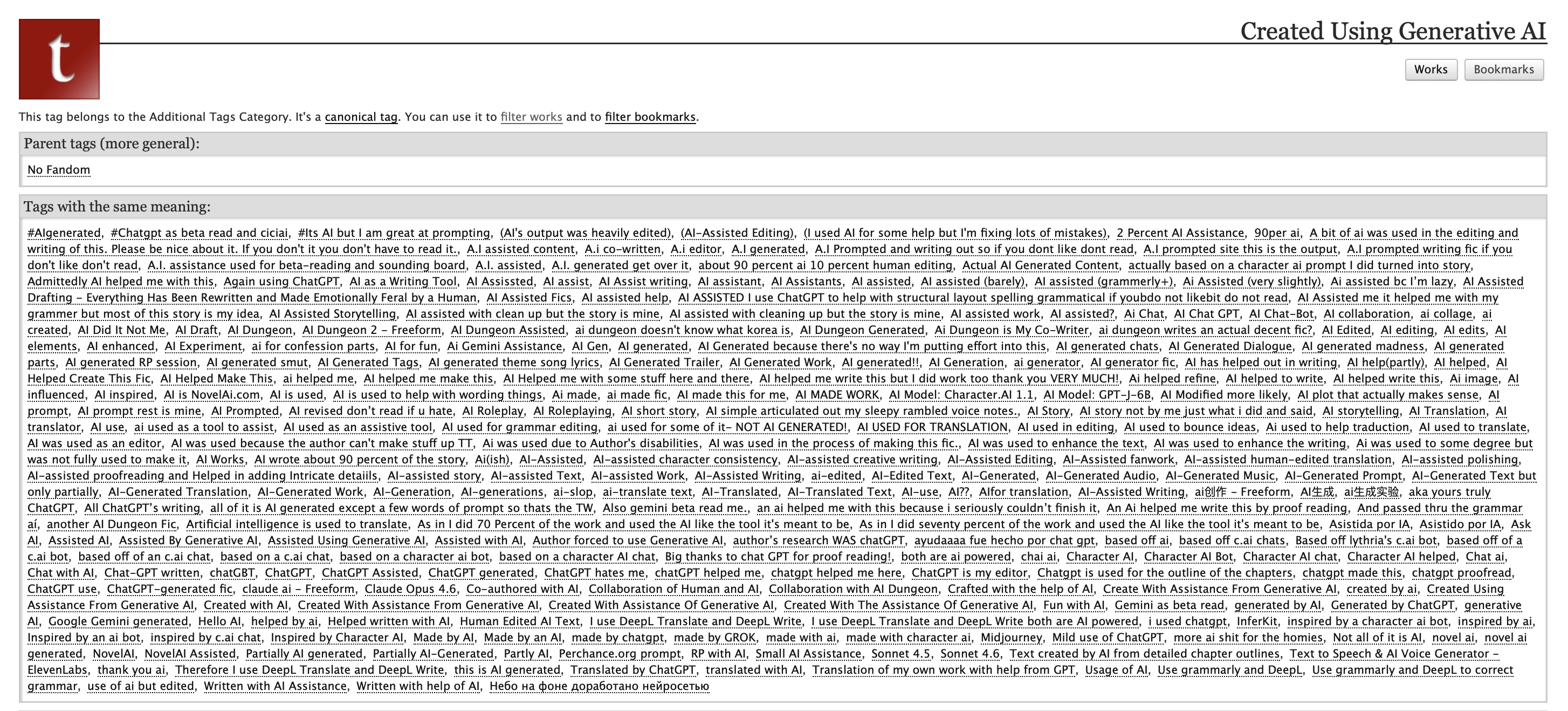
For Jen, a writer in the Heated Rivalry fandom, the issue is one of transparency and accountability. “I would occasionally see the tag AI assisted or AI generated content, and I would ignore those, but I appreciated the transparency,” they told me in an interview. (The “Created Using Generative AI” tag on AO3 currently has over 10,000 works.) “My problem with it now is there's no transparency, it's people who rail against AI in the tags, and then next thing you know they're leaving a prompt in, or Claude is in the HTML. Since then, people have been coming out and saying, ‘Oh, I only used it for this one part, for coding,’ or ‘My editor did it,’ or whatever. My problem is you still used it.”
For some, AI use doesn’t seem to be a problem. Some are steadfast in their support of their favorite authors; others just want the next chapter. “[I] may be in [the] minority but why do people feel that they can accuse an ao3 author of using ai,” commented @thetripleaaacrew on a TikTok lamenting the use of AI in OpalApparition’s work. “[I]t’s everywhere we will never know. if u enjoyed the story that is all that matters - i personally do not care if they use it.” Below that, another commenter laments: “Now we are NEVER going to get the rest of Wolfbird. Ugh!” If you need any more proof that fandom is not a monolith, the most-kudos-ed work in the “Created Using Generative AI” tag is a Shane/Ilya fic; it currently has more than 200,000 hits.
Others are worried that the Claude site skin will encourage harassment in their quests to root out the use of AI. “I am anti-genAI, especially in creative fandom spaces, but I'm even bigger against witch hunts and harassment,” wrote princesscas on Tumblr. “Because that's [all] this ‘exposed authors’ document list (and future lists) is going to do. It doesn't matter if there's a big disclaimer about NOT attacking the people listed. The internet will do what the internet does nowadays and backstab anyone they deem unworthy, especially toward ones that they've been given the greenlight to attack.”
More Heated Rivalry fics have been deleted or set to private in the week since the document was posted. Several have amended notes explaining why they used AI. In one case, an author responded to the call for transparency by clarifying that they used Claude to proofread and format their fic. “[I] do not ever use [AI] for generative writing,” they wrote, “but for the sake of transparency if the use of ai in any capacity makes you uncomfortable you should be aware of this.” They apologized for “anyone who feels betrayed or let down by this,” and vowed not to use AI in the future. The user had temporarily turned off comments on their fic following receiving death threats. Another author admitted to using AI in place of a beta reader, but has since found a human to do the task.
JetTheRooster, another Heated Rivalry writer, doesn’t support the use of generative AI in fandom, but worries nuance has been lost in the quest for transparency. “There are hardliner voices in the fandom that demand an AI tag on every work where AI was involved at any point in its creation, for whatever reasons,” they told me in an interview, giving grammar check, formatting, translation, and full-text generation as examples. “Personally, I find this demand difficult to define in a clear way that allows a tag to work properly.”
Other hypotheticals JetTheRooster gives include the use of AI-generated summary on a Google search, the AI-enabled autocompletion in a word processor, or an AI-assisted voice-to-text software. “Depending on the definition of an AI-assisted work, it may very well be that many works would fall under that definition without the authors even realizing it,” they say, adding that the choice to include specific works in the Claude document encouraged dogpiling rather than nuanced discussion about what is and isn’t AI-assisted art: “We may hate genAI, but it's not going anywhere.”
In earlier eras of the internet, the joy of creating and sharing fanworks was more than enough reason to create fanfiction. However, fic is increasingly seen by publishers as a source for commercially viable works. “Editors are looking for people that are coming out of fanfic because they understand the tropes and they understand what readers want,” Deidre Knight, a literary agent who reps Rachel Reid, told Vulture in January. “It’s driving trends on the publishing end a lot more than people realize.” If you’re someone hoping to get a publishing deal, fanfiction might be a way to do it—or at least it seems like a possible golden ticket, even if only a tiny fraction of people will get tapped by agents or editors. Other writers are mirroring the self-publishing model, keeping mention of money off AO3 but charging via external platforms like Patreon. Money incentivizes producing content fast and building a large following around your work—and also hiding the use of generative AI, which carries a stigma in most creative communities.
For Jen, these issues are a core part of AI use in Heated Rivalry fanfiction. “What sparked it all for me was [a fic writer] who had a book coming out and got caught using AI, which led everyone to start talking about the book,” they said. “If you use AI in your fanfic and you're using it in your promotional material for your book, who’s to say you’re not using it in your book?” If accusations around AI use not only threaten your fandom cred, but a possible publishing deal or book sales, the stakes are arguably higher.
After the early blowback, the Organization for Transformative Works made it clear that the AO3 wasn’t going to be deleting AI-generated works. “If fans are using AI to generate fanworks, then our current position is that this is also a type of work that is within our mandate to preserve,” they wrote in a 2023 news post titled “AI and Data Scraping on the Archive.” The Archive’s stance continues to be one of “maximum inclusivity.”
A 2024 update guide to the AO3 Terms of Service announced the explicit forbidding of the scraping of AO3 data for commercial use. On the topic of a possible ban against AI works, the guide stated: “There are many arguments for and against allowing AI-generated content. However, a ban against AI works is not enforceable. Humans, including our all-volunteer PAC team, are not able to reliably detect the use of AI in creative works, and AI-detection programs are extremely unreliable and prone to false positives. AO3 is meant to be a home for all fanworks, regardless of the creator's skill level; as such, removing valid fanworks on the risk that they might be generated by AI is counter to our ethos.”
The OTW declined to comment on the “Fandom Has a Hidden Generative AI Problem” document—and it seems unlikely that their stance here will significantly change any time soon; nor, many would argue, should it. So-called “AI detectors” are unreliable, and are proven to be biased against non-native English speakers. What we’re left with are a lot of unsatisfying options. Doing nothing feels bad, but so does hunting witches. It further exacerbates the erosion of trust that is happening across online fandom, and in large part because of AI.
Fandom, like other parts of society, is going through seismic changes. COVID lockdowns brought more people than ever before to fanfiction, part of a “mainstreaming” of fandom that has made transformative works more accessible and plentiful than ever before. Could the conflict around generative AI send us back into smaller, less open fandom spaces? Or even into—gasp—offline fan spaces in which the humanity of a fellow fan can be 100 percent verified? Is this a good thing? The rollout of generative AI has truly felt like having our faces forced into the contents of a still-opening Pandora’s box. Whatever happens next, hopefully fandom’s ongoing reckoning with this technology will be less volatile.
This article has been modified to add the archive link to the “Fandom Has a Hidden Generative AI Problem” document.