Crunching the Fandom Numbers
In 2013, curiosity about Johnlock fic led me to pull my first fandom stats. Today, the world of fandom data analysis is thriving.

In May of 2013, I posted to Tumblr what I thought would be a quick, one-off analysis of the fanworks on Archive of Our Own. I was a new user of AO3 as both a writer and reader of fanfic, and my graphs addressed a few of my burning questions about the archive—e.g., how much of AO3 is devoted to explicit smut? I figured maybe a few other fans on Tumblr would be interested in what I’d learned.
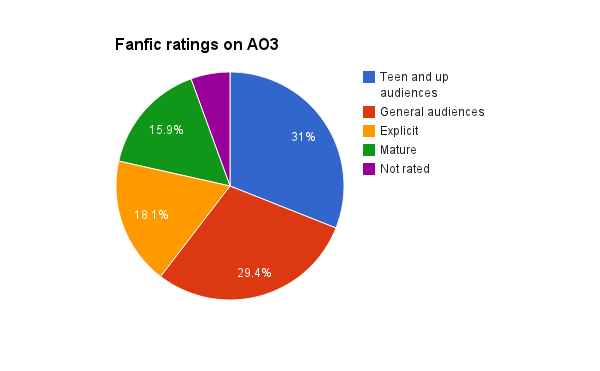
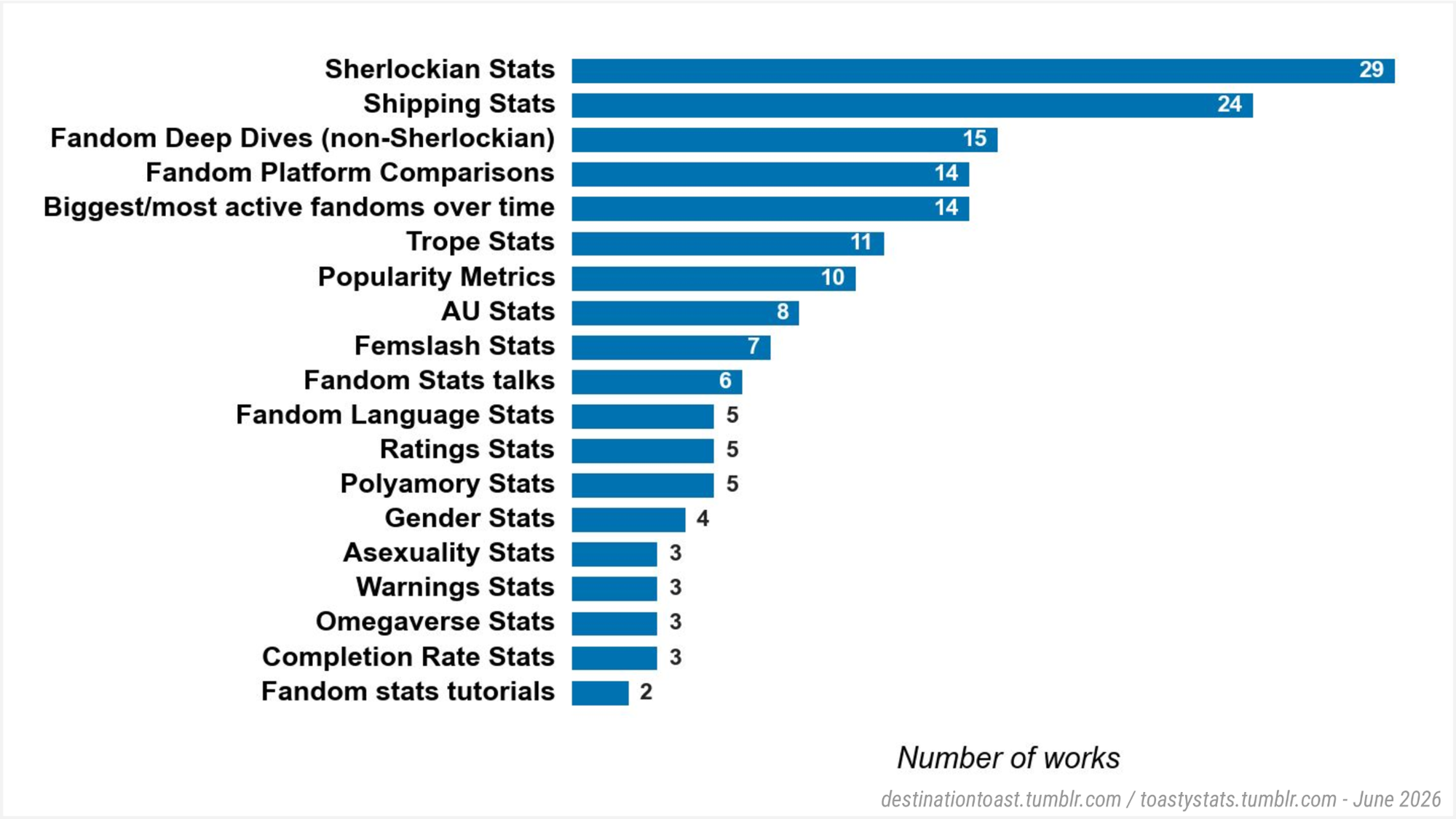
More than a dozen years later, I’ve shared over 130 such analyses in my Fandom Stats series and toastystats blog, featuring hundreds of graphs and hundreds of thousands of words devoted to fandom data. I’ve gone on several fandom podcasts (including many appearances on Fansplaining) to discuss my work, and have been cited by academics and journalists writing about fandom. What caused my evolution from AO3 n00b to someone people turn to when trying to understand fanfiction?
You could say it’s AO3’s fault for its tagging system and its radical data transparency. You could also say it’s the fault of the unexpectedly intense curiosity of other fans. I would not have ended up here without both.
When I first watched BBC Sherlock in late 2012, I felt compelled to seek out fanfic for one of the first times in my life. I had been intensely fannish about books and shows for as long as I could remember, but I had generally only read fanfic that was recommended to me by friends. (I wrote fanfic back in high school with my best friend, before we had a name for what we were doing.)
But the BBC’s modern adaptation of the Holmes mysteries compelled me to think, “Surely someone out there must have written fanfic about Sherlock Holmes and John Watson having sex.” I googled it and was led to AO3, where, in fact, many, many people were writing about that very thing.

In previous decades, I’d read fanfic on fandom-specific newsgroups, websites, and LiveJournal communities, but by 2013, much fannish activity had migrated to centralized multi-fandom archives like AO3. I was immediately impressed with how easy AO3 made it to search across many fandoms at once, and how their tagging system made it possible to filter fanworks by fandom, ship, character, and more.
Thanks to the AO3 volunteer tag wranglers, the freeform user-generated tags were clustered into synonyms and organized into hierarchies. This meant users didn’t end up with the common problem on other sites that used tags, where fanworks were fragmented across many different variants that meant the same thing. No need to search separately for #johnlock, #john/sherlock, #sherlock/john, #sherlock x john, #s/j, etc., as on other platforms heavily adopted by fandom, like Tumblr and Wattpad.