The Bachelor and the Fantasy of Performance
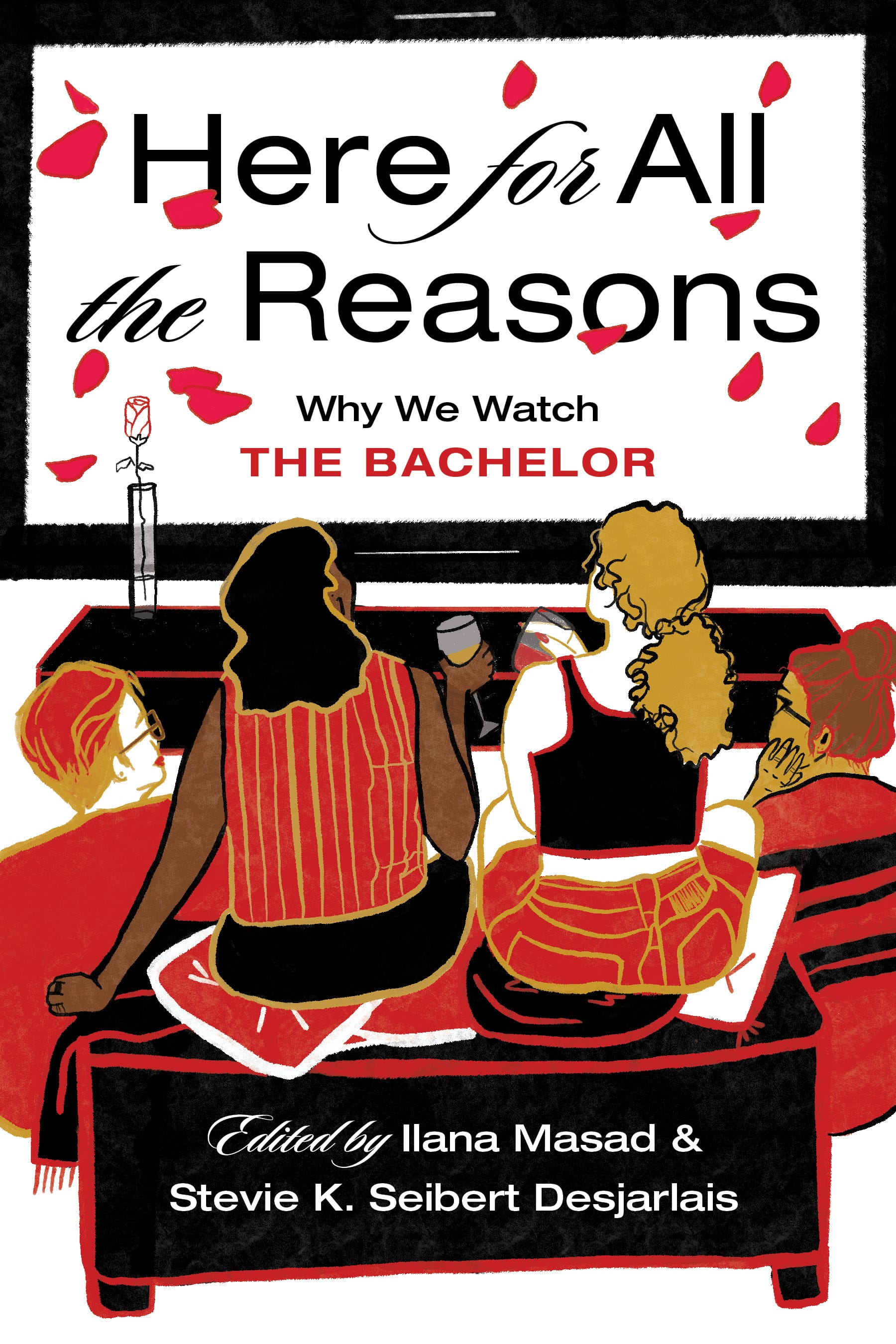
In Here for All the Reasons: Why We Watch The Bachelor, Ilana Masad imagines competing on the show, imaginary straightness and all.

I fill out a long form, list my age and height and weight. I attach a carefully curated collection of photos that show a lot of skin and capitalize on the thinness I “earned” (read: self-harmed myself into) via a years-long, relapse-filled bout of anorexia and (ongoing) recovery. A producer decides that my application is interesting; after all, how often do they see applicants with wholesome bookish tattoo sleeves, tasteful piercings, no apparent dreams of an influencer career, and a sincere desire to find love with a heterosexual hunk? I probably look more like a SuicideGirl than the usual applicant, and that makes me unique enough to be considered for a spot as a contestant on The Bachelor.
(Of course, I don’t know what the producers are looking for. I’m speculating, or perhaps it’s more exact to say that I’m extrapolating from the data available to me in the near-decade I’ve been watching this franchise and making reasonable deductions.)
I get an email or maybe a call. The producers want to meet me! I undergo a lengthy interview—several, most likely—in which I attempt to seem like someone I am not: straight, cis, feminine, apolitical, a person of faith (i.e., Christian). They ask about my former relationships, and I tell them about the first high school boyfriend, then the second; I tell them about the whirlwind summer romance with the one I call Soldier Boy (they’ll like that story); and the many disappointing dates and hookups with men that came in the couple years that followed. I omit the high school girlfriend, obviously, and the one in college, and the two I had (not simultaneously) in grad school.
They ask about my family, and I tell them I come from an unbroken home, which is to say, my parents were together for decades. My closest family are my mom; my brother, who is married and has a daughter; and my aunts. My aunts are gay and married, but contestants are allowed to have queers in their family these days, as long as they’re not too out there. They’re all so loving and supportive, and I tell the producers that family means everything to me. I’m telling the truth about this part.
Actually, outright lying makes me incredibly anxious, so I’m telling some version of the truth throughout, lying by omission. I’m not saying I’m straight, for instance, just not telling them I’m queer; I imagine this can be a fun admission to make once I’m on the show. Yes, I’m dressed in some kind of acceptable femme outfit, but they needn’t know that it feels like I’m in drag. I’m not claiming I’m Christian, just not sharing that I’m Jewish; if they ask if I believe in a higher power, I can comfortably say I do, and they’ll assume I mean god.
When asked about any hardships I’ve endured, I have plenty of palatable trauma to conveniently exploit (my dad died when I was sixteen; the aforementioned eating disorder). As a once (and thus, always) theater kid, I perform well enough to charm my interlocutors.
They want me. I can tell. I flush with pleasure. Part of me is forever a bullied seven-year-old kid, a tween getting left out of the cool kids’ circle, a college student always being asked whether my hot friend is single. My nonconformist streak grew, at least in part, out of my desire to give the middle finger to the normative people and spaces that rejected me. The Bachelor is nothing if not the height of normcore, and the producers letting me into the club is thrilling. Yes, they know and I know that I’m never going to win, but I might make it surprisingly far on the not like other girls brand that my physical appearance could signal, and if nothing else, the producers think, there will be some viewers who will love to hate me and my whole vibe.
Next up: the background check.
This is where the fantasy always falls apart. Even if I scrubbed all my social media, the internet is forever, and I’ve written personal essays, articles, and reviews that publicize my political leanings, mental and chronic illnesses, and queer and polyamorous “lifestyle.” All this would instantly disqualify me from one of the straightest dating shows on television. (Never mind that multiple men who’ve had restraining orders filed against them have passed their background checks unscathed.)
Long forms and applications are normally not a part of my fantasy life, but I’ve never stopped thinking about the what if of it all. Once, I even asked my partner if he’d be willing to remove our relationship status on Facebook, since I knew that if I had an obviously public one, I would automatically be out of the running. (He refused, not because he particularly cared about the status; he just didn’t want to deal with the flood of “omg what happened?!” messages from friends and family if they noticed the change.)
I never expected to become a fan of any reality TV, let alone The Bachelor franchise, but once I firmly joined the ranks of avid viewers, I started wondering what it would be like to be contractually stuck in a house with a couple dozen women. No phones, no books, no TV, no internet. Instead, a rigorous filming schedule that requires them to stir up drama, do their hair and makeup every day (potentially multiple times), dress well for each outing (frequent outfit changes are part of the gig), and always (always!) be on.
While I’m an introvert, I give good social face, and I’m able to act the part of the extrovert when needed. Is that true for some of the women contestants? Might they, too, be acting out a version of themselves on-screen?
How much does the act of observation—the presence of cameras, the scrutiny from other contestants—influence their behavior? How different is real life, actually, in an age where we are always performing on social media which surveilles us in return?
Believe it or not, these existential questions fuel my enjoyment of the show. I’m endlessly curious about the tension between what is real and what is fake; what is pretend and what is sincere; what feels like truth in a moment of high intensity and what truths can last. I want to know what narratives the contestants tell themselves about their behavior while film ing, and how those change when they’re watching the show back, and how their viewpoint might morph again in ten or twenty or thirty years when their time on The Bachelor is long behind them. Most of what I want to know, I’ll probably never learn; even the contestants who publish memoirs (likely ghostwritten) are still selling a version of themselves to go with their public persona and brand. I want to know how they share their experiences with their therapists, their moms, their children. I want to know what nightmares they wake up from years later.
Sometimes, when I’m watching a contestant having a meltdown over a man she’s known for two weeks or proclaiming she’s found the love of her life only to get over it by the time the next season of Bachelor in Paradise starts filming, I wonder what they must be feeling and thinking in that moment. How many of the crying fits are due to exhaustion, the lack of privacy, the constant camera lenses, the interview upon interview that last for hours? How often do people genuinely fall in love on the show but only because of the situationally heightened emotions, the whirlwind romantic dates, and the fantasy of a happy ending? And what does it really mean, ultimately, that people choose to go on these particular dating shows, known for humiliation and conflict?
In my fantasy, if I ended up on the show, I would be prepared because of how much time and energy I’ve spent on the franchise. I would plan to be as nice as possible, so as to make friends and not get a villain edit, but would pick sides in other people’s drama (not that I would ever bring it up to the Bachelor), so as to get more screen time. I would ask the Bachelor a lot of questions about himself, and I would “be myself,” by which I mean I’d be forward and honest, which will charm him because he likes a “strong woman” and, anyway, he’s secretly always had a bit of a thing for bad girls and that’s obviously what I am, what with all the skin I’ve deliberately inflicted needles on. I’d try to make it to the point of free international travel. I’d vow to use a little journal to write not about myself, but about everyone else; I’m a fiction writer, after all.
All right. Time to be honest with myself. First, there’s simply no way I could ever—and I do mean ever—keep up with the hair and makeup and dressing routines of the other women. When I try to put eyeliner on these days, I end up looking more like my emo-kid self from 2005 than a thirty-five-year-old adult. Most of my clothes I’ve had for at least a decade (except for socks, which I seem to wear out faster than reasonable), some so old that they’re falling apart, but they’re comfortable. I haven’t worn a dress in years, and while jumpsuits occasionally make an appearance on The Bachelor, they’re rare at rose ceremonies; overalls and an old band T-shirt would probably get me preemptively kicked out of the Mansion by producers. Even if I could keep up my social facade, I’m not enough of a method actor to pull off the kind of femininity the franchise requires.
Second, I know that no matter how cynical my intentions, how armored and guarded I’d be, there would be real moments. Friendships I’d make, embarrassments I’d agonize over when trying to sleep, moments of conflict and shaking rage, and the haunting fear (present enough in my real life) that the others didn’t like me. No matter how ready I’d think I was, I suspect things would get messy very quickly. I’d catch feelings (maybe even for one of the other contestants) or I’d end up crying both on- and off-camera or I’d just lose it and start yelling at people about heteronormativity and demanding to know how they can be comfortable wearing heels all the time.
No matter how curated, packaged, and scripted the narratives on our screens are, the process of creating The Bachelor and its offshoots is, truly, a social experiment—the shows are shockingly legal, incredibly well-financed, unambiguously exploitative, qualitative social experiments. A host of people are thrown together into luxurious-looking but realistically uncomfortable situations that might overwhelm, disgust, or trigger them. All the while, at their best—and mostly their worst—they’re being filmed. The producers poke and prod at the contestants’ emotions, inflame their insecurities, inflate their egos, encourage their impulses and outrages. Some contestants are chosen to deliberately dislike each other, whether organically due to personality clashes or pushed into those feelings by producer-leaked gossip. It’s an experiment with no control group—unless that’s us, the audience.
That’s what gets me: Despite all the fakery, the women ostensibly vying for the lead’s heart are also real people. They share bathrooms at the Mansion, snore or lie awake in their bunk beds, get drunk and silly or drunk and maudlin or drunk and unaware. They catch colds, feel the stirrings of desire between their legs, hunger for their favorite foods, miss their pets.
Yes, they know what they’re getting into, at least theoretically. But honestly, how many of them have no idea how to deal with the intensity of the situation once they’re in it? When I fantasize about joining them, it’s always as a dispassionate observer, which I don’t think anyone could ever be when put under this kind of microscope.
Ultimately, despite the fantasy, I don’t envy these women one bit. The amount of pressure they’re under, the constant need to look and sound and act palatable (or, often deliberately, otherwise) sounds utterly, devastatingly exhausting. I feel lucky, really, that I am who I am, that I cannot fathom giving this much of a shit about clothes or makeup or a man. It’s not that I’m better than them—I’m not—but simply that I think being who I am is so much more comfortable. Instead of spending hours on my hair, I get to sit at home with a joint and a bowl of corn chips, a passive viewer in the ride of someone else’s life.