The Limits of Fan Service in Thailand’s Vibrant GL Genre

Thai “Girls Love” thrives on real-life star pairings—for better and for worse.

Share
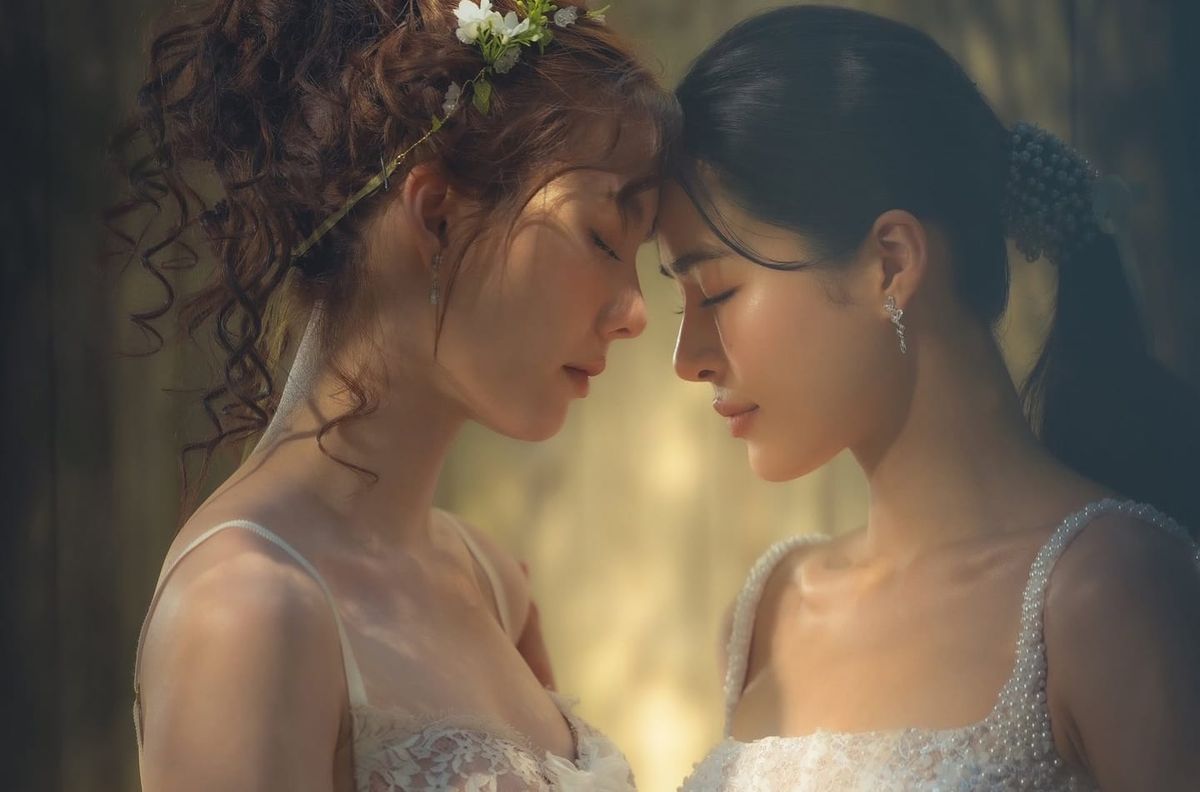
Thai GL stars Orm Kornnaphat and Lingling Sirilak Kwong, aka LingOrm strikpose with foreheads touching and eyes closed in a gauzy promotional poster for the upcoming series In Love Forever.
Thai GL stars Orm Kornnaphat and Lingling Sirilak Kwong, aka LingOrm, in a gauzy promotional poster for the upcoming series In Love Forever. Photograph courtesy Channel 3 Thailand.

In early 2024, after years of watching Thai BL—stories featuring male/male romance, popularly known as the “Boys Love” genre—and in my desperate quest for more sapphic stories in Asian media, I finally sat down to watch GAP: The Series. Released in 2022 and adapted from Chao Planoy’s novel of the same name, this was the first mainstream Thai Girls’ Love (GL) series, kicking off an entire genre built around sapphic storylines and idols with sizzling chemistry.

By the time I watched Gap, GL had become a thriving industry with a robust fandom culture, and my social media feeds were constantly flooded with fan edits of GAP stars “Freen” Sarocha Chankimha and Rebecca “Becky” Patricia Armstrong, alongside clips from their fan meetings, interviews, and livestreams. Don’t get me wrong—I was not complaining.

Part of the reason the show piqued my interest was that people weren’t just obsessing over GAP itself; they were obsessing over FreenBecky as an RPF ship. Their joint public appearances, in which they performed an intimate relationship through touching, flirting, and other titillating hallmarks of classic fan service, felt like extensions of the series itself. 

While fan service is often in the eye of the beholder, defaulting broadly to anything that seems to be deliberately catering to fans, fan service in the Thai GL and BL industries has the specific aim of creating moments that fuel a fan’s love for various romantic pairings. The fan service that FreenBecky performed in their fanmeets and other public appearances was intentionally designed by their studio, Idol Factory, to make people fans of the two actors together as a “co-brand” outside of the show—a tactic that’s become an increasingly common part of Asian media marketing. 

This practice significantly overlaps with RPF shipping, to the point where it’s sometimes impossible to separate fandoms of paired actors from fans who ship those actors together. The co-branding also fuels interest in the show they’re in; all the FreenBecky promotion made me eager to see how their fictional GAP ship would evolve, with cold, intimidating Sam (Freen) slowly revealing a softer, more loving side as she fell for Mon (Becky).

Now that the industry is four years old, GAP may no longer be considered the strongest Thai GL in terms of production or storytelling, especially after later releases like 2024’s The Loyal Pin, also starring Freen and Becky, whose chemistry and acting felt more fully developed. Other standout Thai GL series include 23.5, Pluto, The Secret of Us, Queendom, and Affair. But GAP undeniably changed the trajectory of Thai GL. At a time when many entertainment companies still viewed GL as financially risky and too niche, Idol Factory, the company behind GAP, was the first to prove that GL could generate serious revenue through the main couple’s ancillary fanmeets, brand endorsements, and merchandise, beyond just the show itself.

But as the industry continues to expand, I have witnessed growing conversation about whether the very thing that helped the genre thrive—fan service and shipping culture—could now be stifling its creative growth. Some fans worry that the industry has become so dependent on fan service that good storytelling is no longer prioritized.
“Don’t get me wrong, fanservice can be fun and it’s definitely part of what keeps people engaged. But sometimes it feels like the plot is just a thin excuse to string together cute or suggestive moments,” Reddit user ThiagoFcastro posted to the Thai GL subreddit last year. 

In another discussion asking whether Thai GL could survive without fan service, many Reddit users argued that the answer, at least for now, is no. Several pointed out that pairings’ off-screen interactions have become so deeply embedded in the business model that removing them would completely reshape the industry. One commenter, No_Priority_8887, said, “The industry and actresses wouldn't be making this kind of money and we wouldn't have fandoms without fanservice.” 

But if fan service helped build Thai GL into the thriving industry it is today, can the genre realistically move beyond it without undermining the very system that made its success possible? Or is the future of Thai GL less about choosing between fan service and good storytelling, and more about finding a way for both to coexist? 


Fandom’s influence on a pairing sometimes starts long before a series even airs. Actresses who perform opposite each other may be paired together again after audiences react strongly to their chemistry in previous shows. Before Thai GL became the booming industry it is now, sapphic pairings first appeared as side couples in Thai BL series, where viewers would often latch onto actresses whose chemistry stood out. Production companies would then test audiences’ reactions to the pairing through curated public appearances, building fans’ emotional investment in their RPF ship and eventually developing entire series around them.

Even though Freen and Becky mainly became synonymous with GAP, fans first encountered them as side characters in Secret Crush on You, a Thai BL series that aired in early 2022. Fanvids of their characters’ sensual chemistry quickly began circulating on YouTube, long before GAP was even announced. 

While Secret Crush on You’s main pairing drew criticism from fans for romanticizing a disturbing stalker premise, viewers loved the chemistry between the sassy and fun-loving Khongkwan (Freen) and the more introverted Fon (Becky). Even with limited screentime, the pairing stood out enough that fans became deeply invested in them, which led Idol Factory to build an entire series around the actresses—but playing different characters in a new story.

“That’s the core revenue model of Thai GL: choose beautiful actors with intense chemistry, build a relationship brand around them, and let fandom amplify it,” says Emily, a U.S.-based fan who first got into Thai GL through GAP. Every famous pairing, she explains, occupies a different niche. “LMSY [Lookmhee Punyapat and Sonya Saranphat] are known for their sensual chemistry, FreenBecky are known for their intense, yearning stares, while LingOrm [Lingling Kwong and Orm Kornnaphat], who first starred in The Secret of Us, are known for their playful goofiness.”

@faymayent FAYMAY’s Total look from KCL awards. #KCLAWARD2026xFAYMAY #FAYMAYentertainment #fay_riezz #maywyda ♬ Boyfriend - Dove Cameron

This formula has become the modern blueprint for Thai GL. Actresses  are not tied to a single series. Unlike many Western film and television industries, where actors interact on a project-by-project basis, Thai entertainment companies frequently manage talent across multiple areas of their careers. Paired actresses are expected to make public appearances together, performing a sense of overall closeness. The bigger the fandom for a co-branded pair of actresses is, the easier it is for production companies to justify keeping them together across future projects, turning a successful onscreen relationship into a marketable, long-term brand. The pairing becomes the product. 

Emily describes LMSY as “a perfect example.” The pair debuted in 2024’s Affair, and were so popular with fans that they quickly starred in two more series within 18 months: Harmony Secret and Hometown Romance. Emily also noted that the fandom for GL actors Engfa Waraha and Charlotte Austin, aka EngLot, is so loyal and unwavering that the actresses can take two or three years off, return with a new series, and still find fans showing up in full force. 

But entertainment companies’ prioritization of pairings-as-brands can sometimes come at the expense of well-developed storylines. Besides the performed intimacy of offscreen fan service, many scenes within the shows themselves appear designed primarily to fuel shipping conversations online. Some of the most common examples include prolonged eye contact, repeated jealous misunderstandings that are quickly forgotten, accidental falls into a partner’s arms, one character tending to the other’s injuries, and the almost obligatory scene where the leads end up bathing together. These moments usually become the most widely shared clips on TikTok and YouTube, even though in some cases, they don’t add anything significant to the story. 

For instance, in Denied Love (2025), adapted from a very spicy novel of the same name, I was initially excited by EnjoyJune (“Enjoy” Thidarat Puerthong and “June” Nannirin Varokornwatcharakool) as a pairing, but actually watching the show, it became one of the clearest examples of poorly executed fan service. The constant emphasis on unconvincing kissing scenes, moaning tracks, and repetitive dirty talk felt like a substitute for the deeper characterization and storytelling that could have made their relationship more compelling.

Maeve Quigley, a Thai GL fan who studied film and media, brought up 2025’s Only You, a vehicle for LingOrm, as another prime example. The series initially hooked viewers with the tension surrounding their characters’ relationship, she explains, yet often seemed to rely more on LingOrm’s popularity than on the strength of the script itself. 

“The writing wasn’t strong enough to justify watching purely for the plot,” Maeve says. “So it ended up feeling like the production was relying on people watching simply because it was LingOrm instead of producing a show audiences would want to watch regardless.” A similar thing happened, she argues, with LMSY’s series Harmony Secret: “The writing felt a bit forced,” she says, yet “people still watched it because they love LMSY's chemistry even though it was disappointing to most fans.”

Due to fans’ attachment to specific actress pairings, production companies are becoming reluctant to fully disrupt popular ships, even when a storyline appears to be leading to something different. Girl Rules (2026), which had popular pairings MilkLove (“Milk” Pansa Vosbein and “Love” Pattranite Limpatiyakorn) and NamtanFilm (“Namtan” Tipnaree Weerawatnodom & “Film” Rachanun Mahawan), had promised the first proper messy series that would mix ship dynamics. Despite a few dalliances between different pairings, by the end of the series, the expected pairings still ended up together, which left some viewers feeling like the show never fully embraced the level of messiness and unpredictability it had originally teased.


The audience’s desire for fan service may not just be about shipping or industry marketing; it may also be about scarcity. For many queer women, sapphic storylines in Western media haven’t fared very well over the years—shows get cancelled, a character dies, they don’t get enough screentime, or the relationships get sidelined in favor of heterosexual storylines. There’s also very little romance-genre television in Western media, full stop; when queer characters are centered in these stories, the pairings are usually men.

Thai GL offers something different, where women-loving-women (WLW) stories are the central story, not a subplot. Juxtaposed against a Western media landscape where WLW stories have frequently been seen as secondary, Thai GL’s focus on chemistry and emotional intimacy has been affirming for those who have spent years searching for that representation. 

Simultaneously, there still aren’t many deeply developed WLW narratives being adapted within Thailand itself. A significant number of Thai GL productions are adapted from popular webnovels, which usually come with built-in fandoms. These often lean heavily into cliched romance tropes, which can sometimes leave proper development of the characters and more layered storytelling feeling secondary. 

Cassie, a UK-based fan who got into the Thai GL fandom after watching GAP, says that underwritten novels can carry over into shallow series adaptations. “A lot of these are what I refer to as Wattpad authors, people living out their personal fantasies through fictionalized romances,” Cassie says. “There’s a sparsity of in-depth stories. We all know that Chao Planoy is the most prolific Thai GL writer, yet there [are] a lot of problematic themes in her works. Because there’s still not enough source material, to adapt good storylines, directors find a way to give fans what they want. The only way they can think of doing that is to pad out fan service.”

That creates a somewhat self-fulfilling cycle for studios. With fandoms rewarding chemistry-driven pairings and fan service continuing to generate enormous engagement, production companies have little incentive to move away from the formula that helped Thai GL become globally successful in the first place.

Rebecca Patricia Armstrong and Freen Sarocha Chankimha, aka FreenBecky, look lovingly at one another in a promotional poster for The Loyal Pin. Freen is wearing a pink flower crown and showing off a prominent ring on her ring finger. A caption in Thai above their heads translates to: “Once love is taken and the heart and soul are devoted, affection will not waver even when apart.”
Rebecca Patricia Armstrong and Freen Sarocha Chankimha, aka FreenBecky, look lovingly at one another in a promotional poster for The Loyal Pin (2024). The caption translates to: “Once love is taken and the heart and soul are devoted, affection will not waver even when apart.” Image courtesy Idol Factory.

Because GL (and BL) fan service involves actors performing a romantic fantasy both onscreen and offscreen, it’s incredibly easy for lines to blur: for fans’ interest in two celebrities acting together to lead to shipping them as an RPF ship, and then to begin believing that they are in fact a real-life couple. We occasionally see such zealous, conspiracy-laced RPF shipping around Western celebrities, but Thai GL and BL culture cultivates this intensity. Because studios deliberately market the actors as couples, fans’ attachment to pairings frequently spills beyond fiction and into real life. 

Parts of Asian fandom culture also place significant emphasis on wanting confirmation that onscreen pairings are romantically involved in real life. Anything that threatens that confirmation can become controversial. For example, while many viewers embraced that ship experimentation in Girl Rules, it also attracted a lot of negativity from fans who believed that the co-branded actresses’ sapphic relationships had been real all along. 

We also saw this toxicity regarding FayeYoko, “Faye” Peraya Malisorn and “Yoko” Apasra Lertprasert, one of Thai GL’s most popular pairings. After their breakout series Blank (2024) ended, the pair built a loyal RPF fandom. When Faye later left their studio, NineStar, and the pairing dissolved, parts of the fandom struggled to accept the shift. Even after Faye was paired with “Atom” Pariya Piyapanopas in Broken of Love (2026), comment sections were still flooded with comparisons to FayeYoko, alongside hostility toward the new pairing. Entire Reddit threads became dedicated to dissecting the breakup of the RPF ship itself, with fans debating everything from whether their studio had interfered with their alleged real-life “relationship” to whether the actresses’ real offscreen dynamic had ever extended beyond fan service in the first place.

Murky barriers between real-life and fictional personas have fueled troubling—even alarming—behavior in the Thai GL space. In 2023, one half of FreenBecky, Freen Sarocha, was reportedly photographed inside of her home by an intrusive fan who captured her allegedly kissing actor Seng Wichai. When photos of the couple spread online, both of them experienced harassment, with some fans accusing her of cheating on Becky, even though there was never evidence of the two actresses being a real-life couple. As of late 2025, Seng was still receiving hate comments tied to the controversy on his Instagram account, to the extent that he has since limited comments there.

Earlier this year, after fans discovered Thai GL actress Mim Panthita had previously dated a man, she received intense online backlash. Despite the fact that her personal dating history had nothing to do with her role in a GL series, she had to apologize to her fans.


It seems premature to assume that Thai GL, as a young, still-expanding industry, will never evolve beyond fan service, but obstacles persist. Juliet, who’s been a Thai GL fan since 2024, said that today, it might be borderline impossible for the GL industry to turn away from fan service because doing so would upset lots of fans in the Chinese market, one of the largest international fan bases for Thai GL. 

It’s also difficult to sidestep the broader cultural expectations that audiences bring to these pairings. “This doesn't mean it's impossible for GL to survive without fan service,” she says. “I believe that by diversifying the types and genres of stories told, more international fans could be drawn in, lessening the need for fan service.”

We’re already seeing some progress in that direction. Newer series are becoming far more ambitious than the early wave of school romances and fluffy love stories that first dominated Thai GL. Fandom conversations are expanding beyond ships to consider writing and acting quality, directing choices, and cinematography. Audiences are also pushing back against problematic romantic tropes that were once normalized in earlier GLs, especially scenes involving intoxicated characters being kissed while unable to fully consent. Studio-network GMMTV recently drew praise for sensitively handling one such scene in the series Enemies with Benefits.

“There was a moment in the script where one character was inebriated, and in earlier GLs this would have led to a romantic or intimate moment,” Emily explains. “But this time, they changed it, the sober character explicitly said they would wait until morning before engaging in anything romantic. That shift shows that creators are listening to fan concerns and evolving away from outdated tropes. This is a good sign for the industry.”

Maeve says she hopes that production companies will no longer force popular ships into roles they do not necessarily fit, which weakens the story. If Thai GL studios continue adapting their stories from webnovels, she feels, they need to be more willing to refine the material for television instead of just treating the source text as untouchable. “Use professional screenwriting teams to improve on the source material.”

Unlike Thai BL, which has gained popularity far beyond queer spaces, the GL industry’s core audience remains primarily queer women. As the genre keeps growing and reaching more mainstream international audiences, the fandom may evolve and shift away from a demand for stories that uphold established co-branded RPF pairings.

“It’s a matter of the agencies being more confident, braver, and standing up for their artists,” Cassie says. “That takes initiative to make these changes without worrying about the backlash from the relatively small but very loud community. If they manage that, they will most likely drift into more detailed, story-driven commercial projects.”

Fan service in the Thai GL industry will likely never entirely go away, no matter how strong the storytelling becomes. It’s too deeply entrenched as the primary way audiences connect with these actresses and pairings. Yet not all fan service-heavy Thai GL sacrifices storytelling. Cassie referred to Mate (2024) as one example where she felt fan service was integral to the plot of the story. “The whole plot revolved around the two women, one overcoming quite serious trauma, one overcoming serious family difficulties,” she explains. “The fan-service enhanced the story rather than the story being there to hold together certain scenes.”

Perhaps, then, the future of Thai GL does not depend on choosing between fan service and storytelling at all. Audiences have already proven that they will show up for pairings they love. As the industry grows and evolves, the real challenge will lie in creating stories powerful enough to keep audiences talking long after the shipping discourse and fan service ends.